






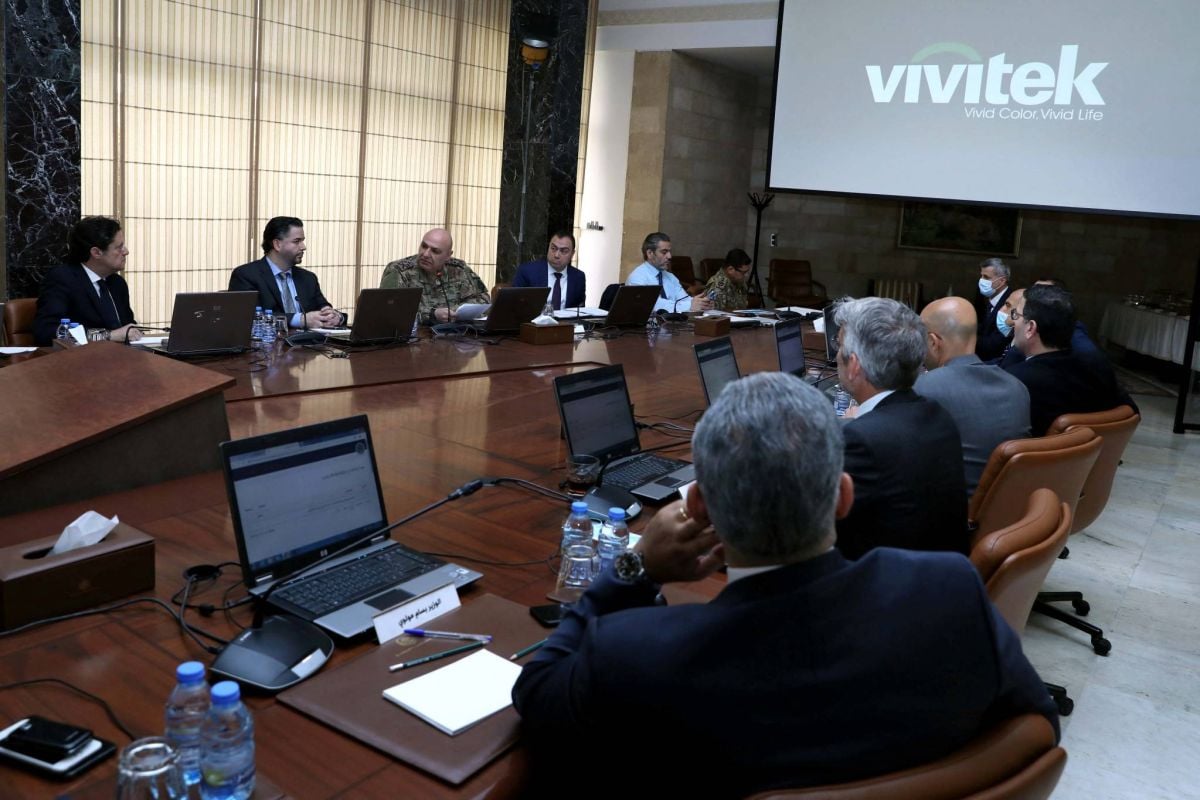
Lebanese Army Commander Joseph Aoun attends a cabinet meeting at the Presidential Palace in Baabda, Lebanon, on April 26, 2022. (Credit: Dalati Nohra)






Want to get the Morning Brief by email? Click here to sign up.
The Military Court will investigate the sinking of a migrant boat off Tripoli on Saturday night, Information Minister Ziad Makary said following an extraordinary cabinet session yesterday. Makary added that the Army chief Joseph Aoun has put himself under investigation in relation to the incident, which left at least six people dead and more than 30 missing. Aoun and the army’s Director of Intelligence Brig. Gen. Tony Kahwaji, as well as the head of the naval forces, Col. Haissam Dannaoui, were summoned to the cabinet session to report on the preliminary investigation into the tragedy. Additionally, a request was put in to transfer Tripoli municipality dues from the government’s central revenue source for municipalities. A search for the remaining passengers by land, air and sea is still ongoing. In response to allegations made against the army, which a survivor accused of ramming the boat twice, causing it to sink, Mikati said he refuses “to throw accusations randomly,” and instead will follow up on the issue “in accordance with the judicial and security principles.”
A joint committee session on the capital control law was canceled amid a large protest yesterday morning. Protesters managed to thwart the session taking place by blocking MPs from entering Parliament, insisting the economic recovery plan be discussed before anything. The draft law aims to legalize and standardize banking restrictions put in place since the start of the economic crisis in 2019. Adopting a capital control law is a requisite of the International Monetary Fund’s preliminary agreement to unlock $3 billion over the next four years. Protesters, including several unions and opposition parties such as MMFD (Citizens in a State) and LiHaqqi, convened under the common slogan, “All of us means all of us will drop the general amnesty project for banks,” a throwback to the slogan of the Oct. 17, 2019, popular uprising, "kellon ya3ne kellon [all of them means all of them]". More than 80 percent of the Lebanese population now lives below the poverty line, as depositors are struggling to withdraw enough money to meet their basic needs due to the plummeting of the value of the lira.
Two weapons and ‘nearly a hundred grenades’ were seized on the Lebanon-Israel border on Monday, an Israeli army spokesman tweeted yesterday. “The Israeli army has spotted suspects approaching Israeli territory at the security fence from the Lebanese side,” spokesman Avichay Adraee said in his tweet. “They then called the security forces who found two weapons and nearly a hundred grenades,” Adraee added. The seizure took place as tensions rose over the weekend after a rocket was launched toward Israel from Lebanon. The Israeli army responded to the rocket attack by firing more than 20 shells into Lebanese territory. No casualties were reported as a result of the incident, which occurred amid weeks of violent attacks on Palestinian worshippers around holy sites, including Jerusalem’s Al-Aqsa Mosque, one of the holiest sites in Islam, and denying Palestinian Christians access to the Church of the Holy Sepulcher.
Elie Haykal, the activist accused of assaulting Energy Minister Walid Fayad Sunday evening, turned himself in at the Zouk Mosbeh police station yesterday afternoon. Videos circulated Sunday of Fayad being accosted by a group of people while leaving Pacifico, a bar in Beirut's Achrafieh neighborhood. In the videos, protesters affiliated with the thawra (revolution) can be seen shoving Fayad and accusing him of being drunk mere hours after the tragic sinking of a boat off the coast of Tripoli. “We are sending you a message on behalf of the Lebanese people, so that you wake up,” said Haykal, before pushing Fayad against a wall. On Monday, the energy minister said that he will “file a personal complaint” against anyone involved. At the extraordinary cabinet session yesterday, Parliament condemned the attack on Fayad, requesting that security and judicial authorities take necessary measures to prosecute the perpetrators and impose penalties against them.
A study by Oxfam predicts a low voter turnout in the May 15 parliamentary elections, but relatively high support for independent candidates. Only 54 percent of respondents in the areas of Beirut, Chouf, Aley, Sour and Zahrani said they plan to vote in the 2022 elections, and more than 48 percent of that number said they would vote independent. A little over 50 percent of the study’s subjects believe that none of the candidates running are promising. Although the study showed that a significant number of people intend to vote for candidates within the opposition, the study excludes certain key geographic areas, like the Bekaa, Akkar, and parts of South Lebanon. Those surveyed preferred independent candidates because of their perceived ability to solve the economic crisis or to improve living conditions, and the perception of independent candidates as less corrupt. The researchers also wrote that efforts to include women in the electoral process are “almost entirely absent.”
In case you missed it, here’s our must-read story from yesterday: “In Akkar, Hariri’s departure rekindles covetous interests”
