

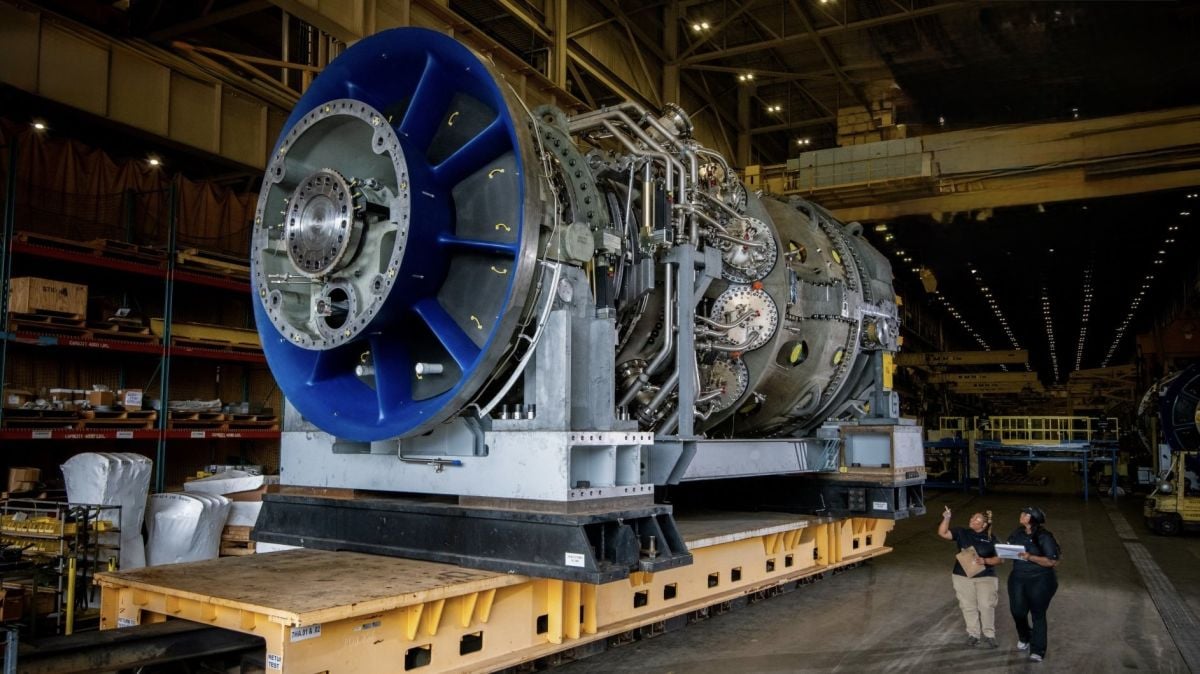
Photo of a gas turbine (used with the authorization of GE Vernova)

Has Lebanon’s long-awaited decision to turn to gas to make up part of its structural shortfall already been compromised by new market realities? As part of his plan to modernize the sector, Energy Minister Joe Saddi said in May that one of the solutions being considered to address the country’s chronic electricity deficit was the construction of two new gas-fired power plants, at an estimated total cost of around $2 billion. A project to build one of these plants, Deir Ammar II, which is expected to generate around 875 MW, is already under consideration as part of a project structured with the International Finance Corporation (IFC), a member of the World Bank Group.
This additional capacity would be welcome after years of stopgap measures, but it would still fall short of meeting round-the-clock electricity and meet a nationwide demand of around 3,000 MW.
Lebanon has seven power plants and around 1,500 MW of effective capacity, but only Deir Ammar and Zahrani, which can run on both fuel oil and gas, are currently operational. Their combined capacity stands at around 900 MW, but high fuel costs limit actual production to approximately 500 MW today.
Discussed for two decades, the transition to gas offers a relatively cheaper and less polluting alternative to fuel oil, but political and financing obstacles have so far prevented its implementation. Beyond the new gas-fired plants, the government’s plan also includes the development by private producers of up to 350 MW of additional solar capacity, accompanied by storage systems with a total capacity of 1,000 MWh.
Lebanon’s gas gamble is now facing another obstacle, one extending far beyond the country’s borders: a global shortage of gas turbines, the core components of power plants. The result could be a substantially higher bill for a sector already running a structural deficit.
“Under current market conditions, Lebanon could have to spend three times as much as the ministry’s estimates, or roughly $6 billion,” said financial expert Mike Azar, who is advising U.S. government agencies on power projects for data centers.
'Competition on both price and schedule'
“We are seeing unprecedented global demand for gas turbines, driven simultaneously by multiple factors. As a result, lead times have increased across the market,” Hussein Shoukry, Siemens Energy’s managing director for the Middle East and Africa, told L’Orient-Le Jour.
At the top of these factors is “the rapid growth of energy-hungry AI data centers over the past two years, mainly in the United States,” Azar explained. This rush has created long queues at the companies capable of manufacturing these turbines, including Siemens Energy, GE Vernova, and Mitsubishi.
“Delivery times, which used to be one or two years, can now extend to six years,” he added.
In mid-2026, GE Vernova told L’Orient-Le Jour that the company was “effectively fully sold out through 2030 and is currently contracting for 2031. A new order today would likely be targeted for 2031 or beyond.”
Shoukry likewise confirmed that lead times at Siemens Energy had increased, though he could not provide an exact timeline.
Technology companies are also prepared to pay a substantial premium to secure reliable power supplies quickly, forcing the energy sector to bid higher. “Competition would be on both price and delivery times,” Azar stressed. “The idea that Lebanon could build two gas-fired plants for $2 billion over the next few years no longer reflects reality.”
GE Vernova and Siemens did not confirm any specific increase in turbine prices, stressing that costs vary from one project to another.
Saddi told L’Orient-Le Jour that the impact of the turbine shortage would depend on the developer selected.
“If it is a company that has already reserved turbines, the process could move more quickly,” he said. Otherwise, the developer would have to join the waiting list. The minister nevertheless said the IFC would be better suited to comment on the matter.
Contacted by L’Orient-Le Jour, the IFC declined to comment.
“Developers that have already secured turbine manufacturing slots will charge an even higher premium,” Azar countered.
‘Thirty years late’: The high cost of delay
This market-related obstacle is, however, largely the result of the decades of delay accumulated by the sector. Had the process been launched in 2022, Lebanon’s situation might have been different. “We would have obtained the turbines more quickly,” said Marc Ayoub, an energy-policy researcher at the Issam Fares Institute.
“We are 30 years behind on reforms,” energy expert Jessica Obeid added, arguing that decades without proper planning have left the country needing to build at the worst possible time. With both the state and BDL effectively bankrupt, she believes private investors will have little appetite to finance new power plants.
After years of delays, Lebanon can therefore no longer rely solely on new gas-fired plants to close its generation gap quickly. Some experts recommend focusing, in the meantime, on transitional solutions.
“We need to operate the existing plants more efficiently, connect to new energy infrastructure in Syria and Iraq to improve fuel supplies, and accelerate the large-scale development of renewable energy,” Ayoub said.






