

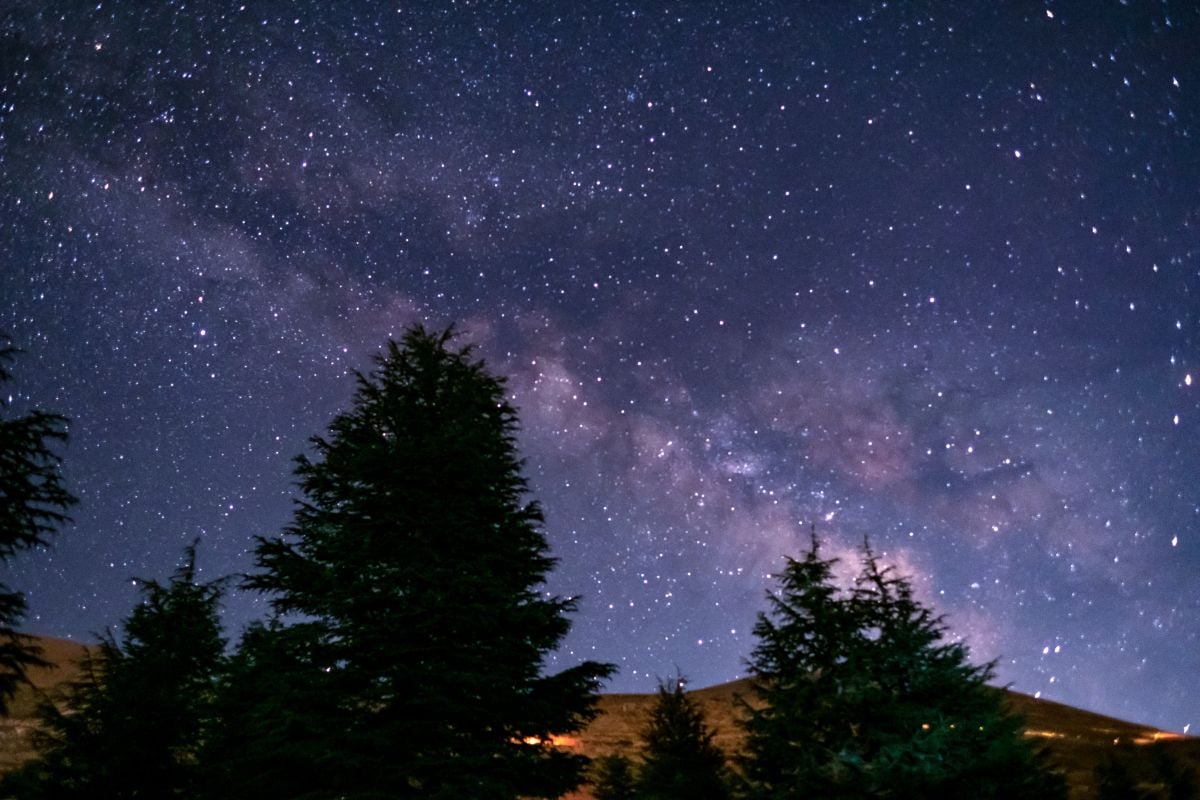
The stars and the Milky Way visible in the sky above the "Cedars of God" forest in Bsharri, Northern Lebanon, on July 10, 2021. (Credit: Ibrahim Chalhoub/AFP)






BEIRUT — Astronomy enthusiasts have a date with the sky on the night from Wednesday to Thursday: all they have to do is look up. The annual Perseid meteor shower, which runs from July 17 to Aug. 24 this year, is set to peak on the night of Aug. 12-13, offering one of the year’s most anticipated celestial spectacles.
Conditions are particularly favorable this year in Lebanon: the peak will coincide with a new moon, plunging the sky into darkness and making it possible to see even more meteors.
The best time to watch will be between midnight and dawn on Thursday, with activity expected to intensify as sunrise approaches. According to NASA, the Perseids are among the most significant and popular meteor showers of the year. Under perfectly dark skies and ideal conditions, activity can reach around 100 meteors per hour at the peak. Best of all, there is no need for a telescope or binoculars: the spectacle is best viewed with the naked eye.
Where do these "shooting stars" come from? The Perseids are produced by debris left behind in space by comet 109P/Swift-Tuttle. Each year, as Earth passes through this cloud of dust and small fragments, the particles enter the atmosphere at extremely high speeds and burn up, creating the luminous streaks visible from the ground. The particles that produce the Perseids enter the atmosphere at about 59 kilometers per second.
Where to observe them in Lebanon?
To make the most of the show, it is above all important to escape light pollution. In an interview with L’Orient-Le Jour in previous years, Jean-Pierre Saghbini, president of the UniversCiel association and former national coordinator for astronomy education at the International Astronomical Union, recommended choosing high-altitude areas, where humidity and light pollution are low.
“Turn off the lights to turn on the stars,” he advised.
Mountain regions such as Tannourine, Dinnieh, Zaarour or Faraya offer good observation conditions when the sky is particularly dark and clear. Ideally, choose “any area located at 1,000 meters above sea level,” with an open spot that offers the widest possible field of vision, away from the lights of homes and roads.
This year, the new moon is an added bonus. Unlike a bright moon, which can mask fainter meteors, the absence of moonlight will provide particularly dark skies at the Perseids’ peak.
The sky on Aug. 12 therefore offers an unusual succession of astronomical phenomena: a new moon, the Perseids and a solar eclipse visible in some parts of the world — including as a total eclipse in Spain, Iceland and Greenland, though not from Lebanon.
For astronomy enthusiasts, whether novice or experienced, who happen to be outside Lebanon and have the chance to witness the eclipse — in northern Spain for totality, or partially in France, Canada, northern West Africa and the United States — don’t forget to wear proper safety glasses before looking directly at the sun, even if it is hidden.

 7 p.m. recap: 1 person killed near border with Lebanon; 200 kilos of explosives carried by mules; Riyadh shuts its airspace