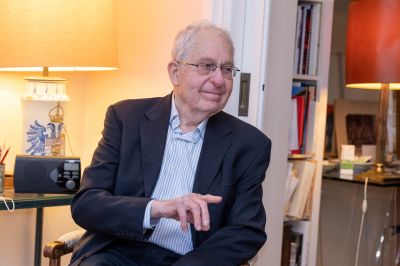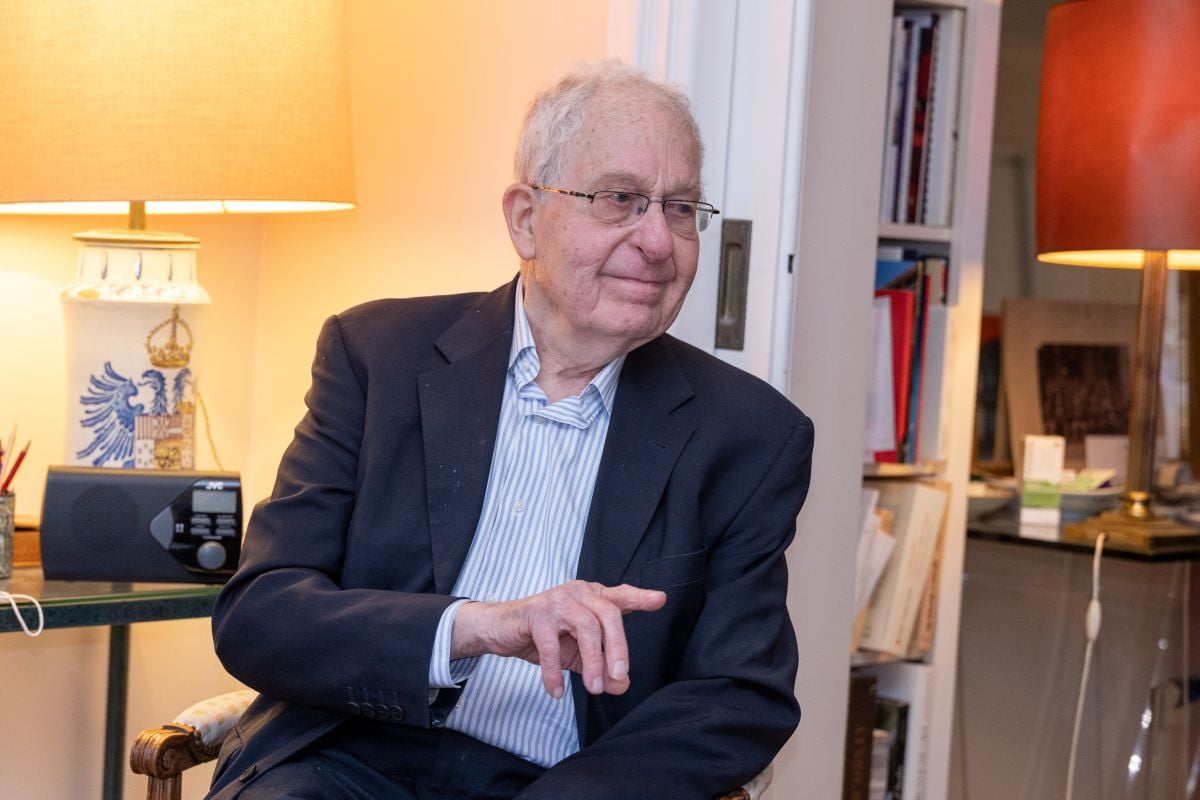






Jean-Pierre Lafon, France’s ambassador to Lebanon from 1994 to 1997, was the driving force behind the creation of the École supérieure des affaires (ESA). Serving as a bridge between Jacques Chirac and Rafic Hariri, he quickly secured the approval of both politicians to establish a management school he saw as essential in a country of seasoned traders. That was all it took for the project to sell the site where ESA now stands to be dropped, allowing Lafon’s desire to contribute to Lebanon’s reconstruction to take shape. In the offices of ESA, Lafon, now 85, recalls his memories with acute precision.
L’OLJ: How did the idea of creating ESA come about?
Jean-Pierre Lafon: I came to Lebanon by pure chance. Dominique de Villepin, then chief of staff to the foreign minister, gave me 12 hours to decide whether I wanted to take over from Ambassador Michel Chatelais who was suffering from cancer. I immediately said yes, knowing nothing about the country. I arrived in Lebanon with two ideas: first, I would be the ambassador of reconstruction; second, I wanted to get a feel for the place. I was basically given free rein.
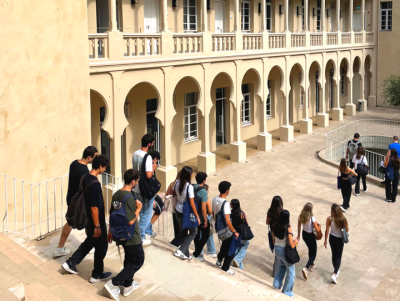
I drove 400 km the very first weekend. I came to the Clemenceau grounds, half damaged and mined. I decided the embassy would no longer occupy a 3.2-hectare plot. Then I noticed there was no real management school in Lebanon, a country built on commerce. That potential couldn’t be overlooked.
I scheduled a meeting with then Prime Minister Rafic Hariri who gave his approval and asked me to meet with the governor of the Banque du Libann [BDL, central bank], whose support I also secured. I called the Paris Chamber of Commerce, which was enthusiastic from the start. The director of studies came to Lebanon with a colleague, met the city’s mohafez [governor], and, in just a year, the program was put together.
In Paris, the Budget Ministry opposed the project and I was told the land had to be sold for 400 million francs. This was in April 1996. Jacques Chirac was about to visit Lebanon. He called Rafic Hariri to discuss it: the deal was done. A few days later, the agreement was signed in their presence.
L’OLJ: What do you attribute ESA’s success to?
Lafon: ESA’s success comes down to the three directors who have led it. Roger Ourset, the first, laid solid foundations and carried out key projects. Then Stéphane Attali, an exceptional person, took the helm at 38 and led for a decade before dying of a tumor. Finally, Maxence Duault, who had worked with Attali, arrived at just the right time and proved to be the man for the job.
L’OLJ: What explains ESA’s ability to weather all these crises?
Lafon: For me, it’s the strength of the management and the Lebanese teams supporting the director. And it goes deeper than that: it’s simply the strength of the Lebanese, for whom life always prevails over everything else. And perhaps, also, the Lebanese traits of the French directors.
L’OLJ: What is ESA’s greatest asset?
Lafon: Thirty years later, ESA is at the heart of a vast network of business leaders and economic circuits, in Lebanon and abroad, thanks in particular to its diaspora. This is the result of the work done, especially by the last two directors.
L’OLJ: What future do you wish for ESA?
Lafon: Like the rest of the world, ESA faces new technological challenges, particularly artificial intelligence and, soon, quantum computing. I already discussed this with Stéphane Attali in Paris, who created SmartESA, the school’s start-up incubator-accelerator, and I see that Maxence Duault, the current director-general, has already engaged the institution on issues related to artificial intelligence.
L’OLJ: Are you afraid of these technological advances?
Lafon: Not only do they not scare me, they've actually been a driving force for creating schools that are in step with changes in the world, management methods, and technologies. That was the starting point: to create a school that would serve as a reference. It was also about wanting to give a different image of France.
L’OLJ: Do you think the way management is taught today is bound to change given ongoing technological progress?
Lafon: Yes, certainly. Changes are constant, the world is ever-evolving and, above all, it is very unstable. Who better than the Lebanese know this instability, which is also the reality of the Middle East — of which I won’t even speak?
But ESA is already in touch with these ongoing changes: that’s its real strength in adapting! There aren’t many institutions, either in Lebanon or elsewhere, as in tune with a changing world, and the synergy with the great business schools under the Paris Chamber of Commerce guarantees this ability to evolve. I think this will lead to genuine cross-fertilization. Even the top French business schools have things to learn from what’s being done here!
In partnership with