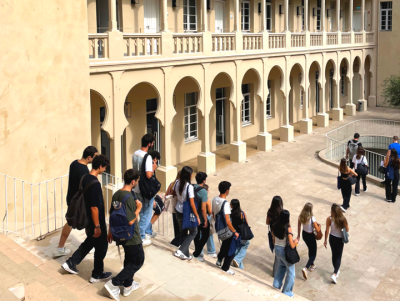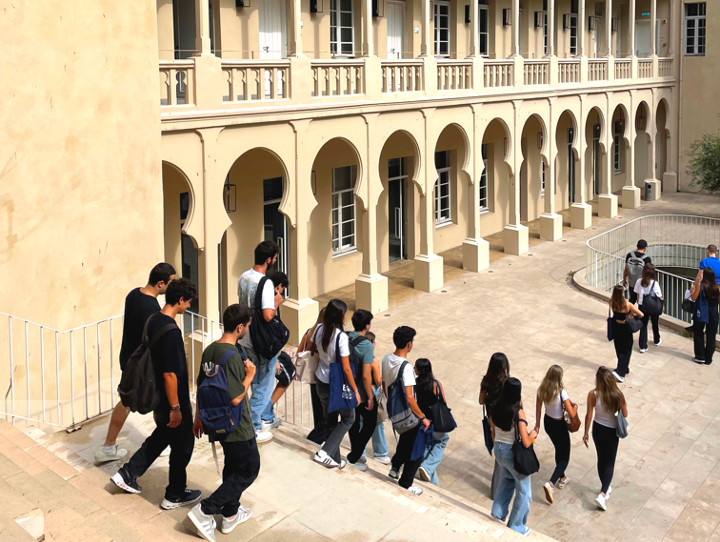
Students on campus. Photo provided by ESA.






Founded in 1996, while Lebanon was still undergoing reconstruction, École supérieure des affaires (ESA) has spent three decades evolving alongside the country. Through war, economic and political crises, the 2019 uprising, the pandemic, the Beirut port explosion, mass departure of young people, and upheaval in the job market, the school’s history has paralleled that of a Lebanon repeatedly forced to reinvent itself. Created under an agreement between France and Lebanon, ESA was conceived from the outset as a school closely connected to the needs of the professional world.
“ESA does not exist in a vacuum,” Director General Maxence Duault said. The school has gradually broadened its role, moving from degree-based education to providing much wider support to professionals and companies. Customized training, business support, entrepreneurship and multidisciplinary teaching have expanded its offerings as the school responds to an economic and professional environment that has become increasingly unstable and complex.
This adaptation also extends to the very concept of education. For Duault, one of the major transformations lies in the growing importance of lifelong learning. The model in which a student earns a diploma, enters the workforce and never needs additional training is a thing of the past. As professions evolve and the working world becomes increasingly complex, the ability to question one’s assumptions and adapt has become an essential skill in its own right.
ESA also observes these transformations through the companies it supports. Hundreds of companies have worked with the school over the years. The institution aims to play a role in the Lebanese economy not only by training future executives, but also by working directly with companies and their teams. This proximity to the professional world allows the school to assess the changes affecting businesses and the skills they seek.
The profiles employers seek are no longer the same, and career paths have become less linear. Technological advances, changing jobs, and economic uncertainty are forcing businesses and employees alike to continually rethink their practices. For ESA, this reality means viewing education not as a period limited to the first years of working life, but as a process that can accompany people throughout their careers. This also explains the gradual diversification of the school’s offerings and the growing importance of programs aimed at professionals and companies.
Crises, too, have shaped the school’s trajectory. ESA has had to adapt its resources, operations and priorities to a country whose economic foundations have changed profoundly.
Perhaps this best sums up ESA’s history: The school changed because Lebanon changed. “And if it has managed to get through these upheavals, it’s also because it has had three directors, each one suited to the needs of the moment,” said Claude Abou Chedid, director of academic affairs.
“Every decade at ESA has, in a way, been defined by a different stage in its development and by the personality of its director. The first was about building and launching projects. With Stephane Attali, ESA then increased its influence and visibility, thanks to his charisma and ability to serve as its ambassador, both in Lebanon and abroad.
“The last decade was marked by challenges of a very different nature, with three major crises: economic, health and security. Maxence Duault steered the school through this particularly difficult period, preserved its fundamentals and, beyond that, confidently projected the school into the future,” Abou Chedid continued.
This adaptability is also reflected in Duault’s approach. He recalled the extent to which the country’s needs, both financial and otherwise, have been taken into account, particularly through the awarding of significant scholarships.
ESA, historically known for its MBA and master’s-level programs, also chose 12 years ago to develop a bachelor’s program. “The aim was also to offer young people the chance to pursue excellent training in Lebanon, while remaining open to the international sphere,” said Abou Chedid. Duault points out, however, that although he hopes as many young people as possible will return to the country, ESA’s primary mission remains to prepare the leaders of tomorrow and support them wherever they choose to go.
In partnership with