






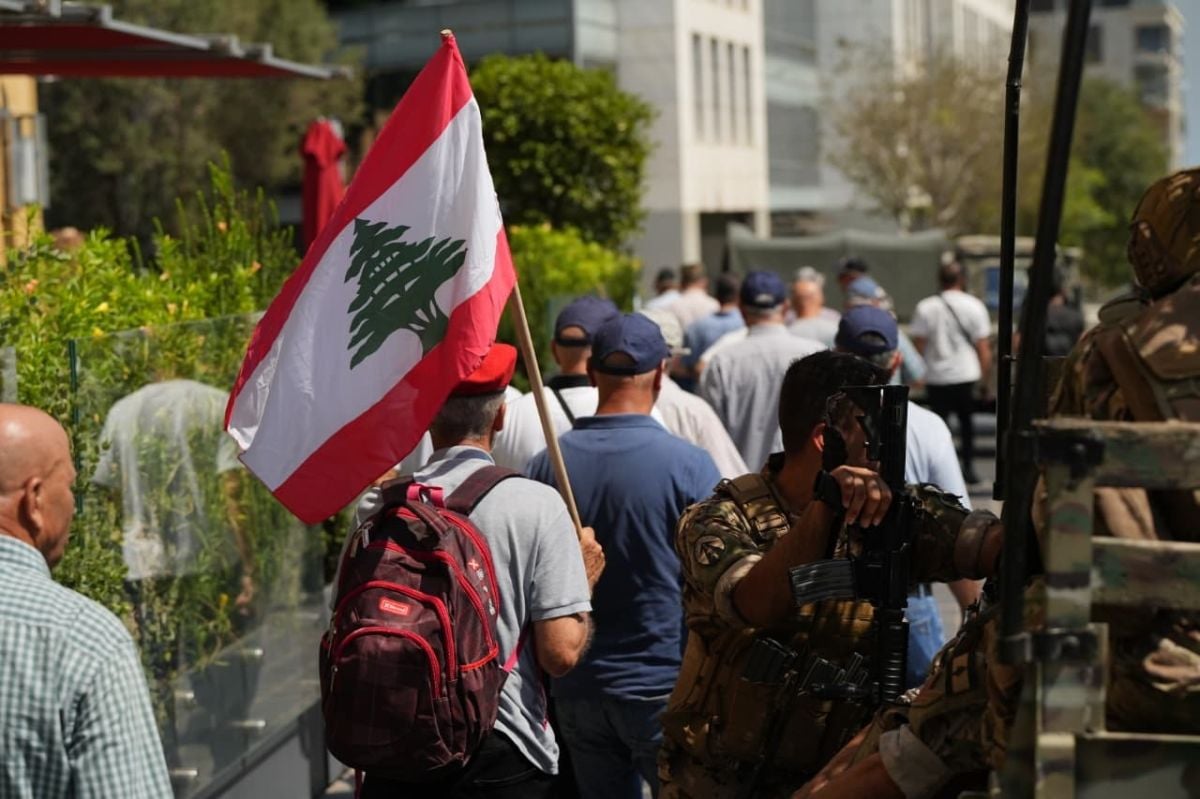
Protesters stationed not far from the Lebanese Parliament, in downtown Beirut, on the sidelines of the parliamentary sessions scheduled for Aug. 11, 2026. (Credit: Mohammad Yassine/L’Orient-Le Jour)






BEIRUT — Defense Minister Michel Menassah broke his silence Thursday, saying the army was “prevented from speaking” and “ignored” in the dispute with Prime Minister Nawaf Salam over the amnesty law, warning that “this is not the end of the story.”
Cherished by the Sunni street, this law, which ultimately allows the release of 86 Islamist detainees, was strongly criticized by the Lebanese Army, which opposed any measure allowing people who had killed soldiers to benefit from it.
While Menassah, an ally of President (and former army commander) Joseph Aoun, had prepared an address to present this viewpoint to the chamber on Tuesday, Salam refused to let him deliver it, asserting it was his sole prerogative to represent the government.
The defense minister was absent from the chamber during Wednesday’s decisive vote, after months of political and sectarian wrangling.
"[On Wednesday] the army was prevented from speaking, but the blood of its martyrs was not prevented from speaking in my conscience. Let those who chose to ignore the army know that it is not a party to any conflict, nor a card to be played and then discarded. The army is what remains for this country as the last source of trust," the minister wrote.
With a repeat anaphora, Menassah said he "offers his apologies" to the families of Lebanese soldiers who died in combat. "I offer you my apologies because, regardless of the position I hold, today I feel I have let you down," he particularly said. In an implicit jab at the prime minister, he continued: "I offer you my apologies because I saw how voices rose up to drown out that of the army and how stances allied against it when it should have been protected, not besieged."
And he concluded: "I make this promise [to the victims within the army]: silence will not be fate, and yesterday’s abandonment will not mark the end of the story."
The Free Patriotic Movement (FPM) and Hezbollah deputies, siding with Menassah and not participating in the decisive vote as a form of protest, invoke Article 67 of the Constitution, which states that ministers have free access to Parliament and must be heard when they request it. On their side, the Lebanese Forces (LF) intended to support any bill that would gain the support of all Sunni deputies. After the session, Tripoli’s Sunni MP Ashraf Rifi thanked the LF and the Kataeb, declaring that the vote "showed that the general amnesty is a national issue that goes beyond political and confessional divides."
“You have done us proud,” Haykal congratulated. Following the release of his statement, Menassah welcomed the commander-in-chief of the Lebanese Army, Rodolph Haykal, accompanied by a military delegation, to his office in Yarzeh. “You have never disappointed the families of the martyrs, and you never will. You have done us proud, and you have done the army proud,” Haykal declared in response to the statement, according to a message published by the Ministry of Defense.
“There is no sect among those who wear the fatigues,” the army chief also emphasized. The [Sunni] prime minister reportedly told Menassah on Tuesday that he would “put the Lebanese Army in confrontation with the Sunni community” if the law was not adopted, according to remarks reported to the press at the time by Shiite MP Jamil al-Sayyed, a critic of the amnesty law.
In a statement to Haykal, the Defense Minister more broadly praised the troops' "efforts," asserting that "the current period demands greater cohesion and cooperation within the military institution," at a time when the Israeli withdrawal from southern Lebanon is contingent upon the Lebanese army disarming Hezbollah. Members of the "National Moderation" party, comprised mainly of Sunni ex-Hariri members, expressed in a statement on Thursday "the hope that this law will be a step towards closing a chapter of injustice and suffering and that it will be implemented swiftly and fairly, without delay or procrastination." They also deplored "the exploitation of the parliamentary session to present the issue of redressing injustices as a confrontation between the Sunni community and the military institution."

 8 p.m. recap: Israel again threatens Beirut’s south suburbs; 2 ships hit near Hormuz; Riyadh football matches canceled