





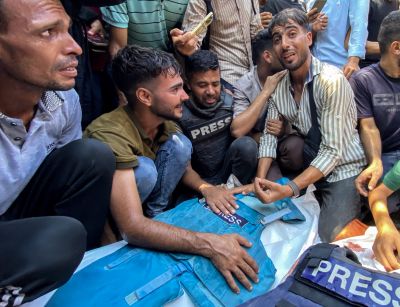
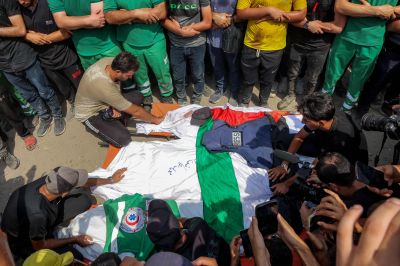
Palestinians mourn journalists killed by an Israeli strike on Nasser Hospital in Khan Younis, Gaza, on Aug. 25, 2025. (Credit: AFP)






A Reuters analysis of visual evidence and other information about the Israeli attack on a Gaza hospital last month contradicts Israel’s explanation of what happened in the deadly strike.
The Aug. 25 attack on Nasser Hospital killed 22, including five journalists.

Reuters' findings
Israeli forces planned the attack using drone footage which, a military official said, showed a Hamas camera that was the target of the strike.
But the visual evidence and other reporting by Reuters establish that the camera in the footage actually belonged to the news agency and had long been used by one of its own journalists.
The Israeli military official now says that the troops acted without the required approval of the senior regional commander in charge of operations in Gaza. The official told Reuters about the breach of command after Reuters presented the findings of its investigation to the Israeli army.
The official said troops viewed the camera with suspicion because it was covered by a towel. A decision was made to destroy it, the official said then.
A screenshot from the Israeli army drone footage shows the camera, draped with a two-toned cloth, on the hospital stairwell. The military official confirmed to Reuters last week that the cloth-covered camera was the target.
But the cloth shown in the screenshot was not put there by Hamas. It was a prayer rug belonging to Hussam al-Masri, a Reuters journalist who was killed in the attack, the news agency’s investigation of the incident found.
At least 35 times since May, Masri had positioned his camera on the same stairwell at Nasser Hospital in the southern Gaza city of Khan Younis, to record live broadcasts fed to Reuters media clients. He often covered his camera with the green-and-white prayer rug to protect it from heat and dust, Reuters found.
The Associated Press, which lost a journalist in the hospital attack, previously reported that it had found strong indications that the camera Israeli forces described as their target belonged to Reuters.
Israeli Prime Minister Benjamin Netanyahu called the hospital attack a “tragic mishap.” The military official told Reuters that Masri and other journalists present were not the target of the attack and were not suspected of having ties to Hamas.
The Israeli army claim that Hamas was filming Israeli military forces from Nasser Hospital “is false and fabricated,” said Ismail al-Thawabta, director of Gaza's government media office. Israel is trying to “cover up a full-fledged war crime against the hospital, its patients and medical staff,” he said.
The Israeli military also has not explained:
- Why it did not warn hospital staff or Reuters that it intended to strike the hospital.
- Why, after striking the camera in its initial attack, the Israeli army shelled the stairwell again nine minutes later, killing other journalists and emergency responders who had rushed to the scene.
- Whether it took into account that the hospital stairwell where Masri was filming when he was killed was a spot used regularly by many journalists to record footage and file reports throughout the war.
- Who approved the strike. The military official did not say who gave the order to attack despite the lack of approval from the regional commander.
The absence of a full explanation of what happened at Nasser Hospital fits a pattern in Israeli military attacks that have killed journalists since Israel launched its nearly two-year war on Gaza.
The Committee to Protect Journalists says it has documented 201 journalists and media workers killed in Gaza, Israel and Lebanon, where the war spilled over shortly after the initial attack. The count includes 193 Palestinians killed by Israel in Gaza and six killed by Israel in Lebanon.
The CPJ said Israel never published the results of a formal investigation or held anyone accountable in the killings of journalists by the Israeli army. “Furthermore, none of these incidents prompted a meaningful review of Israel’s rules of engagement, nor did international condemnation lead to any change in the pattern of attacks on journalists over the past two years,” said Sara Qudah, CPJ’s regional director for the Middle East and North Africa.
Reuters' investigation
In examining the Aug. 25 attack by Israeli forces, Reuters reviewed more than 100 videos and photos from the scene and interviewed more than two dozen people familiar with the attack and the events leading up to it. Those sources include two Israeli military officials and two Israeli military academics briefed by Israeli military sources on the strike.
Twenty-two people were killed in the two attacks, including journalist Mariam Dagga, who worked for the Associated Press and other news organizations, and Moaz Abu Taha, a freelance journalist who worked with several news organizations, including Reuters.
A few days before the Aug. 25 strike, an Israeli military surveillance drone recorded a camera on the top level of the eastern stairwell at Nasser Hospital, according to the Israeli military official, who cited the Israeli army’s initial inquiry, and the two military academics with close contacts in the Israeli military.
Troops characterized the camera as a threat, they said, because Hamas has used cameras to plan attacks. Asked whether the group used cameras, the Hamas official said it used them to document its attacks on Israeli soldiers.
A screenshot taken from the drone footage shows a thick, two-toned cloth draped over the camera. A person wearing a white head covering and dark clothing sits behind it. The screenshot was first published on Aug. 25 by an Israeli TV news channel, N12, which said at the time that it depicted the camera “that endangered our troops.”
Reuters obtained the screenshot from Refael Hayun, an Israeli civilian who says he monitors the situation in Gaza, where he has contacts on the ground. Hayun said the drone footage was captured around 2:15 p.m. on Aug. 21. On that day, Masri set up a camera to record from the hospital stairwell continuously between 8:00 a.m. and 6:14 p.m., according to a Reuters archive of the footage.
Hayun declined to identify the source of the screenshot or how he obtained it. But the Israeli military official confirmed that the screenshot is from drone footage that Israeli troops recorded before the Aug. 25 attack and shows the camera that troops targeted in the shelling.
The official, who said his information is from the Israeli army’s initial inquiry, did not provide the precise date of the screenshot but said the camera was seen “repeatedly for many days in a row.”

A drone, stairwell, prayer rug
On the day after the strike, the Israeli military official referred to the cloth covering the camera as a “towel” and said troops viewed it with suspicion. The official claimed that towels can be used to evade Israeli army heat sensors and visual observations from the sky.
The troops saw “a lot of suspicious behavior that was tracked for days and cross-referenced with intelligence,” he said, without elaborating.
The cloth covering the camera in the drone screenshot was Masri’s green and white prayer rug, Reuters found. It is shown in an Aug. 13 photo taken by Dagga, which captures Masri standing next to his camera in the same hospital stairwell that was targeted by the Israeli army.
Masri often used the thick cloth, which was his prayer rug, according to his brother Ezzeldeen al-Masri. Reuters was never asked by Israel not to cover its camera with a towel or other cloth, a spokesperson for the news agency said.
Adding to the Israeli military’s suspicion about the camera and its location was that troops also saw another “towel” covering the head of a person nearby, the military official said, referring to the person in the Israeli TV screenshot.
In the screenshot, a person sits near the camera wearing dark clothing and a white hijab. The person appears to be Dagga, in a similar outfit to what she is seen wearing in four other visuals taken at that same location, including one from Aug. 16 and another from the day of the attack.
On Aug. 21, the day the Israeli army drone footage was recorded, Dagga was using her phone to record a live broadcast from the stairwell for AP.
Reuters visuals journalist Mohammad Salem, who left Gaza earlier this year and knew Dagga well, identified the person in the drone screenshot as the AP reporter. Salem said he recognized her head scarf. Also, Masri had told Salem that Dagga was recording near him on the stairwell a few days before the attack.
A hub for journalists
In the early days of the war, Reuters shared with the Israeli military locations of its teams in Gaza, including at Nasser Hospital, to try to ensure they would not be targeted, the Reuters spokesperson said. But after many journalists were killed in Israeli army strikes, Reuters stopped giving precise coordinates.
“However, Israel was fully aware that Reuters and multiple other news organizations were operating from Nasser Hospital, which has been one of the nerve centers for coverage out of Gaza,” the spokesperson said.
Witnesses said the Israeli army had drones in the sky throughout the attack. About 40 minutes before the first tank strike, Reuters photographer Hatem Khaled was outside the hospital. He sent a message to Khan Younis colleagues on a WhatsApp group: “Quadcopter now, exactly over Nasser Hospital.”
At 10:12 a.m., about four minutes after the first attack, freelance journalist Khaled Shaath recorded a quadcopter drone flying over the hospital.
Ahmed Abu Ubeid, a doctor in the forensic medicine department at Nasser who was injured in the second strike, said the drone hovered in the air near the hospital entrance for more than 10 minutes. “It was recording and seeing us and seeing we are all doctors and civil defense and nurses and journalists,” Abu Ubeid told Reuters. “So, they saw us, and decided to hit us.”
Abu Ubeid said some of those killed and injured in the attack were on the ground level, multiple floors below where the tank shells struck, and were hit with shrapnel.
Israeli forces have repeatedly targeted hospitals in Gaza, baselessly claiming Hamas was operating from them, which the group denies. Attacks on hospitals typically constitute war crimes, two legal scholars told Reuters.

Mohammed Saqer, head of nursing at Nasser Hospital, said the Israeli army had the phone numbers for hospital staff and regularly called the head of the hospital to ask about the number of patients and supplies. The hospital never received a warning of the attack, he said.
Unexplained killings
Reuters still has received no explanation for why, in October 2023, an Israeli tank fired two shells at a group of clearly identified journalists in Lebanon who had been filming cross-border shelling. The strikes killed Reuters journalist Issam Abdallah and wounded six other journalists.
Nearly two years after the attack, the case is still under examination, an Israeli army official told Reuters last week.
A breach of command
In a statement released publicly the day after the attack, the Israeli army identified the troops involved as belonging to the Golani Brigade.
Citing the Israeli army’s initial review of the Aug. 25 incident, the Israeli military official told Reuters that troops had correctly identified the target of the attack. The official, however, said that the Israeli army had launched a closer examination into possible mistakes made in the attack’s execution.
Among the failures, Reuters found, was a breach in the chain of command. Israeli army rules require the approval of a very senior officer before firing on a civilian target if troops are not under attack, the military official said.
In the case of Nasser Hospital, the forces on the ground would have had to obtain authorization from the head of the Israeli army’s Southern Command, Maj. Gen. Yaniv Asor, the military official said.
Reached by phone, Asor told Reuters that he was not authorized to speak to the press.
In addition to possible mistakes in the execution of the attack, the Israeli army has said it also would review which ammunition was approved prior to the strike and how.
Reuters obtained photos of metal fragments found at Nasser Hospital taken by a doctor at the scene that day. The fragments are from tail fins of Israeli-made 120 mm tank rounds, according to five munitions experts who reviewed the photos of the fragments and visuals of the strike for Reuters.
A similar tank shell was used in the 2023 Israeli military attack that killed Reuters video journalist Abdallah in Lebanon.
A tank round was a disproportionate munition selection for the Nasser strike, given that the Israeli army says its target was a camera and that it was located at or within a hospital, said Wes Bryant, former branch chief of civilian harm assessments at the Pentagon. But even a weapon that is likely to result in fewer unintended injuries and deaths than a tank shell will still have a high casualty count when aimed at a crowded stairwell, he added.
The Israeli army still has not explained why it struck the stairwell a second time, as journalists and first responders crowded on the landing.
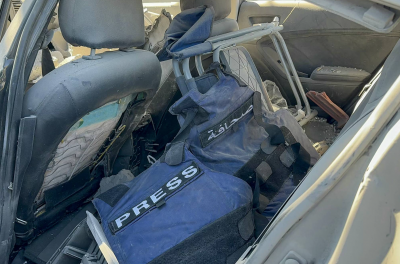
Reuters photographer Khaled was outside the hospital preparing to start his workday when the first blast hit. He grabbed his camera and rushed toward the building, documenting the scene along the way. He climbed the stairs to get to Masri. When he found him, Masri was already dead, his body covered in dust, his clothes torn and his equipment damaged.
Khaled kept filming. “I couldn’t do anything to help him other than document what had happened,” he said. Rescue workers arrived and began moving Masri, placing him in a white bag.
At 10:17 a.m., as Khaled and the rescuers walked down the stairs with Masri’s body, the Israeli military struck the stairwell for the second time.
Two munitions can be seen hitting the hospital a fraction of a second apart in footage obtained by Reuters. Khaled filmed the strike, which left him injured. Khaled has hearing loss from the blast and will require more surgery to remove shrapnel.

 Evening recap: Netanyahu announces West Bank offensive; 7 killed in Jordan church shooting; tents burned in south Lebanon
 US strike on Iran this weekend? ‘Absolutely,’ says Barrack; ‘I have no idea,’ says Trump