






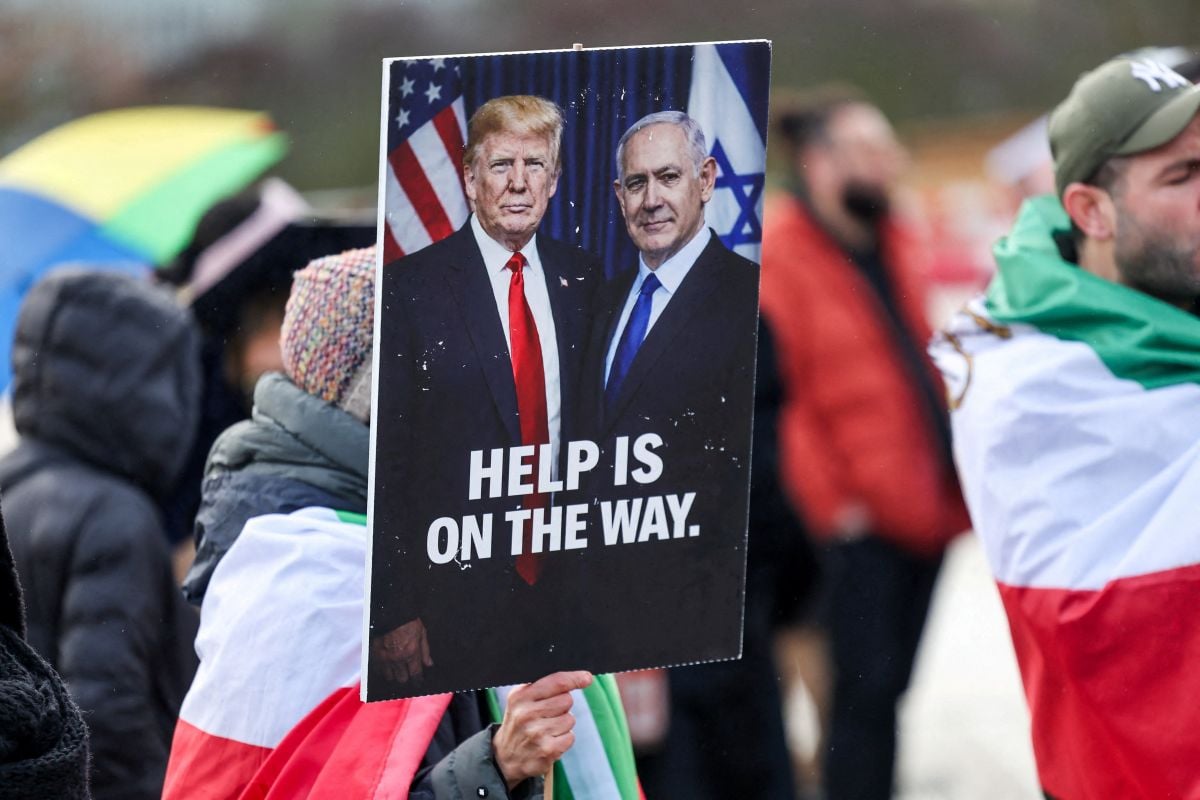
A person holds a placard with a picture of U.S. President Donald Trump alongside Israeli Prime Minister Benjamin Netanyahu, as protesters gather near the United Nations office, on the day of the second round of nuclear talks between U.S. and Iran, in Geneva, Switzerland, Feb. 17, 2026. (Credit: Pierre Albouy/Reuters)






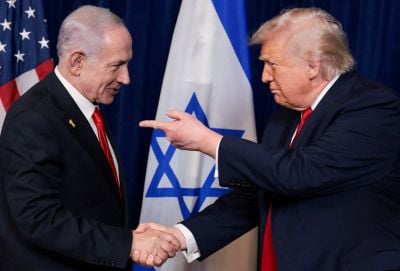
U.S. President Donald Trump's intervention to prevent large-scale Israeli strikes on Beirut's southern suburbs drew condemnation across the Israeli political spectrum, with some criticizing Israeli Prime Minister Benjamin Netanyahu.
Residents had already fled the southern suburbs on Monday morning following Israeli threats, even before the Israeli army issued an evacuation warning. During a phone call, however, Trump reportedly pressured Netanyahu to halt, at least temporarily, planned strikes on the capital.
"I had a conversation with Bibi Netanyahu today, asking him not to go into a major raid of Beirut, Lebanon. He turned his Troops around. Thank you Bibi!" Trump later wrote on his Truth Social platform. "I also had a conversation with Representatives of the Leaders of Hezbollah, and they agreed to stop shooting at Israel, and its soldiers. Likewise, Israel agreed to stop shooting at them. Let’s see how long that lasts — Hopefully it will be for ETERNITY!"
'A prime minister says no to the US when necessary'
Many Israeli politicians viewed Washington's intervention as a humiliation for Netanyahu. Far-right National Security Minister Itamar Ben-Gvir urged the prime minister to reject Trump's request.
"You said that a strong prime minister tells the President of the United States 'yes' when possible, and 'no' when necessary," Ben-Gvir wrote on X, recalling Netanyahu's own past assertion. "This is the time to tell our friend, President Trump, 'no.'"
He added, "Now is the time to do what is required and necessary to strike Hezbollah." Ben-Gvir has repeatedly called for the southern suburbs of Beirut to be "flattened."
The relationship between Trump and Netanyahu was already strained by Washington's efforts to reach a new agreement with Iran, reviving debate over the limits of the U.S.-Israeli strategic partnership.
Netanyahu's challengers in elections due by October accused the prime minister of acquiescing to Trump on national security issues.
"The location is different, the story is the same," said Naftali Bennett, a right-wing security hawk and former premier who also criticizes Netanyahu over Hamas militants' resurgence in Gaza.
"A government that has lost control of Israeli sovereignty," Bennett wrote in a post on X.
Bennett and his coalition partner in the upcoming election, centrist Yair Lapid, have pressed for strikes against Hezbollah.
"A full protectorate," Lapid said in an X post, in effect accusing Netanyahu of allowing the U.S. to dictate Israeli military policy as if Israel were an American client state.
'Diplomatic failure'
Gadi Eisenkot, a former chief of staff of the Israeli military who is also running for prime minister, said on Monday that Trump's push for Israel to halt attacks was unreasonable.
"There has never been an Israeli prime minister who accepted such a humiliating demand," Eisenkot wrote on X.
The criticism extended beyond political circles. Conservative Israeli media outlets, generally supportive of the government, also criticized the American intervention, particularly Channel 14, considered close to Likud.
"This is a bad proposal," said commentator Tamir Morag, one of the channel's leading figures. Writing on X, he argued that while the Israeli army had expanded its control on the ground and established a broader security zone, committing not to carry out strikes and limiting operations to preventive targeted actions represented a step back from the previous cease-fire conditions in Lebanon.
In his view, such an arrangement would allow Hezbollah to rebuild its capabilities, albeit under more difficult conditions and with a weakened Iran.
Netanyahu disputed criticism, arguing that air strikes under his watch have dealt Hezbollah blows. After Trump's announcement on Monday of a new Israel-Hezbollah agreement, Netanyahu said Israel's stance "remains unchanged."
"[If] Hezbollah does not cease attacking our cities and citizens, Israel will attack terror targets in Beirut," Netanyahu said in a statement following Trump's announcement," Netanyahu wrote on X.
Despite Trump's announcement of a halt to hostilities between Israel and Hezbollah, Israel continued its operations in southern Lebanon and launched several deadly strikes. Hezbollah, meanwhile, claimed responsibility for an attack targeting an attempted Israeli advance in the central sector.
