


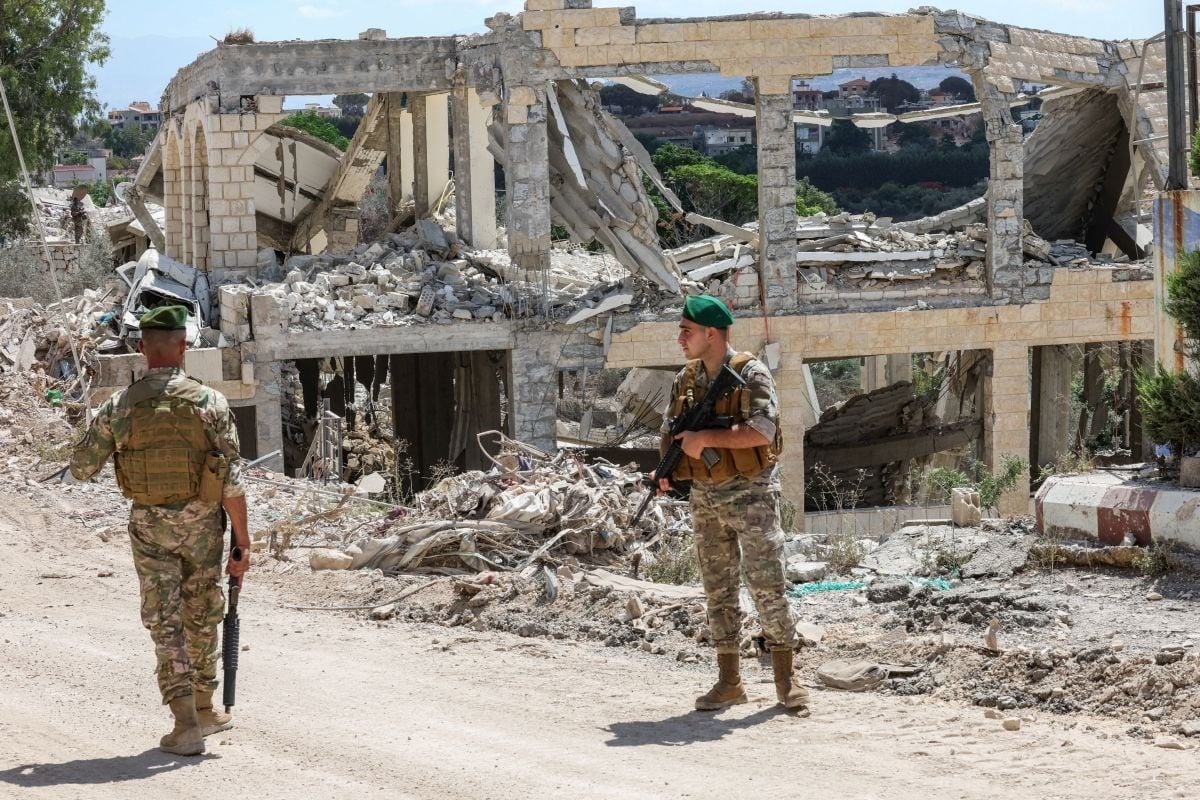
Lebanese soldiers stand guard in the town of Zawtar Gharbieh, after the withdrawal of Israeli forces as part of a plan negotiated by the United States, in southern Lebanon, on July 26, 2026. (Credit: Aziz Taher/Reuters)






BEIRUT — U.S. Senators Jeanne Shaheen, a New Hampshire Democrat and the top Democrat on the Foreign Relations Committee, and James Lankford, an Oklahoma Republican and member of the Intelligence Committee, introduced a bill providing up to $1.2 billion in security assistance to Lebanon over five years, with part of the funds conditioned on measures supporting the state's monopoly on weapons and the disarmament of Hezbollah.
Called the "Lebanon Sanctions, Stabilization, and Support Act," the bill more broadly aims to strengthen the authority of the Lebanese state, support the Lebanese Armed Forces (LAF) and Internal Security Forces (ISF), and impose sanctions on foreign individuals materially supporting Hezbollah or Iranian financing of non-state armed groups in Lebanon that hinder Lebanese authorities' efforts to establish a state monopoly on weapons and disarm Hezbollah, or block reforms in Lebanon's banking and financial sectors. The sanctions include asset freezes, bans on certain financial transactions and visa restrictions.
"For decades, Iran has used Hezbollah to destabilize Lebanon, Israel, and threaten Americans who live in the region, but President Trump has created a real opening for change by bringing Israel and Lebanon to the table for the first direct talks in 30 years," James Lankford said in a press release from his office published Friday. The senator explained that this bill "imposes tough sanctions on the network financing Hezbollah and provides security assistance to the Lebanese Armed Forces." According to him, "A sovereign Lebanon protects Lebanese, Israeli, and American citizens living in the region, and puts real pressure on the terrorists."
Aid could increase with 'significant progress'
The bill sets a base allocation of $240 million per year for five years, including $200 million for foreign military financing, $25 million for drug control and law enforcement programs, $11.5 million for nonproliferation, anti-terrorism and demining, and $3.5 million for military training.
The text also provides for the creation of a fund to finance the reconstruction of state and municipal services and institutions, as well as civil infrastructure. It calls for a strategy to expand state services in communities currently dependent on Hezbollah's parallel services.
"For the first time in decades, Lebanon has a real chance to reclaim its sovereignty, disarm Hezbollah and break free from Iran’s malign influence, but success depends on sustained American support," Shaheen said, according to the statement from Lankford's office.
“That’s why I’m proud to introduce the bipartisan Lebanon Sanctions, Stabilization, and Support Act with Senator Lankford. It combines tough sanctions on Hezbollah’s enablers with targeted security and recovery assistance as well as congressional oversight. This legislation helps the Lebanese state extend its authority and build toward a peaceful future with its neighbors. A sovereign, stable Lebanon is firmly in America’s interests, and I urge my colleagues to support this bill.”
However, the bill stipulates that no more than half of the annual $240 million allocation can be committed before the secretary of state certifies to Congress that the Lebanese government has declared Hezbollah's military activities illegal and that the army is implementing government directives to establish a monopoly on the use of force across Lebanese territory and disarm the group. This restriction would not apply to aid destined for military special operations units and their associated forces.
Regular congressional oversight
The bill also provides that security aid may be increased if "significant progress" is made by the LAF and ISF in countering Iran-allied groups operating in Lebanon, including Hezbollah, Hamas and Palestinian Islamic Jihad, as well as in government efforts to expand state services in "communities currently dependent on Hezbollah's parallel services."
Part of the funds must also be used to strengthen the Lebanese security forces' ability to target Hezbollah's and other actors' sources of revenue, including "financial crimes, the production and trafficking of captagon and other illicit goods," as well as to "detect and intercept arms trafficking."
The bill further provides for regular congressional oversight of progress in disarming Hezbollah, reforms to the banking sector, U.S. coordination between the Lebanese and Israeli armies, and progress toward "peaceful relations" between Lebanon and Israel.
The secretary of state would also be required to report to Congress on measures aimed at suspending or repealing Lebanese anti-normalization laws with Israel.
The bill comes as direct negotiations between Lebanon and Israel, mediated by the United States, have struggled to produce concrete advances. The seventh round of talks, which ended Thursday in Rome, concluded without a major breakthrough, notably on expanding "pilot zones" in south Lebanon. Israel, backed by Washington on this point, insists on completing the implementation of already defined zones and on the Lebanese Army disarming Hezbollah and dismantling its military infrastructure.
At the same time, Israeli military operations continue in southern Lebanon, while a new round of negotiations is currently scheduled for Sept. 1.

 7 p.m. recap: Houthis strike Riyadh airport again; Yemeni forces claim Bab al-Mandeb gains; Abbas postpones Palestinian polls