





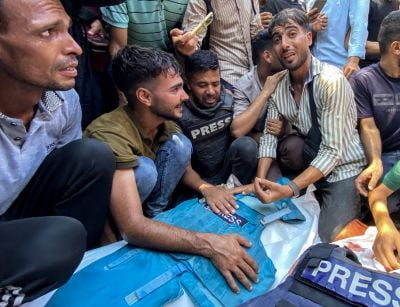
Palestinians mourn journalists killed by an Israeli strike on Nasser Hospital in Khan Younis, Aug. 25, 2025. (Credit: AFP)






On Monday, Aug. 25, after an Israeli strike hit a floor of Nasser Hospital in Khan Younis, Israeli forces launched another strike on the same site just minutes later, according to a CNN video analysis. Two rounds landed as journalists and medical personnel were on scene to provide aid or report on the attack.
Mariam Abou Dagga, Mohammad Salameh, Moaz Abou Taha, Houssam al-Masri and Ahmad Abou Aziz were among those killed, joining more than 200 journalists killed since the war in Gaza began on Oct. 7, 2023. Many observers condemned the incident as an intentional strike and a war crime.
Principles of distinction, precaution and proportionality
International humanitarian law does not explicitly address the concept of “double taps.” The tactic is often described as launching a second strike on the same target shortly after an initial attack, hitting rescuers and first responders. In 2016, then-British Prime Minister Boris Johnson said of Russian actions in Syria: "One thing that, in my view, undoubtedly amounts to a war crime is the double-tap procedure they use."
Though often justified as a way to ensure a target has been neutralized, double taps must still be assessed under established principles of international humanitarian law. Civilian protection is the foundation of the Geneva Conventions and their Additional Protocols.
The principle of distinction requires separating combatants from civilians, with only the former being legitimate targets. The principle of precaution requires all feasible steps to avoid or minimize civilian harm. The principle of proportionality prohibits attacks that cause excessive civilian damage compared to the concrete and direct military advantage anticipated.
CNN’s analysis said the second strike at Nasser Hospital came nine minutes after the first, which had already killed two people, including a journalist. The follow-up strike landed as people — including several wearing reflective vests identifying them as first responders — had gathered to treat the wounded. About 20 Palestinians were killed in total, including five journalists and a Gaza Civil Defense rescuer.
According to CNN, two tank projectiles struck almost simultaneously at a hospital stairwell from which reporters typically broadcast. Prime Minister Benjamin Netanyahu expressed regret over what he called a "tragic accident," saying, "Israel values the work of journalists, medical personnel and all civilians." The Israeli military, however, later said it had killed six "terrorists" in the strike and added that its investigation was ongoing.

Double taps not only a terrorist tactic
Hospitals, medical transports and cultural sites receive special protection under international humanitarian law. An attack on Nasser Hospital could therefore qualify as a war crime unless proven that the site was being used for military purposes. Israel has frequently and baselessly claimed that Hamas uses civilian infrastructure as cover, including tunnels beneath schools, mosques and hospitals. The Israeli military claimed, with no evidence, that it had targeted a Hamas "camera" monitoring its troop movements and claimed to have killed "terrorist operatives" in the Nasser strike.
While double taps are not illegal under international law, they have been used more often in recent decades, frequently by terrorist groups aiming to maximize casualties. The U.S. Department of Homeland Security in 2007 described double taps as "Hamas’s preferred tactic." Washington has also used the method in Iraq, Pakistan, Yemen and Afghanistan. Observers say the tactic became widespread during Barack Obama’s presidency, though it was also used under George W. Bush.
According to an investigation by +972 Magazine and Local Call, which drew on testimony from Palestinians in Gaza, Israeli security sources and case analyses, the Israeli army uses double taps as standard procedure in Gaza to prevent rescuers from reaching victims and sometimes to deliberately kill medical workers and first responders. Data revealed by The Guardian in coordination with those outlets showed that as of May, 83 percent of those killed in Gaza were civilians.

 Evening recap: Netanyahu announces West Bank offensive; 7 killed in Jordan church shooting; tents burned in south Lebanon
 US strike on Iran this weekend? ‘Absolutely,’ says Barrack; ‘I have no idea,’ says Trump