



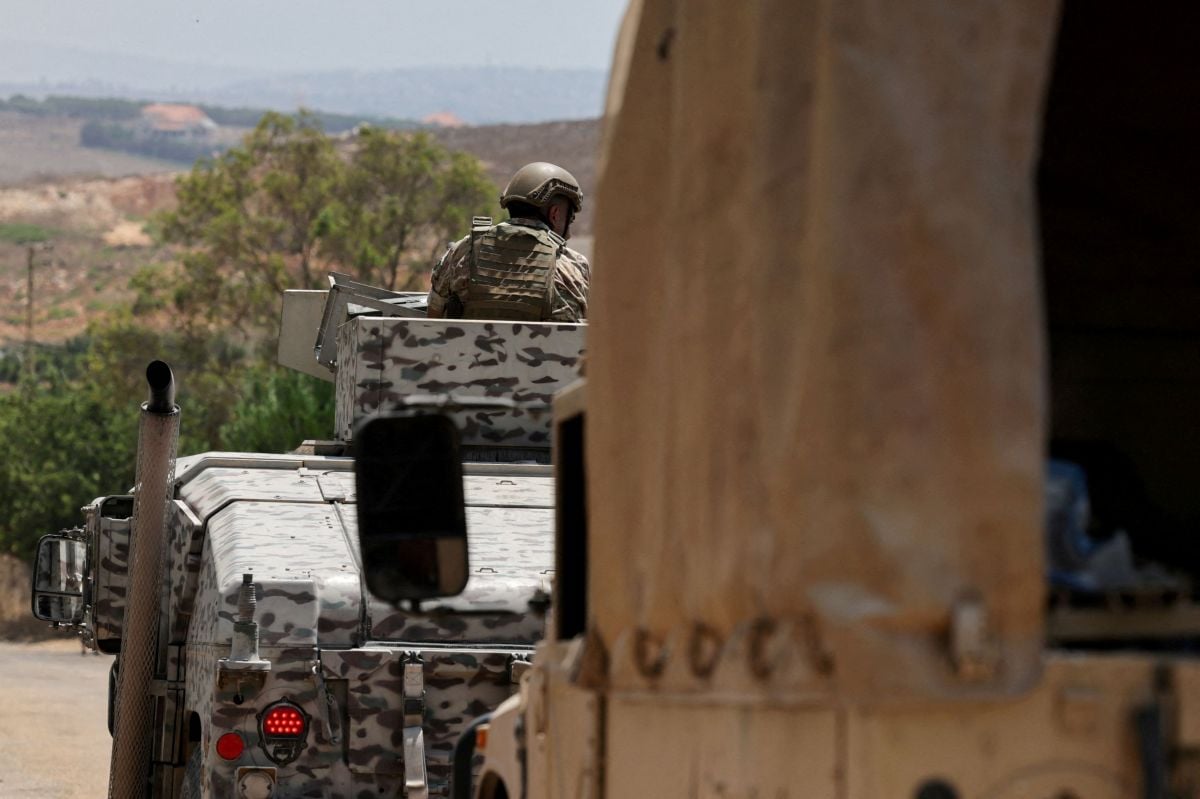
A Lebanese Army soldier sits on a vehicle in Zawtar Gharbieh, southern Lebanon, on July 23, 2026, following the withdrawal of Israeli forces under a U.S.-mediated agreement. (Credit: Emilie Madi/Reuters)






The Israeli army continued its bombing campaign in southern Lebanon overnight from Saturday to Sunday, focusing on the hills of Ali al-Taher, while five Lebanese soldiers were wounded in the Bint Jbeil district under circumstances that remain unclear.
According to initial reports from our correspondent in the region, an Israeli drone targeted a car in Sarbine, slightly injuring five soldiers who were escorting villagers. The Lebanese Army issued an initial statement confirming the incident, but locating it in Kafra (Bint Jbeil district) and specifying that a military vehicle was escorting residents in the village.
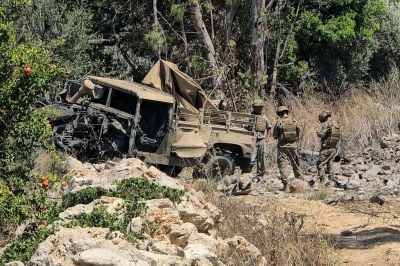
Shortly afterward, it issued a second statement revising the information in the first and indicating that the explosion that injured the five soldiers had been caused by a "suspicious object," without mentioning an Israeli strike.
"The investigation is continuing in order to fully clarify the circumstances of the incident," the unit stated. The incident comes on the eve of a new round of direct negotiations between Lebanon and Israel in Rome aimed at advancing the implementation of the framework agreement concluded in June. The agreement established "pilot zones" where the Lebanese Army deployed to disarm Hezbollah without intervention from the Israeli army.
Our correspondent later reported that fires have broken out on the hill toward a plain in Kfar Roummane, as a result of the artillery shelling and explosions.
On Sunday evening, Israeli artillery shelling targeted the outskirts of Shamaa (Sour district).
New Israeli blasting operations in south Lebanon
Throughout Sunday, small Israeli drones dropped explosives on Ali al-Taher hill in three waves. During the third wave, the explosions were heard as far away as the city of Saida.
In addition, more than 12 artillery shells struck the hill, and the shelling was still ongoing at the time of publication.
The Israeli army has recently increased its bombing of Ali al-Taher and has repeatedly claimed the strategic hill contains an underground Hezbollah "command base."
After 9:30 p.m. Saturday, the Israeli army blew up houses and infrastructure near the village of Zawtar Sharqieh (Nabatieh district), close to Zawtar Gharbieh, one of the "pilot zones" under the Lebanon-Israel framework agreement.
A source within the municipality told our correspondent in southern Lebanon that the survey of homes and residential units destroyed in the part of the village vacated by Israeli forces last week, where the Lebanese Army has since deployed, is nearing completion.
Preliminary results indicate that about 213 housing units were destroyed. The source said the survey has not yet covered the part of the village that remains under Israeli occupation.
The source added that the municipality and relevant authorities are working on a plan to clear the rubble and level the land to install prefabricated housing for residents whose homes and apartments were destroyed.
The explosion was followed by another in the village of Tallousa (Marjayoun). An Israeli Merkava tank also fired three shells at the village of Haddatha (Bint Jbeil). In parallel, machine-gun fire targeted the village, while similar fire was directed at Qantara (Marjayoun).
The Israeli army also blew up houses and infrastructure in the village of Kounin (Bint Jbeil). Detonations were also reported in the town of Bint Jbeil.
At around 2 a.m., the Israeli army carried out a large-scale demolition targeting several houses in the village of Haddatha. The blast was heard far from the site, and thick smoke was seen rising from the area.
In total, the Israeli army carried out one airstrike, conducted detonations in seven villages, and burned houses in two other villages Saturday.
On Sunday morning, the explosions continued, as two Israeli detonations were reported in Taybeh (Marjayoun).
401st Israeli Brigade ends its mission
In parallel, the Israeli army announced Sunday that its 401st Brigade Combat Team had completed its mission in southern Lebanon after eight months of offensive operations there.
According to Israeli army spokesperson Ella Wawiya, the forces destroyed more than 1,200 pieces of what the military described as Hezbollah infrastructure, including "underground routes stretching a cumulative length of hundreds of meters."
"In addition, the forces located more than 600 weapons and killed more than 60 Hezbollah fighters," she added in a post on X.
The brigade took part, alongside other Israeli army units, in demolition operations in occupied villages in southern Lebanon. Several soldiers from the brigade have been killed since the war resumed in March.
Politically, Hezbollah MP Hassan Fadlallah said "what the enemy is doing in terms of destroying everything connected to civilian life must become a cause for all Lebanese, regardless of political differences." He added that "primary responsibility falls on the state, which could have taken effective steps, but instead the authority chose to sign an agreement that offers nothing but a gift to the Israeli enemy."
Meanwhile, Tashnag MP Hagop Terzian said "the continued Israeli attacks raise questions about the usefulness of negotiations in the absence of Israeli commitment," stressing that the priority should be "Israel's withdrawal and the reconstruction of the South."
Separately, the Amal Movement announced the death of Hussein Yassin Ibrahim on Saturday night. He died of wounds sustained in an earlier Israeli strike that targeted the village of Touline (Marjayoun).
Despite the cease-fire agreement reached after months of war between Hezbollah and Israel, the Israeli army continues its campaign of demolishing infrastructure in what it calls the "buffer zone," which includes dozens of occupied villages in southern Lebanon.
On Thursday night, Israeli forces carried out large-scale demolitions in the Beaufort Castle sector in the Nabatieh district, which they occupy, saying they had destroyed several Hezbollah tunnels. The Crusader-era site, located in occupied southern Lebanon, was added last week to UNESCO's List of World Heritage in Danger. The damage appears to have affected the site's perimeter but not the fortress itself.
The war resumed on March 2 after Hezbollah carried out its first attack in 15 months, two days after the start of the war between the United States and Iran. More than 4,300 people have been killed in Israeli attacks on Lebanon since March 2.
Reporting contributed by our correspondent in the South, Muntasser Abdallah