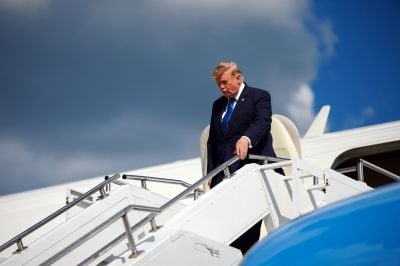
U.S. President Donald Trump disembarks from Air Force One after arriving at Morristown Municipal Airport in Morristown, N.J., on July 31, 2026. (Credit: Aaron Schwartz/AFP)






President Donald Trump said Saturday that the United States and Israel had agreed to hold off on planned strikes against Iran, provided a deal to end the months-long conflict is reached quickly.
Fears had been mounting that the fighting could escalate again after Trump threatened during a Cabinet meeting Friday to strike Iran "very hard," just days after another visit by Israeli Prime Minister Benjamin Netanyahu to the White House. Following those remarks, U.S. embassies across the Middle East warned American citizens of possible regional escalation and urged them to be prepared to leave if necessary.
In a message posted Saturday on his Truth Social platform, Trump said the United States was "locked and loaded and ready to go against the Islamic Republic of Iran."
"Despite this, we have just been asked by Iran, and other Middle Eastern Countries, to hold off any attack," he added. "Based on this request, I have agreed, for the future benefit of the WORLD and, likewise, the survival of a successful and prosperous Iran, to cancel the attack, subject to being able to rapidly make a DEAL. The Country of Israel joins me in this commitment."
Iran on Sunday denied Trump's claim that it had asked the United States to refrain from carrying out new strikes. Mehr news agency, citing military officials, called the allegation "nothing but a new lie" and said Iran's armed forces were "on high alert and ready for any eventuality."
Iran's Fars news agency, citing a source close to Iranian negotiators, said the Strait of Hormuz would remain closed "as long as the United States maintains its hostile actions." Iran has blockaded the strategic waterway since the start of the war, requiring vessels to obtain permission and pay transit fees before using it.
Saudi intervention and progress on the Strait of Hormuz
According to U.S. media reports, Washington had been considering new large-scale strikes over the weekend. CBS News reported that the United States and Israel were preparing joint attacks, with oil refineries and power plants among the possible targets.
Saudi Arabia's official SPA news agency said Crown Prince Mohammed bin Salman spoke with Trump and "emphasised the necessity of prioritising dialogue to reduce tensions and the importance of exerting all possible efforts to achieve a truce that paves the way for diplomatic solutions."
The call followed contacts between Riyadh and Tehran. Iranian state media reported that Foreign Minister Abbas Araghchi spoke with his Saudi counterpart, as well as with officials in Pakistan and Turkey, which have acted as mediators, about "the risk of escalating tensions and insecurity in the region."
Araghchi also warned that "any hostile action on the part of the United States or Israel — or any participation or cooperation from regional countries in such actions — would meet a decisive and proportionate response from the powerful Iranian armed forces," according to a statement posted on his Telegram channel.
At the same time, talks continued between Qatari mediators, their Iranian and Omani counterparts, and U.S. envoy Steve Witkoff to advance negotiations over the Strait of Hormuz.
Trump said any agreement with Iran would have to include the "Immediate, Complete and Total OPENING OF THE HORMUZ STRAIT, and an end to Iran's nuclear threat."
Avoiding a wider war for an uncertain victory
In an interview published by Fox News before Trump's announcement, Secretary of State Marco Rubio said Iran's military capabilities had been diminished and that Iranian officials "are now willing, and in some cases seem eager, to conclude a denuclearization agreement."
Although Iran and the United States resumed exchanges of fire last month after a brief lull, there were no reported strikes between Friday and Sunday.
The Islamic Republic has also expanded the conflict through its regional allies.
On Wednesday, a drone struck a U.S.-owned gas carrier docked at an Egyptian port, causing a fire. Egypt is investigating the attack but has not accused any group of carrying it out.
Meanwhile, an "unknown projectile" struck a tanker off the coast of Oman on Saturday, according to a British maritime agency.
Maritime analytics firm Kpler said Friday that traffic through the Strait of Hormuz has dropped sharply.
On the Bab al-Mandeb Strait, another critical shipping route linking the Red Sea to the Indian Ocean and the Suez Canal, Yemen's Iran-backed Houthi rebels on Saturday denied seeking to impose transit fees on commercial vessels.
Beyond the risk of a wider conflict and its expected effects on hydrocarbon markets, other factors make escalation risky for the United States.
A decisive victory appears unlikely given Iran's resilience and Tehran's willingness to raise the cost of the conflict for its opponents and their partners.
Meanwhile, security officials have repeatedly warned of declining stocks of munitions and interceptors. The head of U.S. European Command, Gen. Alexus Grynkewich, has also indicated there are not enough warships to protect Israel, the Washington Post reported.
Trump has previously dismissed reports of ammunition shortages. Nevertheless, U.S. strategic oil reserves are at their lowest level on record, reducing Washington's room for maneuver if hydrocarbon prices spike just months before the U.S. midterm elections.