












Dear readers,
We have known many tragedies in the Middle East in recent years. Outbursts of violence fueled by ultra-radical discourse, the vast majority of which have been — and still are — centered on the imperative of erasing the Other, based on nationality, religion, ethnicity, or political affiliation.
At L’Orient-Le Jour and L’Orient Today, some of us still carry, like many of you, the scars of the civil war. Others lived through the waves of censorship and repression during the Syrian occupation, or — on a regional scale — the authoritarian winter that followed the brief Arab Spring. Having been compelled to cover the endless conflicts that continue to tear the region apart — from Libya to the West Bank, through Iraq, Yemen, and Sudan — many of us thought we had already witnessed the worst with the war in Syria: its barrel bombs, sarin gas, and death prisons.
But the tragedy now unfolding in Gaza — and more broadly across the Palestinian Territories — is in many ways without precedent, even by the standards of this region. Beyond the nature of the crimes being committed there, which the international community has shown itself unable to halt; beyond the far-reaching impact — on Israel, on the Palestinian cause, on the Middle East, and even on the international order — that it is certain to leave in the years ahead; what is under direct and deliberate attack is the very core of our collective mission: to report, to understand, and, when necessary, to bear witness and denounce — amid a prevailing sense of helplessness.
“For 23 months, the Israeli authorities have refused to grant journalists outside of Gaza independent access to the Palestinian territory — a situation that is without precedent in modern warfare,” reminds the NGO Reporters Sans Frontières (RSF) [Reporters without borders]. “Local journalists, those best positioned to tell the truth, face displacement and starvation,” it continues.
And finally, in two years, at least 210 journalists have been killed by the Israeli army to date… Figures that are staggering and already among the bloodiest tolls in recent history in this regard. Above all, as with our Lebanese colleagues killed while covering the conflict between Israel and Hezbollah, numerous independent studies have concluded that in most cases, journalists were deliberately targeted.
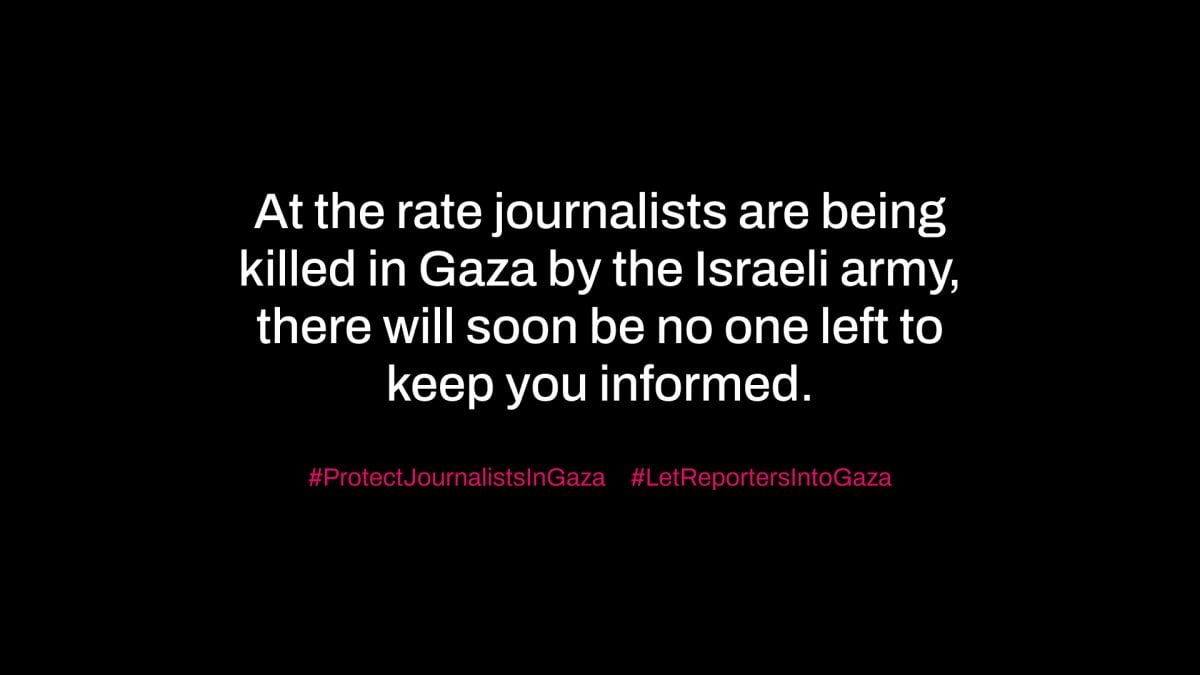
This is why it was simply unthinkable for us not to take part in today’s campaign launched by RSF and Avaaz — joined by 150 media outlets from 50 countries — to condemn this double assault on press freedom and the right to information. With one shared front-page message: “At the rate journalists are being killed in Gaza by the Israeli army, there will soon be no one left to keep you informed.”
If L’Orient-Le Jour and L’Orient Today — along with many other media outlets — are clad in black today, it is to defend the right to bear witness to the horror unfolding in Gaza without becoming targets ourselves.
If L’Orient-Le Jour and L’Orient Today wear the colors of mourning today, it is also in tribute to Mariam Abou Dagga, Anas al-Sharif, Mohammad Salama, Moaz Abou Taha, Houssam el-Masri, Ahmad Abou Aziz, and dozens upon dozens of other journalists killed by Israel.
But paying tribute alone is not enough. We must fight to ensure that journalists from around the world can enter the enclave to report on what is happening, and that our Palestinian colleagues who still have the strength to bear witness — while they are bombed, terrorized, starved, and grieving — are not silenced in turn. This is our mission. This is our guiding compass.
The Editorial Team

 7 p.m. recap: Saudi Arabia warns Houthis as Israeli strikes hit south Lebanon
Thank you for doing this. Many newspapers and media have been silent, but you haven’t.
01 September 2025 13:54