





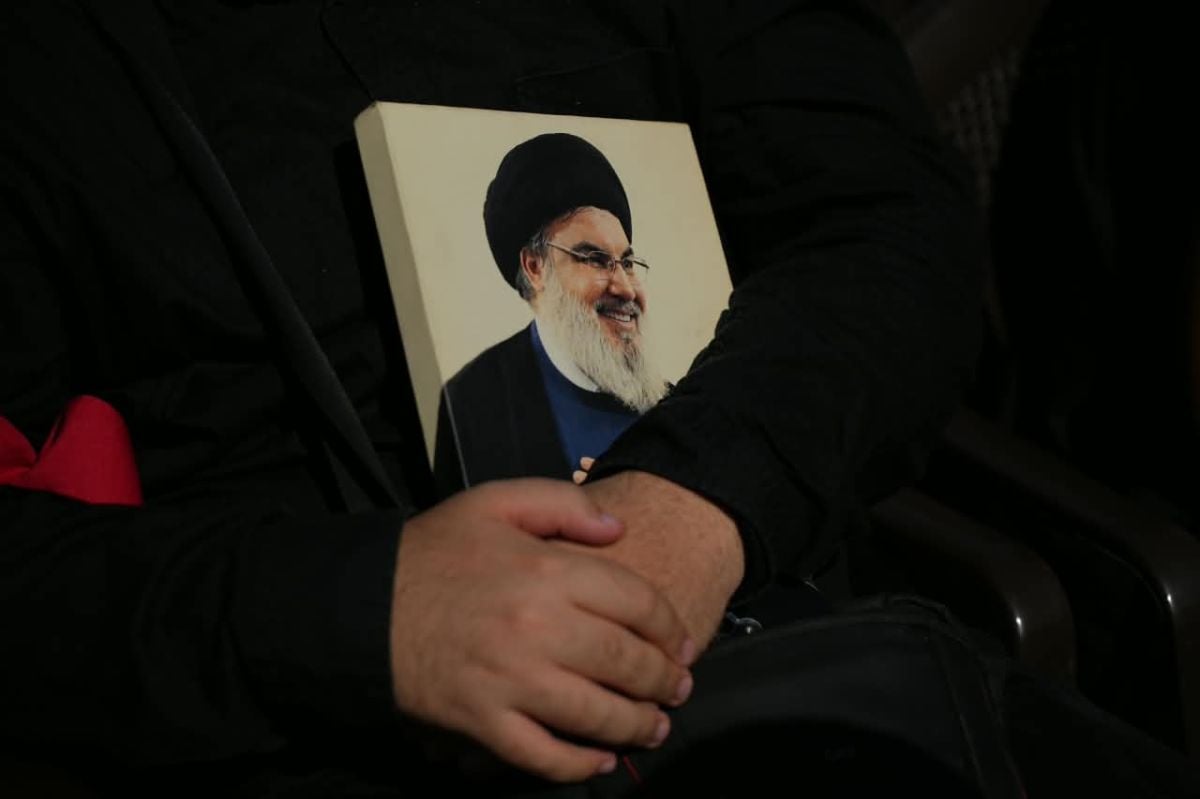
A person holding a portrait of the former Hezbollah leader Hassan Nasrallah, killed in Sept. 2024 during massive Israeli strikes in the southern suburb of Beirut, on Sept. 27, 2026. (Credit: Mohammad Yassine/L’Orient-Le Jour)






BEIRUT — "We tracked him for a very long time ... We knew his apartments, his wife's residence, his emergency hideouts and the places where he hid." An Israeli colonel has revealed new details about the planning of the operation that killed former Hezbollah leader Hassan Nasrallah on Sept. 27, 2024, in a series of massive strikes on Beirut’s southern suburbs, in an article published Sunday by the Jerusalem Post.
The officer, who headed the Israeli army’s target bank within the Air Force’s Nahalat Binyamin unit, said the former Hezbollah secretary-general "was not living underground at all" at certain times.
"He sometimes stayed in a penthouse apartment on the eighth floor of a residential building in southern Beirut, with a special elevator allowing him to quickly reach a protected area," he said. "He might have lived in a bunker in principle, but in practice, he wasn’t underground all the time."
According to the officer, those who “planned his elimination” had “detailed plans for every building and every bunker” where he might be found.
“In any bunker he entered, we would have killed him,” the officer said. “On the day of the operation, Hassan Nasrallah had better-protected options. He still chose to go to the complex where his story ended,” he added.
The officer also said that, after estimating that it would take rescuers around six hours to reach people trapped at a site destroyed on such a scale, and citing the lack of organization in Lebanon, the Israeli army decided to prevent anyone from approaching the site for “12 hours.”
“We wanted to be sure that Nasrallah would die, if not from the direct strike, then at least from hemorrhaging or asphyxiation due to a lack of oxygen.” He said the Israeli army struck the first and then the second bulldozer sent to the scene. “The third bulldozer never came,” he said.
Two years of surveillance
In an article published on Monday, the Israeli news outlet Ynet reported that, during the two years leading up to the bombing, Israeli intelligence had studied the Hezbollah leader’s habits in minute detail: “When he slept, what he liked to eat, who he usually traveled with,” said G., the commander then in charge of targets in Lebanon within military intelligence. According to his colleague R., an air force officer, after Oct. 7, 2023, Hassan Nasrallah believed that Israel’s attention would remain focused on Gaza and therefore continued to move about “in a relatively normal manner.”
Officer G. also claims to have known “where [Hassan Nasrallah] was at every minute.” He also states that Israeli intelligence was constantly monitoring the leader at the time, “we had no blind spots.” When new intelligence raised fears that the Hezbollah leader was about to leave his hideout, the team reportedly put pressure on Israeli decision-makers to obtain rapid authorization for the strike. Regarding civilian casualties, Officer G. emphasizes that the final death toll was reportedly lower than Israeli estimates, with around thirty "uninvolved" people killed in the strike. He states that there were approximately as many civilian casualties as there were Hezbollah officials killed alongside Hassan Nasrallah.
In December 2025, another Ynet article revealed that Israeli intelligence had carried out a "meticulous years-long effort" to kill the former Hezbollah leader. Haaretz, in an article published in January 2026, reported that the operation cost $34 million. That day, Israeli fighter jets took off from the Hatzerim air base in the afternoon, armed with at least 83 tons of bombs, which they later dropped on a cluster of six buildings in the Haret Hreik district of Beirut's southern suburbs, where the Hezbollah leader was located, the media reported.
The assassination marked the beginning of a large-scale Israeli offensive against Lebanon, which ended with a nominal "cease-fire" agreement on Nov. 27, 2024. In the meantime, the Israeli army also killed Hassan Nasrallah’s designated successor, Hashem Safieddine, on Oct. 3, 2024, using a similar method.
Naim Qassem ultimately took over as leader of Hezbollah in late October 2024.
