


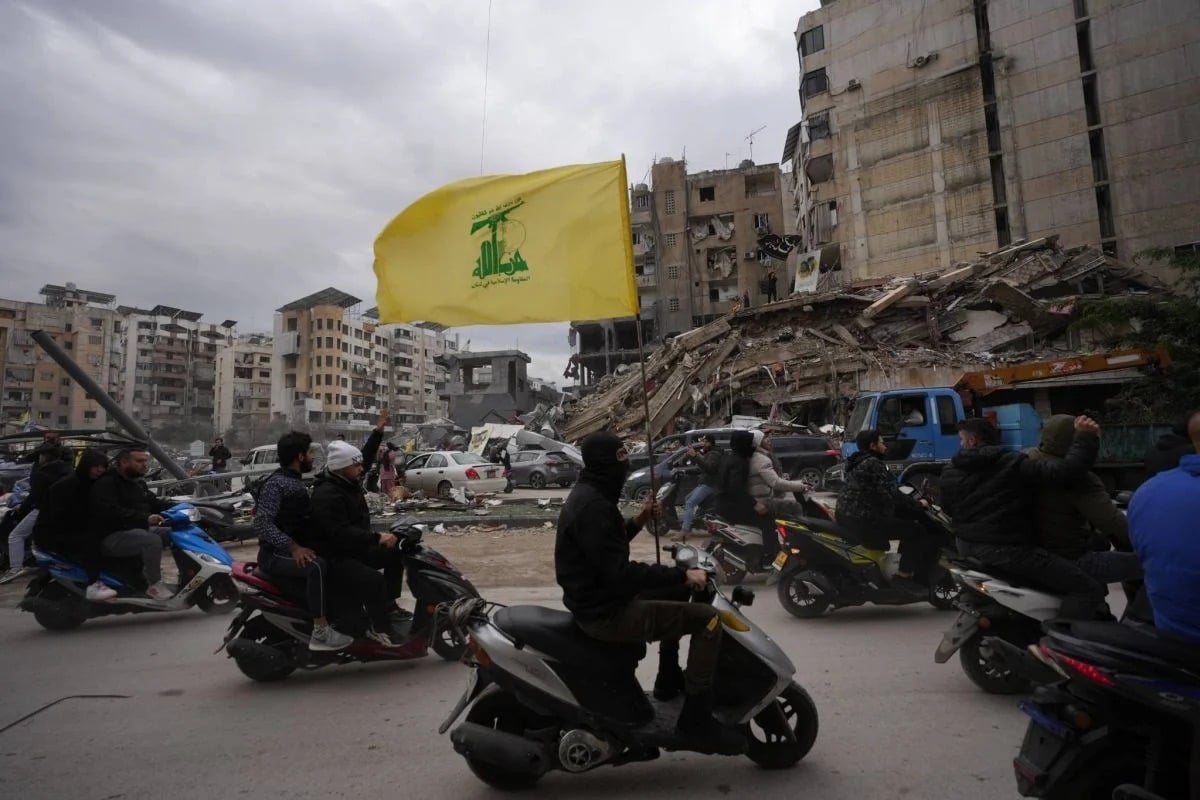
Hezbollah supporters return to Beirut’s southern suburbs a few hours after a cease-fire with Israel took effect on Nov. 27, 2024. (Credit: Mohammad Yassine/L’Orient-Le Jour)







Joseph Aoun takes a tougher stance on Hezbollah’s illegal arms. The Lebanese president on Monday called for a ban on armed demonstrations, the seizure of weapons and ammunition, and the prosecution of offenders, demanding strict enforcement of the law and rejecting any “laxity.”
His stance follows the seizure of explosives belonging to Hezbollah in Dahr al-Baidar and a turbulent raid on a warehouse containing suspicious medicines near Beirut’s southern suburbs.
It echoes statements by Prime Minister Nawaf Salam, who is also calling for the prosecution of those possessing and transporting illegal weapons, even at the risk of fueling tensions with the party.
Why it matters
These statements mark a renewed assertion of state authority in the face of Hezbollah, amid U.S. pressure for the group’s disarmament and fears of renewed war with Israel.
They also come on the eve of a three-way meeting among Lebanese, Israeli and American representatives in Tampa, Florida, following a three-month suspension of negotiations between Beirut and Tel Aviv.
According to information obtained by L’Orient-Le Jour, Israel and Washington are nevertheless making talks conditional on establishing direct coordination between the Lebanese and Israeli armies.
On Monday, a U.S. State Department spokesperson told local television channel Al-Jadeed that the three-party framework concluded with the United States and Israel in June provides for “the complete disarmament of Hezbollah throughout Lebanese territory.”
The spokesperson said Washington “continues to urge the Lebanese government to bring to account all those who ordered, financed, and supervised the delivery of the seized shipment of explosives.”

‘Desert Davos’ postponed. Like the Six Kings Slam tennis exhibition tournament, “Desert Davos” is feeling the effects of escalating insecurity in the region. The major international finance event, organized by the Future Investment Initiative, was scheduled for Oct. 26-29 in Riyadh but “will not take place on the scheduled dates,” a source told AFP.
No new date was immediately announced.
The postponement is another setback for Saudi Arabia’s economic ambitions as the kingdom regularly faces attacks targeting its oil and airport infrastructure.
Meanwhile, Egypt’s parliament has postponed until next week a vote on authorizing military support for Saudi Arabia.
In Yemen, fears of a new ground offensive are mounting after a missile strike attributed to the Houthis hit a government military camp, killing at least 50 people and wounding 200. It was the deadliest attack in weeks, amid intensifying clashes between the Iranian-backed rebels and the Saudi-backed Yemeni government since hostilities resumed in July.
According to a military source, these strikes may precede a new offensive following the rapid takeover of Mokha and several other Red Sea coastal towns, as well as the strategic Bab al-Mandeb strait, in September.

Qatar plans two power plants to help revive Lebanon’s electricity sector. According to a document seen by Reuters, Qatar plans to build two gas-fired power plants with a capacity of 825 megawatts each, one in Deir Ammar in the north and one in Zahrani in the South, alongside a 20-year liquefied natural gas supply agreement with QatarEnergy.
The program, aimed at reviving a sector that has been in crisis for decades, still needs approval from both the Lebanese and Qatari governments.
Implementation could take three years if all approvals are secured quickly, according to a source familiar with the matter cited by Reuters.
These details follow last week’s visit to Beirut by the Qatari prime minister.
During a news conference, his Lebanese counterpart, Nawaf Salam, announced that Doha would finance, build and operate an electricity project under a build-operate-transfer model, with eventual transfer of ownership and no initial investment from the Lebanese treasury.
- Araghchi blames Washington for ‘insecurity’ in the Strait of Hormuz. Iranian Foreign Minister Abbas Araghchi blamed the United States for “insecurity” in the Strait of Hormuz, which has been at the heart of tensions between Tehran and Washington since the outbreak of war in the Middle East. “The war imposed by the United States and the Zionist regime, together with the economic blockade, is the main source of insecurity in our region,” Araghchi said after referring to the “Persian Gulf and [the] Strait of Hormuz” during a joint news conference in Tehran with his Russian counterpart, Sergei Lavrov.
- About 700,000 Syrians have returned from Lebanon, showing the ‘success’ of coordination between Beirut and Damascus, Sayyed says. Speaking in Damascus, Lebanese Social Affairs Minister Hanin al-Sayyed said about 700,000 Syrians had returned from Lebanon to their country, describing the returns as “a sign of the success of coordination between the two countries.” Her Syrian counterpart said “Syria and Lebanon are entering a new phase of their relations, based on mutual respect, good neighborliness and common interests.” She expressed her country’s gratitude to Lebanon for sheltering hundreds of thousands of Syrian families in recent years.
- Benny Gantz, former Israeli defense minister and head of the centrist Blue and White party, has announced he is dropping out of the Oct. 27 parliamentary elections, eight days before the vote. His party had been polling below the electoral threshold for months, according to Israeli media, including The Times of Israel. “I will not run in the next election, but I will continue to fight for unity,” he said, expressing his desire to keep working toward a national unity government.