





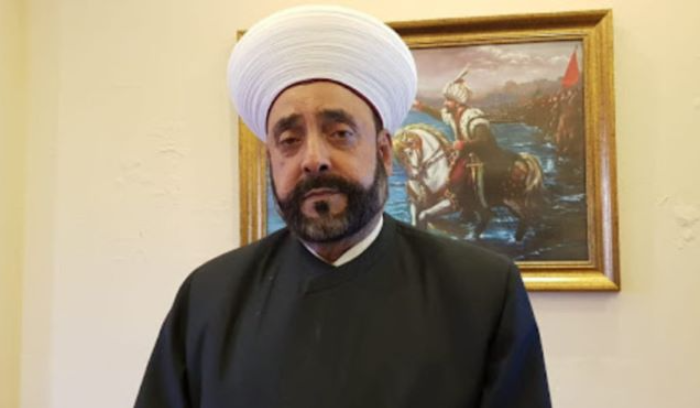
Sunni Sheikh Khaldoun Oraymet. (Credit: NNA)






The Beirut Criminal Court, presided over by Judge Bilal Dennawi, on Monday ordered the release without bail of Mustafa Hessian and Sunni Sheikh Khaldoun Oraymet, who were detained in the so-called “Abu Omar” case.
Hessian, who used the pseudonym Abu Omar, is suspected of posing as a member of the Saudi royal court to convince Lebanese political officials and businesspeople that he could intervene on their behalf with Saudi Arabia, particularly to secure appointments or political support, in exchange for money. Oraymet was suspected of playing a key role by facilitating contact with the individuals concerned.

Contacted by L’Orient-Le Jour, a judicial source said the release decisions issued Monday by the Beirut Criminal Court suggest that the acts attributed to the two men fall under the general amnesty law, enacted Oct. 15 after validation by the Constitutional Council.
Arrested in December 2025, Abu Omar and Oraymet spent 10 months in pretrial detention. Last May, the Beirut indictment chamber referred them to the Criminal Court for “undermining relations with a foreign state,” in this case Saudi Arabia.
Article 288 of the penal code provides for imprisonment for anyone who commits the “crime of exposing Lebanon to the risk of hostile acts, disturbing its relations with a foreign state.”
However, according to the judicial source, such an act is covered by the general amnesty law because it is not expressly listed among the excluded offenses.

The source therefore believes the Criminal Court will no longer have to determine whether the acts with which Abu Omar and Oraymet are charged constitute hostile acts against a foreign state, since the offenses are covered by the amnesty in any case.
The same source also noted that the acts attributed to the two men were committed before March 1, 2026, meeting the amnesty’s timing requirement.
Amnestied offenses
The Beirut indictment chamber had also charged the two men with “identity theft” and “fraudulent schemes.” These offenses are covered by the amnesty, as the law applies to all offenses not specifically excluded.
According to the source, the Beirut Criminal Court is expected to issue a decision Wednesday acknowledging that the acts with which the two men are charged are covered by the amnesty and, as a result, dismissing the criminal proceedings against them.
Further Criminal Court decisions are expected soon in numerous misdemeanor and felony cases, including drug trafficking cases. These offenses are also covered by the amnesty if they were committed before March 1, 2026, provided that the individuals concerned are not repeat offenders — meaning they have not received two final convictions.
This article was translated from L'Orient-Le Jour.

 2 p.m. recap: Pit discovered north of Beirut, Hezbollah warns of ‘imminent explosion’ in the streets, settlers arrested in West Bank