






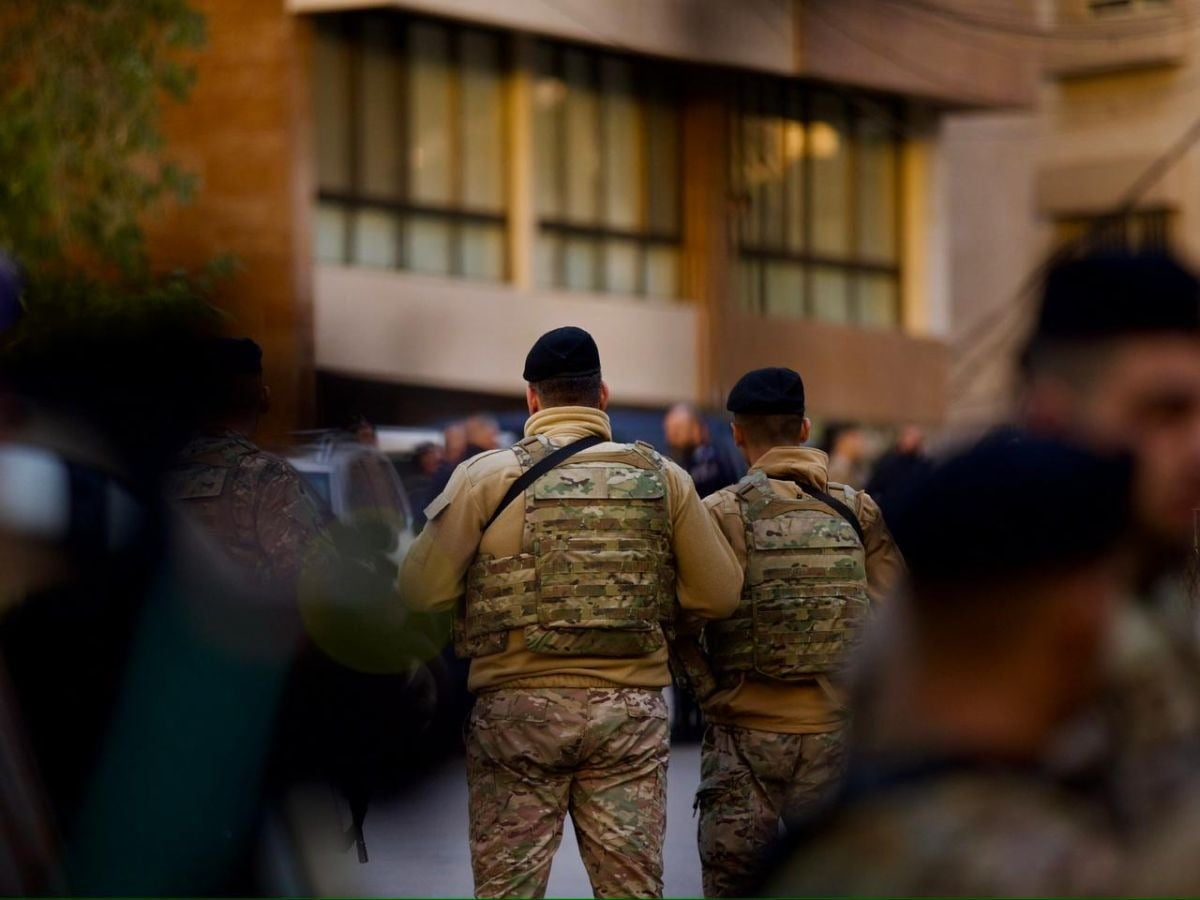
Lebanese Army soldiers secure the perimeter around a building targeted by an Israeli strike, in Hazmieh, east of Beirut, on Monday, March 23, 2026. (Credit: Archive photo Matthieu Karam/L'Orient-Le Jour)






The rift between the Lebanese state and Hezbollah is widening, as illustrated by two concurrent cases: The explosives belonging to Hezbollah that were seized by Lebanese authorities a week ago and continued to draw reactions from the group on Saturday; and Friday’s incident in the Galerie Semaan area, on the edge of Beirut’s southern suburbs, during which dozens of armed Hezbollah members surrounded a judicial police patrol seizing medications from warehouses. The men withdrew after the army arrived at the scene.
After the party condemned a strike the previous day for being carried out “without observing the mechanism agreed upon between Hezbollah and the security services,” the Lebanese army began a “reinforced” deployment in Beirut’s southern suburbs on Saturday morning, according to a source in the military institution.
“We are carrying out a larger-than-usual deployment due to the situation and the clashes that took place yesterday [Friday, editor’s note],’’ the source told L’Orient-Le Jour, describing the move as “routine measures aimed at keeping the security situation under control.” Amateur videos posted online Saturday morning showed military vehicles arriving in Beirut’s southern suburbs from Choueifate, just south of the capital.
Nassereddine defends … the authorities
Notably, in this latest case, Health Minister Rakan Nassereddine, who is affiliated with Hezbollah, sided with the Lebanese authorities. In a statement, he said he had himself reported the presence of medications unfit for consumption and failing to meet the required health standards for distribution, prompting Prosecutor General at the Court of Cassation Ahmad Rami Hajj to issue an investigatory commission.
The minister said his approach was “scientific and legal, totally devoid of any political considerations,” referring to medications that “did not meet the necessary conditions for their use and marketing in the Lebanese market.”
He also called on “the media to exercise caution in the face of any allegations lacking scientific basis, regardless of their source, and to coordinate their efforts with judicial and security authorities, in the general interest and to protect the health of citizens.”
According to the Al-Modon website, the raid reportedly took place after the prosecutor expanded his investigation into the case of anti-cancer medications originating from Iran and India.
Reports circulating online on Saturday indicated that Prosecutor General Hajj had requested an investigation to identify the armed men involved in obstructing the operation at Galerie Semaan, with a view to initiating legal proceedings against them. The information could not immediately be independently confirmed.
The incident also prompted strong reactions from Beirut lawmakers opposed to the pro-Iranian group.
“Since when must Lebanese security forces coordinate with a political party or obtain its permission to carry out their duty on Lebanese soil?” Sunni MP Fouad Makhzoumi wrote on X.
Lebanese Forces MP Ghassan Hasbani similarly asked on the platform: “Are there now areas in Lebanon where security forces cannot enter or conduct searches without prior coordination with a political party? Does law enforcement now require advance authorization from any entity other than the competent judicial and security authorities?”
Protest movement MP Waddah Sadek described the incident as ‘‘a dress rehearsal for May 7 [2008, the date of Hezbollah’s show of force against the state following a controversial government decision], with hundreds of organized members blocking Beirut’s access points.’’
’’What happened yesterday was not just a simple motorcycle procession,’’ he added on X.
Moussaoui denounces Al-Akhbar reports as ‘nonsense’
Regarding the case of the seized explosives, Hezbollah MP Ibrahim Moussaoui denounced reports published by the pro-Hezbollah daily Al-Akhbar, which said that President Joseph Aoun, after receiving a call Friday from U.S. Secretary of State Marco Rubio, had asked army intelligence to “broaden its investigation.”
According to the newspaper, Prosecutor Hajj had then “taken the initiative to issue judicial warrants to the security services for the arrest of Hussein Abdallah, head of Hezbollah’s Coordination and Liaison Committee, and his deputy, Ali Ayoub, on the grounds that they were allegedly aware of the explosives truck and bore responsibility for it, as well as to identify all other individuals responsible.”
Judicial sources denied these reports to MTV. “Stop your rambling, nonsense and false rumors … No judicial warrant has been issued against any Hezbollah member!” the MP wrote on his X account.
During the phone call on Thursday evening, Marco Rubio urged President Aoun to “hold accountable all those who ordered, funded, and directed” the delivery to Hezbollah of half a ton of explosives seized the previous week.
Hezbollah acknowledged Thursday that the shipment belonged to the group, saying it was intended for the ‘‘resistance’’ against Israel. Hezbollah MP Hassan Fadlallah subsequently called for the ‘‘immediate release of the detainees’’ and ‘‘the return of the vehicle and its contents.’’