






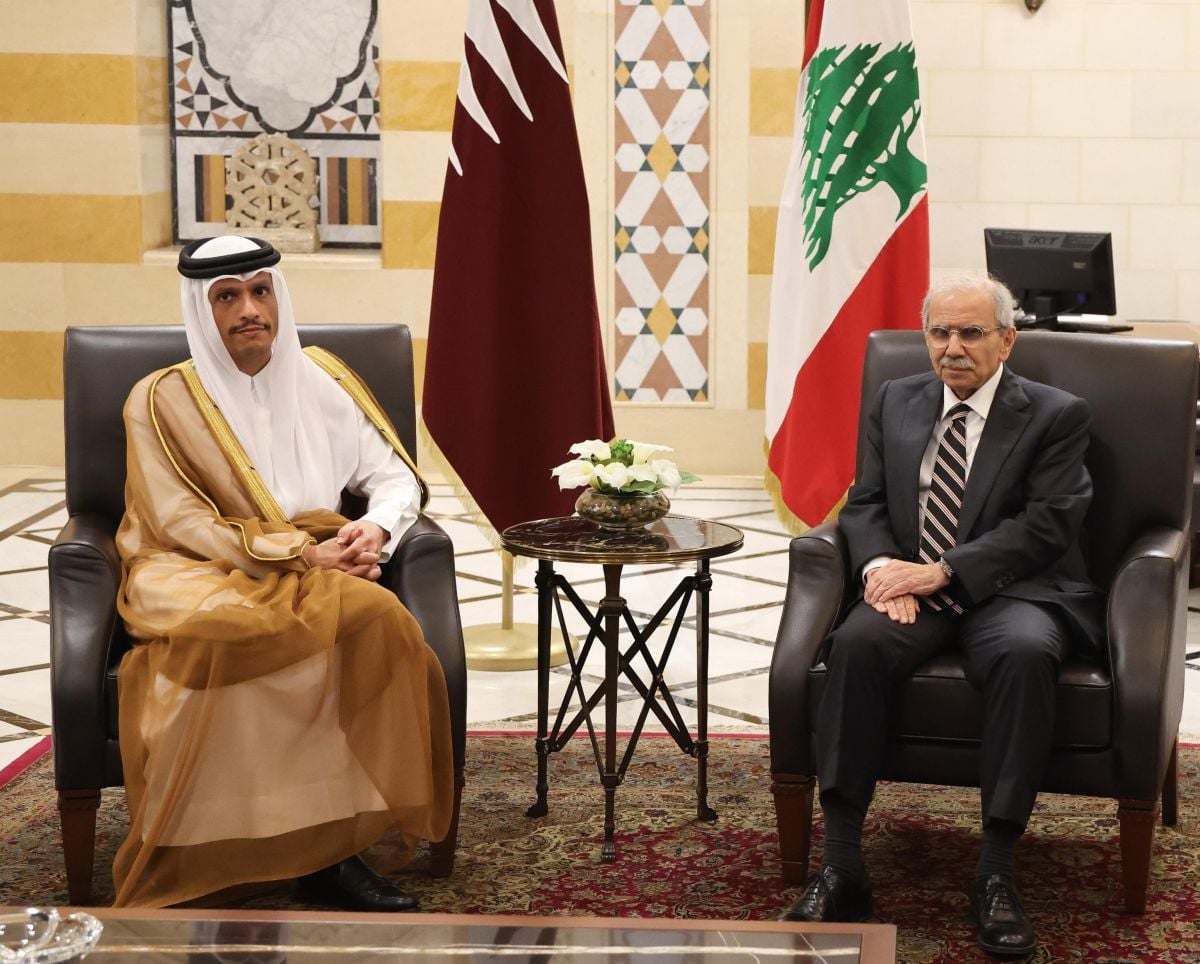
Qatar's Prime Minister and Minister of Foreign Affairs, Sheikh Mohammad bin Abdulrahman Al-Thani (left), during his meeting with Prime Minister Nawaf Salam at the Grand Serail on October 16, 2026. Photo taken from the Grand Serail's X account.






BEIRUT — Prime Minister Nawaf Salam announced Friday that Qatar will finance, implement and operate a project in Lebanon’s electricity sector without requiring an upfront investment from the Lebanese Treasury.
Speaking at a joint press conference in Beirut with his visiting Qatari counterpart, Mohammad bin Abdulrahman al-Thani, Salam said the project would follow a build-operate-transfer (BOT) model. Al-Thani, for his part, said the two countries had agreed to “establish a comprehensive framework for cooperation and propose integrated solutions” in the energy sector through “a major investment project that will benefit the Lebanese economy and participating Qatari parties.”
Salam stressed “the importance of this initiative under the circumstances Lebanon is experiencing,” as the country has struggled to provide an adequate electricity supply since the end of the Civil War (1975-1990). He said the “integrated project” would encompass various sources of energy production and the necessary infrastructure, with the aim of “ensuring a more stable and less costly electricity supply.”
Under the BOT model, a project is built and operated before ownership is transferred.
Neither official specified the investment amount or the implementation timeline.
Implementation of Resolution 1701
On the political front, the Qatari prime minister reaffirmed his country’s “steadfast support” for Lebanon’s “unity, sovereignty, security, and stability.” He said Doha would continue its efforts within the G5 and support the Lebanese Army, in coordination with international partners, as “a national institution that ensures the security and stability of the country.” Al-Thani also stressed “the necessity for all parties to implement Security Council Resolution 1701,” including “Israel’s withdrawal from all positions it occupies” and compliance with agreed commitments, particularly Hezbollah’s disarmament.
He added that work was underway in coordination with the United States to rebuild the South and enable displaced people to return.
Salam, for his part, praised Qatar’s positions in support of Lebanon’s sovereignty, territorial integrity, and stability, as well as its efforts to secure “the complete withdrawal of Israel from the occupied Lebanese territories” and enable the state “to extend its authority over all its territory.”
Earlier in the day, following a meeting with President Joseph Aoun attended by Foreign Minister Joe Rajji, al-Thani said Qatar’s priority in Lebanon was the energy sector. He reiterated his country’s desire “to propose integrated solutions” in a sector with which Lebanon has struggled for several decades. He added that “upcoming meetings will take place, including with Salam, to advance the agreed-upon projects.”
Aoun, for his part, expressed hope that Doha would continue its efforts with Arab countries “to put pressure on Israel to stop its attacks in the South and implement the framework agreement.” He praised the role of Qatar’s emir and Qatari leaders in efforts to restore “regional stability by bringing viewpoints closer together and addressing the causes of escalation.”
The Qatari prime minister also met with Speaker of the Chamber Nabih Berri at Ain el-Tineh. The latter thanked Qatar and its emir for "their steady support for all of Lebanon, and the South in particular." Mr. Berri noted a "convergence of views" with the Qatari official on the importance of "strengthening national unity and supporting institutions, especially security ones, with the Lebanese army at the forefront," which he called the "guarantor and protector" of these principles. Doha has on several occasions in recent years given aid to the force.
The visit of the Qatari prime minister, one of the mediators between Iran and the United States as well as between Hamas and Israel, comes as negotiations between Beirut and Tel Aviv have been deadlocked since August. Washington, which sponsors direct talks between the two countries, continues to press the Lebanese state for tougher measures against Hezbollah, conditioning any assistance for reconstruction on the disarmament of the Shiite party.
The Qatari prime minister’s visit comes as negotiations between Beirut and Tel Aviv have been deadlocked since August. Qatar is one of the mediators between Iran and the United States, as well as between Hamas and Israel. Washington, which sponsors direct talks between Lebanon and Israel, continues to press the Lebanese state to take tougher measures against Hezbollah, conditioning any reconstruction assistance on the disarmament of the party.

 1 p.m. recap: Lebanon's energy sector 'at the heart of Qatar’s priorities,' Rubio criticizes Lebanon's Israel boycott law