




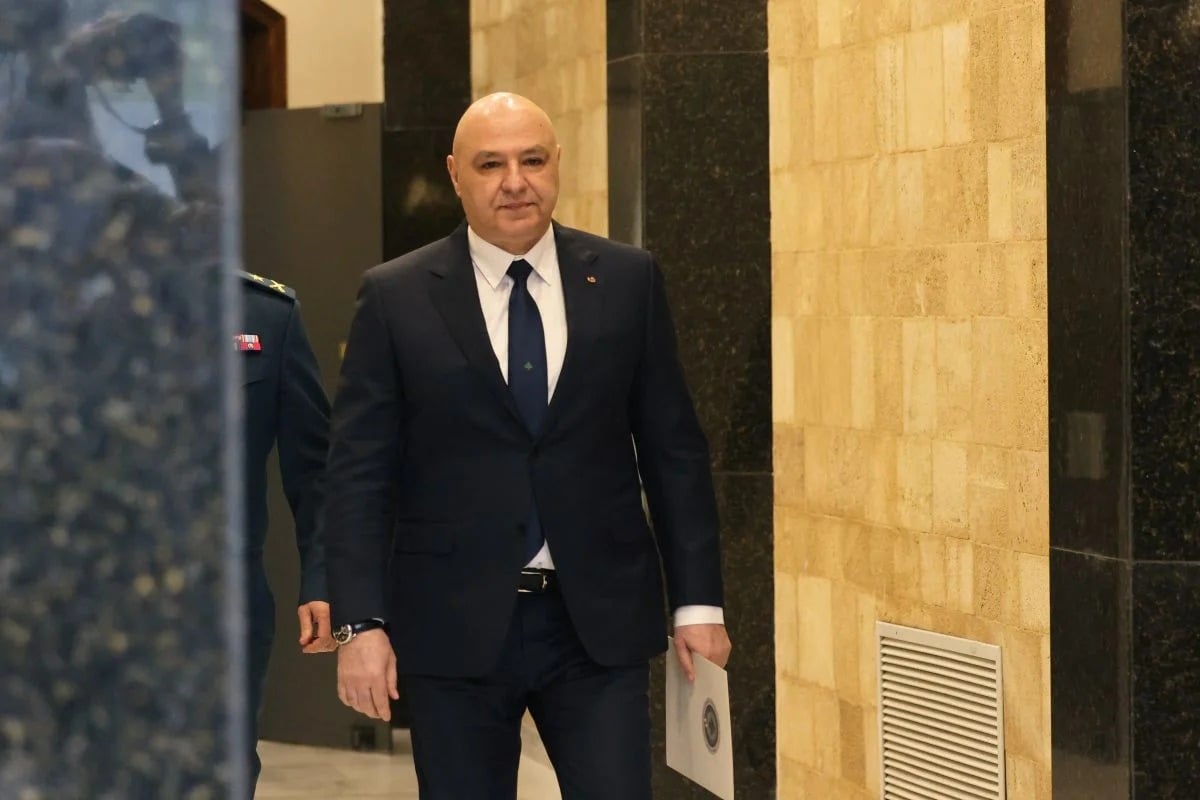
President Joseph Aoun in the Baabda Presidential Palace on Feb. 11, 2025. (Credit: AFP/Anwar Amro)




Lebanese President Joseph Aoun on Monday called for a ban on armed demonstrations, the seizure of weapons and ammunition and the referral of violators to the appropriate courts.
During a security meeting at the Baabda Presidential Palace, he stressed the need for strict enforcement of the law as two recent incidents have reignited tensions between the state and Hezbollah: a turbulent raid on a warehouse containing suspicious pharmaceuticals near Beirut’s southern suburbs and the Oct. 5 seizure of explosives at Dahr al-Baidar, between the Bekaa and the capital.
“It is unacceptable to show leniency in the face of any attempt to undermine security or compromise the stability of the country,” Aoun said. He emphasized the need for “strict enforcement of laws” and called for “accelerated investigations and for violators to be brought to justice.”
He also urged greater coordination between security services and military institutions, continuous information sharing and preventive measures to avert threats to domestic security. Aoun praised “the work of the army and security forces, their readiness, rapid intervention, and effectiveness in solving crimes, identifying perpetrators, pursuing and arresting them.”
He also called for a stronger presence of the Internal Security Forces, General Security and State Security in southern Lebanese villages not occupied by Israel to reassure residents and facilitate their access to administrative services.
On Sunday evening, Prime Minister Nawaf Salam also took a tougher stance against Hezbollah. In a post on his personal X account, he called for prosecuting individuals involved in the possession and transport of illegal weapons. His statements sparked strong reactions from several MPs from the party, who accused him of submitting to foreign “dictates” and warned of an “imminent explosion” in the streets.
Regarding the seizure of explosives at Dahr al-Baidar, Salam said he had contacted Justice Minister Adel Nassar and Ahmad Rami al-Hajj, the attorney general at the Court of Cassation, for an update on measures taken to expand the investigation and on subsequent events. The prime minister, a former president of the International Court of Justice, called on authorities to “arrest all individuals involved in the possession and transport of illegal weapons” so they could be brought to justice and punished.
“Our only limit is the one set by the law,” he added.
اتصلت اليوم بكل من قائد الجيش العماد رودولف هيكل وقائد قوى الامن الداخلي اللواء رائد عبد الله مثنياً على تعزيز انتشار القوات المسلحة في بيروت الكبرى خلال اليومين الماضيين، وعلى أهمية ذلك في بعث الاطمئنان في نفوس المواطنين بأن الدولة وقواها المسلحة ساهرة على امنهم وسلامتهم بعدما شهدته العاصمة من تجمعات ليلية أثارت الريبة والقلق لديهم من مخاطر ما قد ينتج عنها. ولا حاجة للتأكيد ان الاستقرار لن يستتب في البلاد ما لم يتم بسط سلطة الدولة على كامل أراضيها، ولو تدريجاً، بقواها الذاتية حصراً. وكذلك اجتمعت بوزير العدل عادل نصار ومدعي عام التمييز رامي الحاج لمتابعة الإجراءات المتخذة للتوسع في التحقيق بشحنة المتفجرات التي ضبطت في ضهر البيدر وما تلاها، وإيقاف كل المتورطين في حيازة ونقل أي سلاح خارج عن الشرعية واحالتهم الى القضاء المختص لينالوا عقابهم. ولا سقف في ذلك عندنا الا سقف القانون. وانتهز هذه الفرصة لدعوة الجميع الى ضرورة اعلاء مصلحة البلاد على أي اعتبار آخر، وعدم ربطه بأي مصالح واهداف خارجية، واعيد التشديد على ان قرار الحرب والسلام يجب ان يبقى بيد الدولة ومؤسساتها الدستورية وحدها.
— Nawaf Salam نواف سلام (@nawafsalam) October 18, 2026
Hezbollah had acknowledged, through its MP Hassan Fadlallah, that the seized truck and its load of C-4 and TNT belonged to the group. At a news conference last Thursday, Fadlallah said the explosives were intended for “resistance” against Israel in southern Lebanon.
The party has not claimed any new attacks in the south since June, when the United States and Iran concluded a memorandum of understanding.
Meanwhile, the Israeli army continues to occupy about 620 square kilometers of Lebanese territory and demolish entire villages there, claiming to destroy Hezbollah’s “infrastructure.”
Army deployment in Greater Beirut
Salam urged all parties to “put the interests of the country first and not subordinate them to external interests or objectives.” He reiterated that “the decision of war and peace must remain exclusively in the hands of the state.”
With tensions still high between Washington and Tehran, Hezbollah’s sponsor, Beirut fears another war between the party and Israel if hostilities resume in the region.
Hezbollah fired rockets toward northern Israel in October 2023 in solidarity with Gaza and again in March 2026 in support of the Iranian regime. These attacks were immediately followed by violent Israeli offensives that have killed nearly 9,000 people in Lebanon since October 2023.
Addressing the aftermath of the so-called “Galerie Semaan” affair, in which security forces were briefly surrounded during a raid on a medicine warehouse in the southern Beirut district last Friday, the prime minister welcomed the army’s deployment in Greater Beirut over the past two days. On Saturday, following the previous day’s tensions, the army announced it had mobilized additional patrols in the area.
In a Sunday call with army commander Gen. Rodolph Haykal and Internal Security Forces director Gen. Raed Abdallah, Salam said the measure “shows citizens that the state is looking after their security and protection,” especially following convoys of militiamen from the pro-Iranian party. “It goes without saying that stability cannot be restored in the country as long as the authority of the state is not extended over the entire national territory,” he added.
Aoun subsequently met with Interior Minister Ahmad Hajjar at the Baabda Palace to discuss strengthening security measures in “all regions” and the importance of implementing “preventive” measures to forestall “any threat to domestic security.”
Israeli ‘trap’ and ‘dictates’
On Sunday, following accusations from protest movement MP Paula Yaacoubian, Hezbollah Secretary-General Naim Qassem's son, Mohammad Qassem, issued a statement denying any link to the raided warehouse. Police searched the hangar and seized suspicious medicines under a judicial order from Hajj, the attorney general at the Court of Cassation, acting on a request from Health Minister Rakan Nassereddine, who is himself affiliated with Hezbollah. The minister had already denied any connection to the warehouse or its contents. The party argued that the security patrol had entered a sensitive area without following what it described as the “coordination mechanism agreed upon with the authorities.”
The prime minister outlined his positions as Lebanon faces U.S. pressure to disarm Hezbollah, which is refusing to comply.
Responding to the prime minister’s statement, MP Mohammad Raad, head of Hezbollah’s parliamentary bloc, denounced in a statement the “repeated declarations from official and unofficial sources who have fallen into the trap of supporting direct negotiations with the enemy and submitting to its dictates.”
Such positions “hide behind a deceptive concern for stability and the requirement, imposed by the occupier, for a monopoly on arms,” he added, criticizing “attacks on the resistance and the questioning of its legitimacy.” He said such positions “lead the country and its citizens to ruin.”
MP Ibrahim Moussawi, meanwhile, called on authorities in a speech in the Bir Hassan neighborhood of southern Beirut to stop “putting pressure on our supporters by intimidating them and increasing street pressure, as this will lead to an explosion that is now imminent.” Also criticizing submission to “foreign dictates,” he called on “those who feel pressured from abroad because of the positions they hold to resign.”

 2 p.m. recap: Pit discovered north of Beirut, Hezbollah warns of ‘imminent explosion’ in the streets, settlers arrested in West Bank