





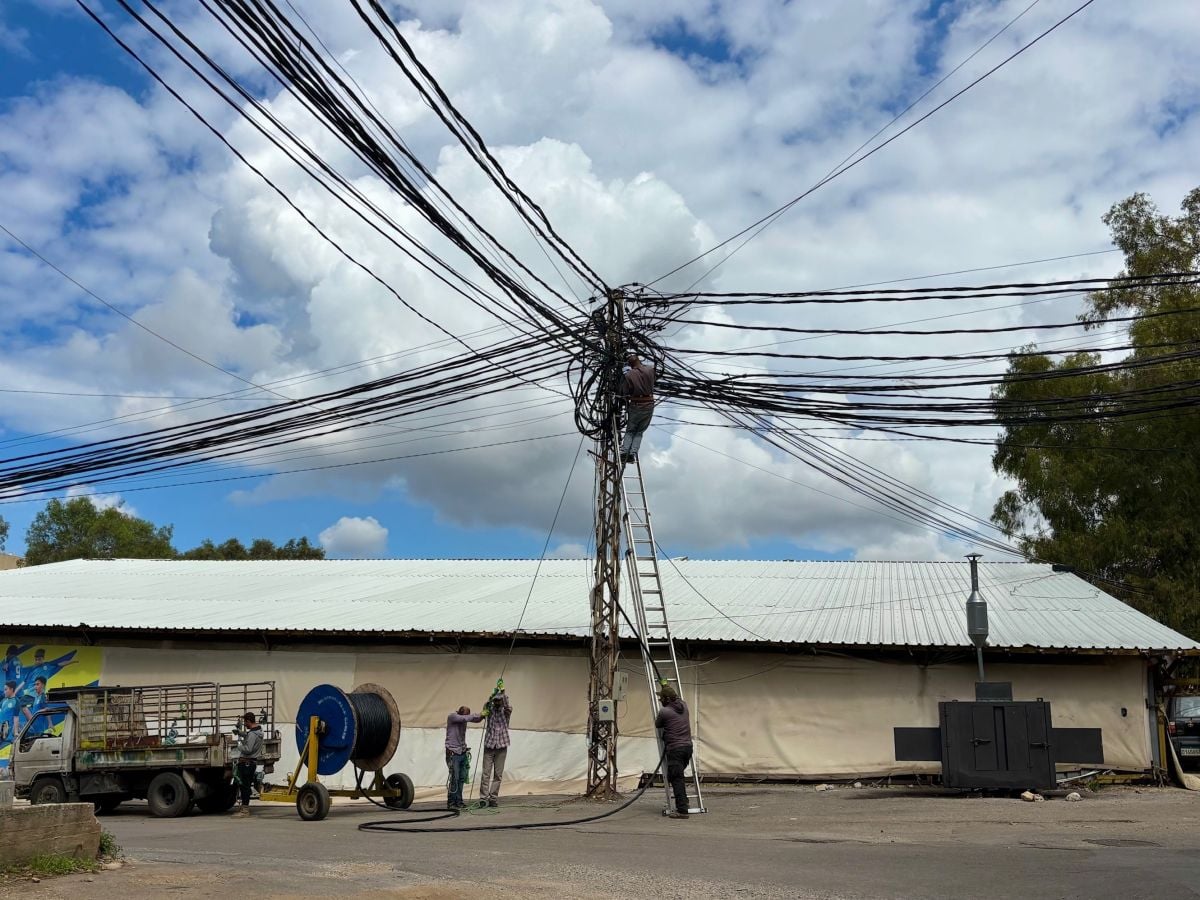
Technicians at work on an electrical pylon overloaded with cables in Mansourieh, on Oct. 6, 2026. (Credit: Philippe Hage Boutros/L’Orient-Le Jour)






Qatar plans to build two power plants in Lebanon over the next three years and sign a 20-year liquefied natural gas supply agreement as part of a project aimed at reviving Lebanon’s long-troubled electricity sector.
Qatari Prime Minister Sheikh Mohammed bin Abdulrahman Al Thani visited Lebanon last week and publicly pledged to help revive the country’s power sector. Few details were shared with journalists at the time.
According to sources familiar with the matter contacted by L’Orient-Le Jour, Energy Minister Joe Saddi has held several discussions with his Qatari counterparts since taking office in February 2025. These sources also confirmed details of the plan prepared by Lebanon and Qatar.
Neither the Lebanese minister nor Qatar’s Foreign Ministry has commented so far.
The plan, reviewed by the Reuters news agency, is dated October 2026 and titled the “National Integrated Energy Investment Program.” It still requires approval from both governments and is subject to change, a person familiar with the matter said.
Gas, solar and wind
Developed with the participation of both the Lebanese and Qatari governments, the plan “covers electricity generation from gas, LNG supply and regasification, renewables, battery storage, and regional electricity interconnections.”
It also aims “to attract private financing and project funding without requiring upfront investment from the Lebanese Treasury; details for payment obligations and guarantees are still to be negotiated.”
Implementation could take three years if approvals are secured quickly.
Specifically, the document proposes building two combined-cycle gas power plants: one at the Deir Ammar site in northern Lebanon and one at Zahrani in the South, each with a capacity of 825 megawatts. These two sites currently house thermal plants supplying most of the few hours of electricity per day that Électricité du Liban can deliver to subscribers, who are forced to rely on expensive private generators at high financial and environmental costs.
The LNG supply deal would be struck between Qatar, through QatarEnergy, and Lebanon. It would be supported by a floating storage and regasification unit with a daily capacity of 3.5 million cubic meters and the Arab Gas Pipeline, which passes through Syria and has a daily capacity of 4.5 million cubic meters.
The project also calls for developing 800 megawatts of solar capacity, 440 megawatts of wind capacity and battery storage, as well as initially importing 300 megawatts of electricity from Syria using two separate routes.
Timeline, pipelines and land
Implementation assumes that existing pipelines needed to deliver Qatari LNG to Lebanon will be refurbished and that the network will also connect to Zahrani, as Deir Ammar is already connected. It also assumes that the project will not be delayed by late deliveries of the turbines needed to build the gas plants amid the artificial intelligence boom and high global demand for power-generation equipment.
The plan’s three-year construction timeline may suggest that the project operator has already reserved turbines from manufacturers. However, this has yet to be confirmed, as the plan still requires approval from both governments. Turbine delivery delays are indeed a challenge for gas plant projects.
For solar and wind, the plan assumes that enough suitable land has been identified to install the proposed capacity.
More broadly, implementation of the plan would, in principle, go hand in hand with carrying out the electricity sector reform prepared by the Regulatory Authority. This reform calls for privatizing EDL and separating its various components — including generation, transmission and distribution — to be handed over to private operators. There is, however, no certainty this will happen.
Qatar has long supported Lebanon financially and politically, often intervening during political and economic crises over the past decades. The project would build on Qatar’s deepening presence in neighboring Syria, where the Qatari conglomerate Power International Holding has secured contracts for 5,000 megawatts of power-generation capacity, as well as oil and gas extraction and pipeline construction.
The energy sector lies at the heart of Lebanon’s financial and economic troubles. It has helped drive up the national debt by tens of billions of dollars since the 1975-90 civil war, while EDL currently provides only a few hours of electricity per day.

 2 p.m. recap: Pit discovered north of Beirut, Hezbollah warns of ‘imminent explosion’ in the streets, settlers arrested in West Bank