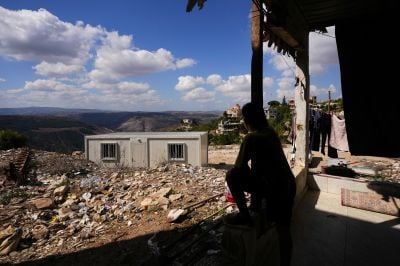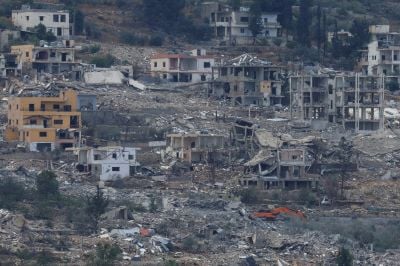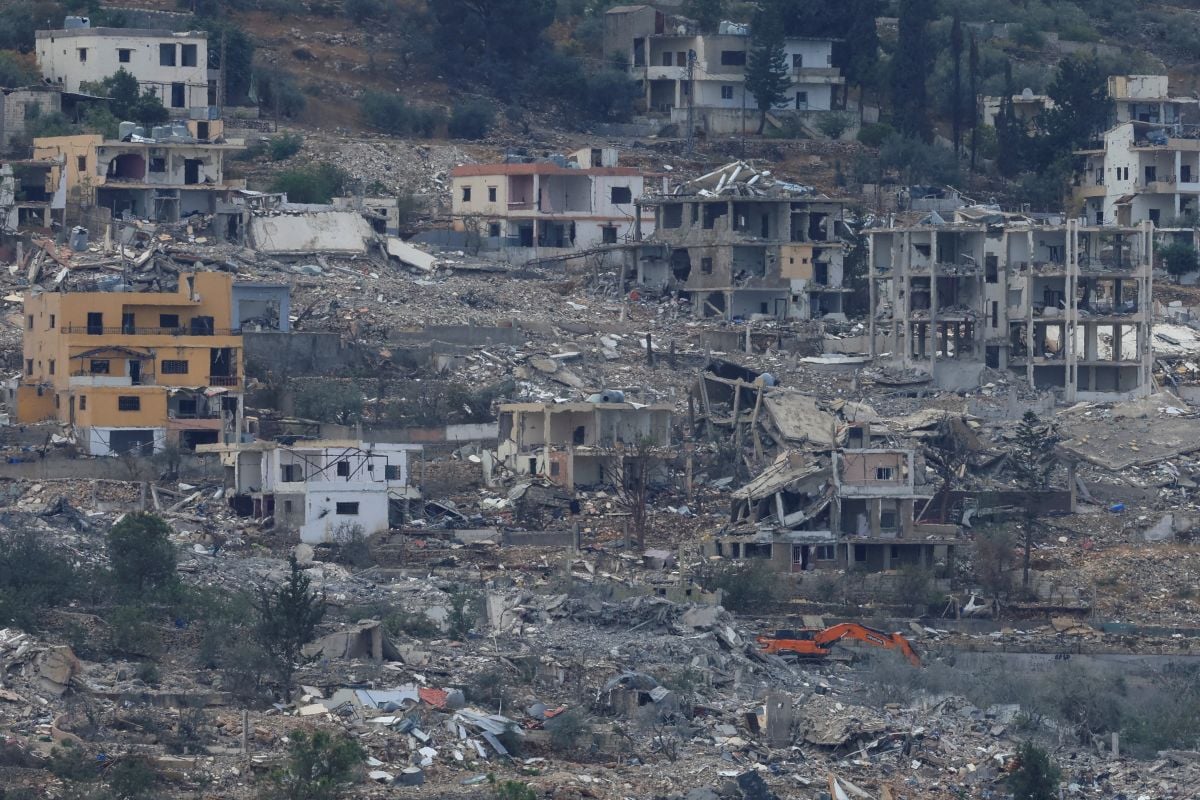
View of damaged and destroyed buildings, as Israeli heavy machinery razes homes in Mansouri, from Hanouiyeh, in southern Lebanon, on Sept. 19, 2026. (Credit: Mohamed Azakir/Reuters)






Today's news
Facing an international community called to support Lebanon in a decisive period, Prime Minister Nawaf Salam delivered a message at the U.N. on Friday focused on the sovereignty of the state. "No one speaks on behalf of Lebanon and no one negotiates on its behalf," he insisted, demanding the Israeli withdrawal from all Lebanese territory, reaffirming the state's monopoly over weapons, and advocating for a solution that would avoid a "vacuum" in southern Lebanon after the withdrawal of UNIFIL. He also defended the reforms undertaken by his government and reiterated that, in his view, regional stability is inseparable from the Palestinian people's right to self-determination.
Why it matters
Nawaf Salam’s speech comes as several issues directly affecting Lebanon’s sovereignty are unfolding simultaneously. The government is continuing to implement the state monopoly over weapons and is seeking to strengthen the capabilities of the Lebanese Army, while Israel maintains positions in the South and tensions and strikes continue despite the cease-fire. Let us recall that UNIFIL's mandate is set to end on Dec. 31, 2026, and no framework for a successor force has yet been established.
The process set out in the Lebanon-Israel framework agreement concluded on June 26, 2026, under U.S. mediation, is making slow progress. The seventh round of negotiations, held in Rome from Aug. 4 to 6, failed to resolve the main points of disagreement, particularly regarding the Israeli withdrawal and guarantees related to implementation of commitments. Since then, negotiations have largely stalled. It is in this context that Nawaf Salam called for "completing the translation of the framework agreement into concrete measures, according to a clear timetable and with a verification mechanism." The UNIFIL question adds an additional constraint: its planned departure at year's end comes as the security arrangements in the South remain in full transition. Beirut is therefore demanding an international presence.
For a review of the main quotes from his speech and the key points Nawaf Salam addressed at the U.N., L’Orient-Le Jour summarizes here the strong statements from the Lebanese prime minister.
What to keep an eye on:
A calm night, then another day of violence in South Lebanon. After a night with no air strikes or demolitions in the occupied zone, the Israeli army surrounded a farm in Kfarchouba Friday morning where several shepherds were present. Artillery and machine-gun fire struck several areas, followed by airstrikes on Bani Hayya and the outskirts of Zawtar Sharqieh, as well as operations and demolitions, notably in Deir Mimas and Deir Siryan.
Elsewhere in the news:
- Air France confirms what we reported a few days ago: the French airline plans to resume its Beirut flights on Saturday, which had been suspended for more than six months after the outbreak of war in the Middle East. The resumption was officially confirmed Friday by AFP. Flights to and from Riyadh, meanwhile, remain suspended until Sept. 28, 2026, inclusive, while those to Dubai are suspended until Oct. 13, inclusive.
- Joseph Aoun criticizes Israel — and Hezbollah. The Lebanese president reminded Israel that "even war has rules" and that Israel "is not an exception" to international humanitarian law. He also praised the sacrifices of the army, including "for those who stand against it and against the state," an implicit reference to Hezbollah.
- Makhzoumi targets Hezbollah and Iran after his meeting with Geagea. The Beirut MP, who met with Lebanese Forces leader Samir Geagea in Meerab, said that Hezbollah "has no right to decide Lebanon’s fate" and called for its disarmament, accusing it of "dragging Lebanon into wars serving Iran’s interests." Addressing the "Iranian regime," he declared: "You have no tutelage over Lebanon."
- Lebanese police warn against gold scams. The head of public relations for the Internal Security Forces (ISF), General Joseph Moussallem, warned of networks that sell copper or fake bars and coins as gold, sometimes in sealed packaging to prevent buyers from checking the contents. Several such networks have already been arrested, he said, and the ISF urges buyers to prefer trusted jewelers and establishments and to demand a receipt.
- Iran proposes to reopen Hormuz within seven days. Tehran has conveyed its conditions to the United States for reopening the strait, Iranian Foreign Minister Abbas Araghchi announced, while Iranian airline flights to the Iraqi holy city of Najaf were suspended Friday due to new U.S. sanctions. On the sidelines of the UN General Assembly, Qatari Prime Minister Mohammed bin Abdulrahman al-Thani also met with Iranian President Massoud Pezeshkian.
- Leo XIV sets the tone for his visit to France: secularism, AI and end of life. Received Friday at the Élysée for his first visit to France, the pope advocated for a secularism that "does not seek to exclude religion from the public sphere" and called for "ethical discernment" in the face of artificial intelligence, warning of the risk of a "paradise of machines." He also denounced bioethical "drifts," notably surrogacy, genetic manipulation, and "the offer of a programmed death," two months after the National Assembly adopted a law on assisted dying.