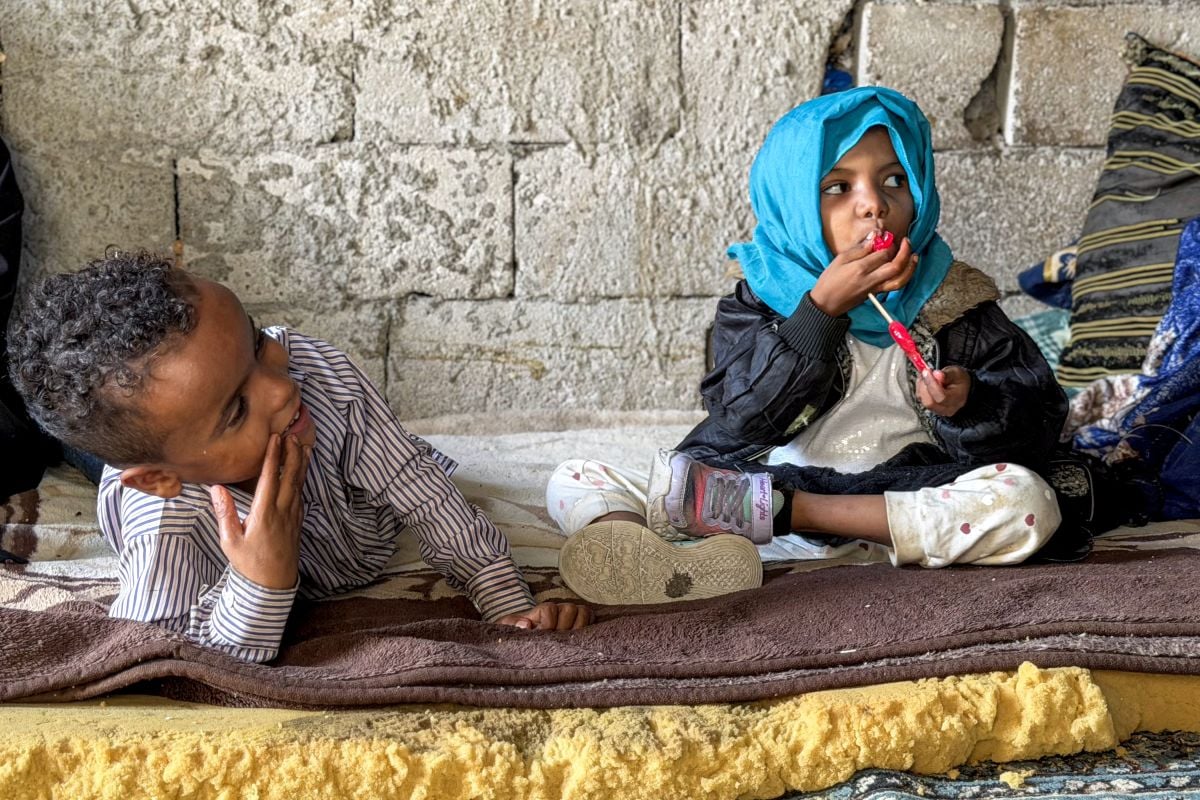
Yemeni children, displaced by the resumption of clashes between Yemeni government forces backed by Saudi Arabia and the Houthis, sit in a shop used as a temporary shelter in Taiz province, southwestern Yemen, on Oct. 8, 2026. (Credit: AFP)







The Houthis attacked Al-Maashiq presidential palace in Aden, the seat of Yemen’s internationally recognized government, with missiles and drones on Thursday. The attacks killed at least four people and wounded more than a dozen, according to government sources cited by AFP.
The Iran-backed movement said it had targeted the Saudi military operations center inside the palace and warned that any Saudi military presence was a legitimate target. They also attacked Marib, a strategic city in central Yemen.
Meanwhile, Riyadh accused Tehran of encouraging an escalation in Houthi attacks, which have targeted Saudi Arabia almost daily. According to the Saudi-led coalition, the kingdom’s capital and its international airport have come under attack 20 times since early October.
The escalation prompted the postponement of a summit between the European Union and Gulf countries, initially scheduled for Oct. 24 in Riyadh.
Why it matters
The escalation extends beyond Yemen’s war and risks intensifying the confrontation between Saudi Arabia and Iran, further destabilizing the Middle East. Tehran faces accusations of providing military support to the Houthis, while the attacks on Aden threaten the stability of Yemen’s internationally recognized government.
The escalation could also disrupt maritime traffic in the Red Sea and the Bab al-Mandeb Strait, threatening global trade and driving up shipping costs.
In other news
Netanyahu reveals 2025 phone call with Syrian president. Israeli Prime Minister Benjamin Netanyahu said Thursday that he spoke by phone with Syrian President Ahmad al-Sharaa in 2025, acknowledging direct contact between the two leaders for the first time. Netanyahu said the call aimed to stop violence against Druze in Syria.
Without specifying the date, he suggested it took place during clashes between the Druze community and Bedouins in southern Syria.
“I called Ahmad al-Sharaa. It was a very short, very frank conversation, and the massacre stopped,” Netanyahu said at a campaign rally with Israel’s Druze community, according to public broadcaster KAN.
The Israeli daily Yedioth Ahronoth reported that Netanyahu initiated the call and warned Sharaa that Israel would intervene if the violence did not stop.

Aoun and Rubio to discuss regional tensions. President Joseph Aoun is scheduled to speak by phone Thursday evening with U.S. Secretary of State Marco Rubio. According to MTV’s Washington correspondent, the discussion is expected to focus on the C4 explosives shipment seized in Dahr al-Baidar, for which Hezbollah has claimed ownership, the risk of regional escalation, and a draft law criminalizing the normalization of relations with Israel.
The call comes after Hezbollah MP Hassan Fadlallah confirmed the group’s involvement. Speaking in Parliament, he warned against “any attack” by the party’s opponents, whom he accused of “pursuing an American agenda.”

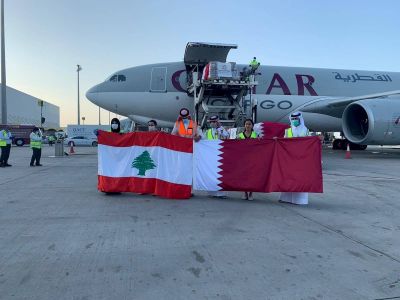
- Electricity crisis sparks Cabinet walkout. Lebanon’s electricity crisis has reignited tensions within the government as Qatari Prime Minister Mohammed bin Abdulrahman al-Thani visits Beirut. On Thursday, three Lebanese Forces (LF) ministers walked out of a Cabinet meeting to protest the lack of a decision on funding Electricite du Liban (EDL).
- Officials are expected to discuss electricity with the Qatari prime minister, whose country supports projects to rehabilitate Lebanon’s gas and oil infrastructure and improve energy supplies.
- Central bank revokes Iranian bank’s license. Banque du Liban has revoked the license of Bank Saderat, one of Iran’s major banks, amid increased U.S. economic pressure on Tehran. Gov. Karim Souhaid said the decision would protect Lebanon’s banking sector from sanctions and support the country’s efforts to exit the Financial Action Task Force’s gray list, which is up for review next week in Paris.
- Beirut discusses resuming direct flights with Canada. President Aoun discussed the possible resumption of direct flights between Canada and Lebanon with Canadian Ambassador Gregory Galligan. The talks came days after U.S. President Donald Trump lifted restrictions that had impeded direct flights between the United States and Lebanon, although the move does not guarantee that the routes will resume.
- Syrian authorities arrest pro-Assad militia leader accused of massacre. Syrian authorities announced the arrest of Ali Kayali, also known as Mihrac Ural, the former head of a militia that supported Bashar al-Assad. Authorities accuse him of being one of the main perpetrators of the Banias and Baida massacres in May 2013. He is also suspected of involvement in the Reyhanli bombings in Turkey that killed more than 50 people that year.
- U.S. weighs using its most powerful non-nuclear bomb against Iran. CNN reported that the U.S. military has drawn up new strike plans that include using the Massive Ordnance Air Blast (MOAB) bomb against Iranian energy infrastructure and nuclear sites. Such an operation would mark a major escalation, although Trump has not ordered airstrikes to resume.
- Iranian President Massoud Pezeshkian, meanwhile, accused Washington of seeking to spark demonstrations by worsening living conditions through its naval blockade, which Washington imposed in response to Tehran’s closure of the Strait of Hormuz.