






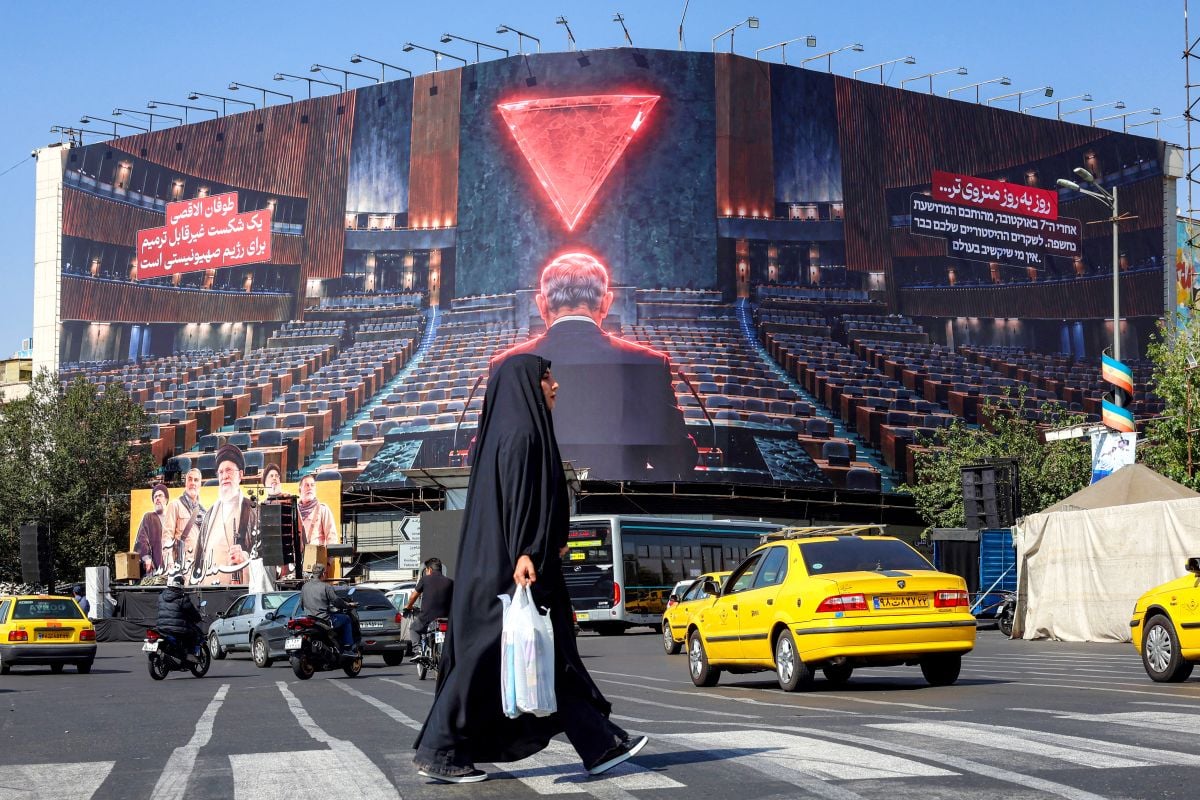
A woman walks through traffic while crossing Enghelab square in central Tehran Oct. 12, 2026, as behind a large anti-Israeli billboard is displayed. (Credit: AFP)






Iranian President Masoud Pezeshkian said Thursday that the country was facing its most intense blockade since the 1979 Islamic Revolution, accusing the United States of seeking to provoke public protests.
Iran and the United States have been at war since Feb. 28, when U.S. and Israeli strikes killed Iran's supreme leader, Ayatollah Ali Khamenei.
"Over the 48 years since the Revolution, we have never faced such intense blockade, war and difficulties as we are facing now," Pezeshkian said in a speech broadcast by state television.
He accused Washington of seeking to make life difficult for Iranians in order to fuel public anger and trigger unrest.
Pezeshkian said the U.S. was focusing its efforts on making "the people become upset and face difficulties, and then for social protests to emerge so that they can achieve their sinister objectives."
The U.S. imposed a blockade on Iranian ports in response to Tehran's closure of the strategic Strait of Hormuz, diverting or stopping vessels travelling to and from Iranian ports.
Iran has repeatedly accused the U.S. and Israel of fomenting unrest inside the country, and in recent months has executed several Iranians accused of collaborating with its foes.
In late December last year, protests over the cost of living erupted in Iran, spreading nationwide and evolving into a wider anti-government movement.
Iran's rulers blamed the U.S. and Israel for the unrest.

 1 p.m. recap: Qatari PM expected in Beirut; missile intercepted in Medina; Hezbollah seeks to recover its explosives seized in Dahr al-Baidar