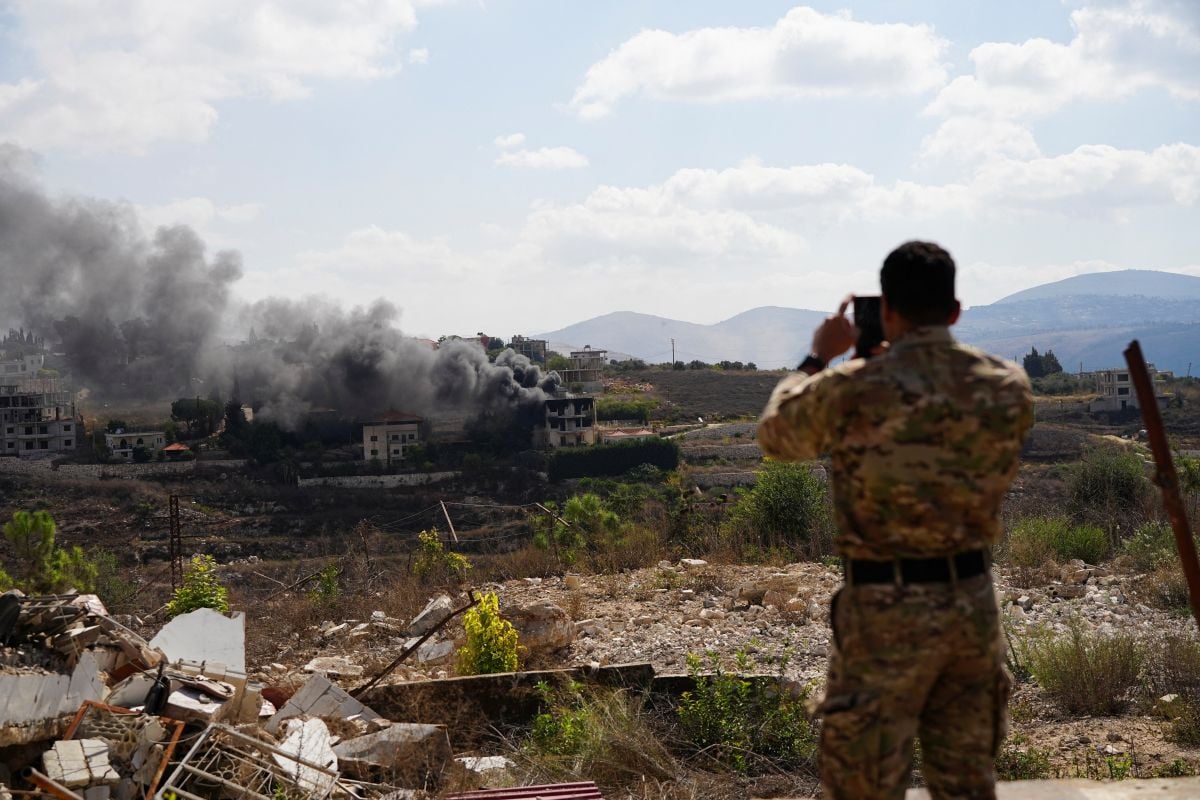
A Lebanese soldier uses his phone to photograph smoke rising from a building in Zawtar Sharqieh while standing in nearby Zawtar Gharbieh, southern Lebanon, Sept. 22, 2026. (Credit: Stringer/Reuters)






Top story
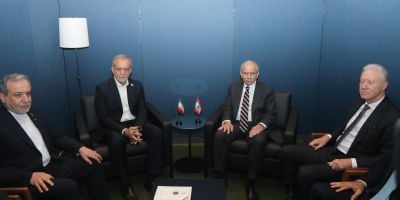
Prime Minister Nawaf Salam is set to deliver Lebanon’s address to the U.N. General Assembly in New York on Friday morning (afternoon in Beirut). He will be followed at the podium by his Iraqi counterpart, as both Beirut and Baghdad face pressure to disarm pro-Iranian militias in their countries.
The speech follows a series of meetings Thursday evening in New York between Salam and several officials, including Egyptian Prime Minister Mostafa Madbouly, Emirati Foreign Minister and Deputy Prime Minister Abdullah bin Zayed Al Nahyan and Pakistani Prime Minister Muhammad Shehbaz Sharif. Salam also met with several heads of U.N. agencies responsible for humanitarian responses to crises in Lebanon, including the World Food Program, the U.N. refugee agency and UNRWA, the U.N. agency for Palestinian refugees.
Why it matters
Under international pressure to extend its authority over its entire territory and disarm militias — including Hezbollah, an ally of the Iranian regime — the Lebanese state is being called on to demonstrate concrete results. Facing an unprecedented financial crisis, it must also contend with an under-equipped and underpaid army reluctant to confront Hezbollah.
The Lebanese state also seeks financial support to address the massive destruction caused by the Israeli offensive and aid those displaced by the war. With UNIFIL’s mandate expiring at the end of the year, Salam is expected to again advocate for maintaining an international force in southern Lebanon and for the withdrawal of the Israeli army, which currently occupies more than 600 square kilometers in the South.
What to watch for
President Joseph Aoun on Friday criticized Israel for wartime attacks on first responders, saying Israel is “not an exception” and must respect international humanitarian law. He also indirectly criticized Hezbollah for refusing to surrender its arsenal to the state.
Aoun first condemned Israeli attacks on Lebanese Red Cross personnel, affirming that “even war has rules” and that international humanitarian law imposes clear obligations on all parties to a conflict. “Israel is not an exception,” he said at the 12th Regional Conference of the Red Cross and Red Crescent in the Middle East and North Africa in Beirut.
He recalled that Israeli strikes had killed two Lebanese Red Cross rescuers on a humanitarian mission. According to an official Health Ministry tally released in June 2026, at least 135 rescuers and medical personnel have been killed in Israeli strikes in Lebanon since the war began March 2, 2026.
Later, in a more veiled criticism of Hezbollah, Aoun praised the army and its “sacrifices, even for those who stand against it and against the state,” referring to the militia.
“Despite the difficult circumstances the country is experiencing, the military institution continues to achieve successes,” he said at the groundbreaking ceremony for a housing project for the association of noncommissioned officers and soldiers near the Baabda Presidential Palace. He stressed that “the trust of the Lebanese people is the most important weapon” and a source of “great pride.”
In other news
- Turkish, Saudi and Pakistani military chiefs to meet in Riyadh after Houthi attacks: Turkey’s military chief, Gen. Selçuk Bayraktaroğlu, will travel to Riyadh, Saudi Arabia, to meet his Saudi and Pakistani counterparts under the Mecca Joint Defense Agreement, the Turkish Defense Ministry announced. Earlier, the Saudi Foreign Ministry said the chiefs of staff would hold an urgent meeting to consider ways to support the kingdom under the defense pact following attacks by the Iran-backed Houthis in Yemen.
- Iran has submitted a proposal to the United States to reopen the Strait of Hormuz within seven days, its foreign minister told several foreign media outlets. The strategic passage is at the heart of the war between the two countries. Foreign Minister Abbas Araghchi, in New York for the U.N. General Assembly, conveyed Iran’s conditions to U.S. envoy Steve Witkoff on Tuesday. Iran has severely disrupted passage through the strait since the start of the Middle East war. “If certain conditions are met, the strait will be open within seven days and talks will be initiated,” Araghchi said.
- Lebanon’s Internal Security Forces arrested three suspects in an early September burglary at a house in Smar Jbeil. According to the homeowner, the stolen safe contained money, gold and jewelry worth $3 million. The three men, Lebanese nationals in their 30s, admitted stealing the safe, opening it and hiding its contents. Authorities recovered $25,500, jewelry, watches and five hunting rifles from their possession.
- Pope Leo XIV arrived in France on Friday for a four-day visit highly anticipated by Catholic faithful, during which he will address topics including artificial intelligence, migration and combating sexual violence. The 71-year-old pope, whose grandmother emigrated from France to the United States, landed shortly before 10 a.m. (8 a.m. GMT) at Orly Airport, where French President Emmanuel Macron greeted him.