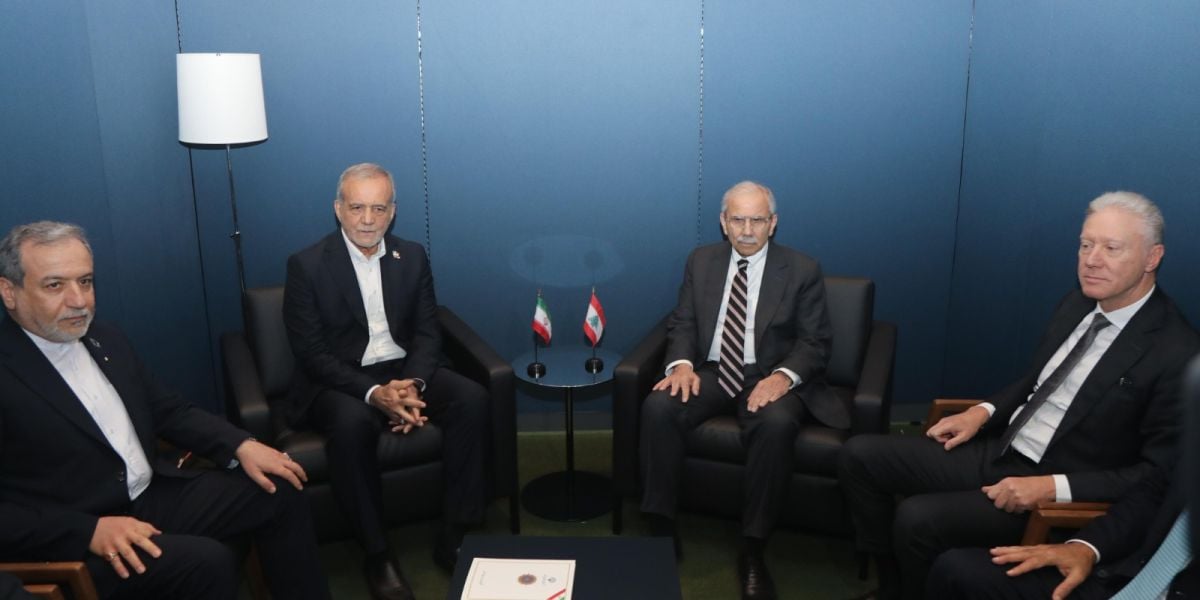
To the right, Lebanese Prime Minister Nawaf Salam and Foreign Minister Joe Rajji; to the left, Iranian President Masoud Pezeshkian and Foreign Minister Abbas Araghchi, at U.N. headquarters in New York on Sept. 24, 2026. (Credit: Grand Serail’s X account)






Top story
Lebanese Prime Minister Nawaf Salam and Foreign Minister Joe Rajji met Thursday in New York with Iranian President Masoud Pezeshkian and Iran’s top diplomat, Abbas Araghchi, on the sidelines of the U.N. General Assembly. “Lebanon has paid a high price in terms of security, stability, and economy, and it does not wish to serve as a battleground for regional conflicts or an arena for exchange of messages,” Salam said.
Why it matters
Reported for several days by multiple media outlets, the meeting finally took place after being requested by the Iranian delegation and accepted by the Lebanese side. It was the first official meeting between Lebanese and Iranian officials since war resumed on March 2, when Hezbollah announced renewed attacks on Israel “in retaliation” for the death of former Iranian Supreme Leader Ali Khamenei, killed on Feb. 28 during the Israeli-American offensive against Iran.
This meeting between Beirut and Tehran comes as the Lebanese state seeks to reassert its security authority over Hezbollah, whose disarmament across the entire territory remains the subject of long-running negotiations. While Israel still occupies more than 600 square kilometers in southern Lebanon, Hezbollah refuses to discuss dismantling its arsenal north of the Litani River, much of which is supplied and funded by its Iranian sponsor.
The encounter concludes a week of diplomatic talks led by the Lebanese prime minister, focusing especially on international support for the Lebanese Army and the establishment of a new international force to replace the UNIFIL peacekeepers in the South, whose mandate expires at the end of 2026.
It also holds broader diplomatic significance. Pezeshkian is in New York as Iran attempts to keep certain negotiation channels open with Washington, despite seven months of war with the United States and Israel. The Iranian president will not meet U.S. President Donald Trump, but his delegation has been mandated to explore possible diplomatic openings.
Salam and Rajji also met the previous day with Syrian President Ahmad al-Sharaa, as an unprecedented interministerial meeting opened Tuesday in Lebanon between ministers and business leaders from both countries, aiming to revive economic cooperation.
What to watch for
This evening at the U.N., Israeli Prime Minister Benjamin Netanyahu is scheduled to address the General Assembly at around 2 p.m. local time, or 9 p.m. in Beirut. Heads of state have been taking the podium at the United Nations since Wednesday, and his speech comes a few hours after that of Palestinian Authority President Mahmoud Abbas.
Denied a visa to the United States for the second consecutive year, Abbas spoke Thursday in a prerecorded video. He accused Israel of waging a "genocidal war" against Palestinians in Gaza and protecting "settler terrorism" in the occupied West Bank. “The danger is no longer limited to undermining the two-state solution and preventing the creation of a Palestinian state. It has now reached the point of threatening the very life and existence of the Palestinian people on their native land,” he said.
Netanyahu's speech also comes amid diplomatic tensions. Though he is scheduled to meet with several international leaders during his stay in New York, the Israeli prime minister will not meet with Trump, unlike on his previous trips to the U.N. General Assembly.
In other news
- The Israeli army is reducing its troop numbers in southern Lebanon. Israeli Army Radio (GLZ) reported Thursday that the general staff had decided to "significantly" reduce the number of brigades deployed in the Israeli-occupied zone, which covers more than 600 square kilometers. According to a military source cited by GLZ, this decision is partly linked to the "financial crisis" affecting the army, as well as to “current operational conditions,” notably after the capture of Ali Taher Hill south of Nabatieh, a strategic point for Hezbollah.
- The Israeli documentary “NAZA” will be available online for free. Directed by two Israeli journalists, the film features Israeli soldiers discussing the mass killings of Palestinian civilians in Gaza over the past three years. One of the directors announced Thursday that it would go online for free in November, ahead of the Israeli legislative elections. Meanwhile, Gaza's Health Ministry reported four new deaths from Israeli strikes in the past 24 hours, bringing to 1,408 the number of Palestinians killed by Israel since the "cease-fire" was announced in the enclave on Oct. 11, 2025.
- Saudi Arabia said it had intercepted a missile attack launched from Yemen. Saudi air defenses shot down six missiles targeting the Taif and Yanbu regions on the Red Sea, Riyadh said. The U.N. high commissioner for human rights, Volker Türk, said he was “dismayed” by the number of civilians killed since the fighting intensified in recent weeks.
- Lebanese Interior Minister Ahmad Hajjar, during a meeting with the director general of the Internal Security Forces (ISF), called for measures to “strengthen security measures, especially in Beirut and along the road to the airport,” following a deadly incident in which a man threw a stone at a car from a bridge. The ISF announced Wednesday that it had arrested a suspect.