






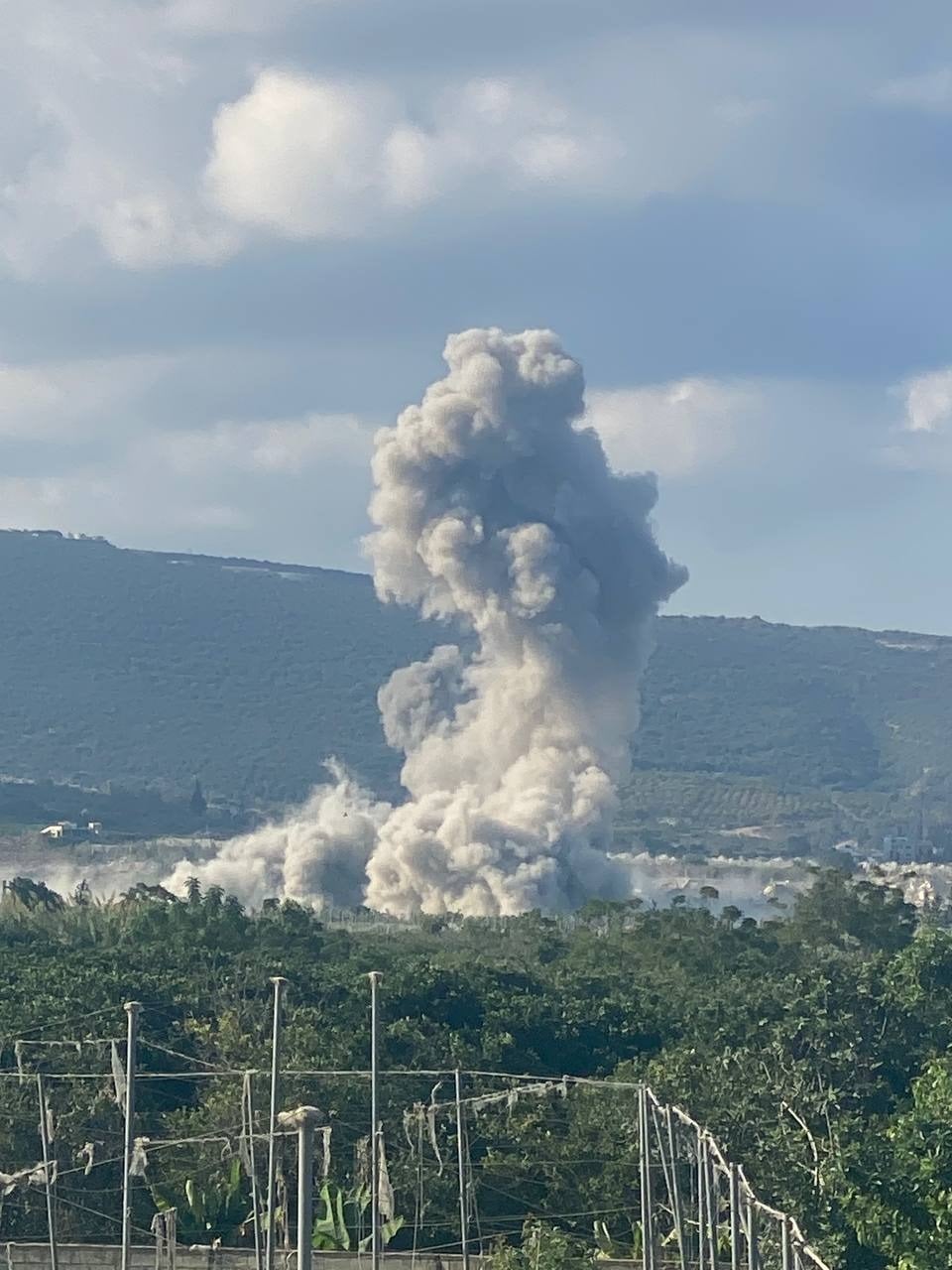
An Israeli airstrike targeting Mansouri (Sour) on Sept. 24, 2026. (Credit: Muntasser Abdallah/L'Orient Today)






BEIRUT — While the Israeli army continued its bombardment of villages and demolition of homes in southern Lebanon on Thursday, Israeli Army Radio (GLZ) announced a "significant" reduction in the number of brigades deployed in the occupied "buffer zone" in southern Lebanon.
A military source speaking to the radio station attributed this reduction in troop numbers — amid a financial crisis within the Israeli military — to "current operational conditions," particularly following the capture of Ali Taher Hill, a strategic position for Hezbollah.
This news follows press reports from early September stating that the Israeli army planned to scale back its occupation zone in southern Lebanon soon — an area currently spanning more than 600 square kilometers where it has been systematically demolishing entire villages.
"In recent days, the army has significantly reduced the number of combat forces deployed in the 'security zone' in southern Lebanon," the radio station reported, noting that four brigades have left the sector while two "regular" brigades have been deployed there, bringing the total number down from eight to six.
"Many reservists have been demobilized," the GLZ military correspondent wrote on X. Among the brigades that have left Lebanon is the "commando unit that was operating in the Ali Taher ridge sector to destroy underground tunnels," he added.
The other departing brigades include "the Golani Brigade, which was fighting in the Beaufort Castle area" — where the citadel serves as a base for occupying forces — as well as "two reserve brigades: the 55th Reserve Paratrooper Brigade and the 4th Reserve Armored Brigade."
In their place, two regular brigades have been deployed: the 188th Armored Brigade and the Bislah Training Brigade, which now occupy vast sectors inside Lebanon.
Citing a "military source," the radio station noted that "this force reduction aims to ease the burden on personnel — particularly reservists — following several months of fighting in Lebanon."
It added that the move is "also made possible by current operational conditions: the ceasefire, the completion of the mission on the Ali Taher ridge, and progress made in destroying Hezbollah infrastructure in numerous other villages across southern Lebanon."
In early September, following the announcement that "operational control" of Ali Taher Hill had been secured, Israeli security officials cited by the public broadcaster Kan 11 said the Israeli army was preparing to scale back its troop presence in southern Lebanon and reduce the size of its occupied "buffer zone."
According to these officials, "discussions" were "underway" regarding the creation of a new zone — "closer to the border" — that would be demarcated by a "gray line" extending roughly 3 to 4 kilometers inward from the Blue Line.
The current "Yellow Line" stretches across the south at a distance of 8 to 10 kilometers from the border.
Kan 11 assessed at the time that this reduction in the size of the "buffer zone" would ultimately lead to a decrease in the number of troops deployed in Lebanon.
Israel shells Wadi Slouqi, targets solar panels in the Nabatieh district
On the ground, the Israeli army carried out several controlled detonations Thursday morning in Beit Yahoun, in the Bint Jbeil district. Military vehicles were also observed advancing — under heavy covering fire — into the Braasheet nature reserve before withdrawing.
In the same area, a fire broke out on the outskirts of Aita al-Jabal. Earlier, a powerful explosion had also been triggered near Bint Jbeil.
During the morning, Israeli aircraft repeatedly bombarded the Wadi Slouqi valley — which serves as a natural boundary between the Marjayoun and Bint Jbeil districts — as well as Bani Hayan, located on the northern slope of the ridge. Beni Hayan was targeted at least twice.
In the coastal district of Sour, an Israeli tank repeatedly shelled Mansouri throughout the day. The village has been under continuous bombardment by Israeli forces in recent weeks.
Overnight, the Israeli army triggered several explosions in Khiam, in the Marjayoun district.
In the Nabatieh district, north of the Litani River, Israeli artillery targeted a solar panel installation in the fields of Mayfadoun, setting it ablaze.
Later Thursday, Israeli artillery fire targeted Doha Kfar Roummane (Nabatieh), while machine-gun fire was reported from Bayyada toward Byout al-Sayyad (Sour). Israeli warplanes also carried out airstrikes on Qantara (Marjayoun) and Kfar Tibnit (Nabatieh). Artillery fire targeted the outskirts of Braasheet (Bint Jbeil) with several shells and Wadi Zibqine (Sour).
Machine-gun fire was again reported along the road between Mansouri and Byout al-Sayyad (Sour). An Israeli drone strike targeted the vicinity of Kfar Shuba (Hasbaya), toward Seddana, hitting a pickup truck. No injuries were reported. Artillery fire also targeted Haddatha (Bint Jbeil) and Mansouri (Sour). The Israeli army later carried out two explosions in Mansouri (Sour).
Despite these ongoing attacks on the south, the General Security Directorate reopened its center in Shebaa, in the Hasbaya district — located on the edge of the occupied "buffer zone" — on Thursday, according to our correspondent.
A similar measure had been taken the previous day in the city of Nabatieh, where authorities have pledged to strengthen their presence.
'The orders necessary to defend the country'
Despite ongoing attacks in the South, the General Directorate of General Security reopened its center in Shebaa — located in the Hasbaya district on the edge of the occupied "buffer zone" — on Thursday, according to our correspondent.
A similar measure had been taken the previous day in the city of Nabatieh, where authorities pledged to strengthen their presence.
Meanwhile, Hezbollah — speaking through its parliamentary bloc — once again accused the Lebanese government of failing to respond adequately to Israeli attacks on Lebanon, charging it with "shirking its most basic diplomatic duties."
The party also criticized the executive branch for "refusing to give the army the orders necessary to defend the country and its population."
These criticisms come as the Israeli army continues its operations in southern Lebanon, where it still occupies several localities despite the framework agreement reached in late June. That agreement calls for a phased withdrawal of Israeli forces alongside the deployment of the Lebanese Army and the disarmament of Hezbollah.
In New York, Israel's U.N. ambassador, Danny Danon, said his country wishes to establish "direct ties with the Lebanese Army to ensure stability" in the area.
He also argued that extending the UNIFIL mission beyond its mandate's expiration — scheduled for the end of December — would allow Hezbollah to "remain entrenched" in the South.
The debate over the future of the U.N. mission is currently at the heart of international discussions, as Beirut calls for maintaining an international presence in the South and several countries work on a mechanism intended to take over from UNIFIL.
Reporting contributed by our correspondent in the South, Muntasser Abdallah

 8 p.m. recap: Israel again threatens Beirut’s south suburbs; 2 ships hit near Hormuz; Riyadh football matches canceled