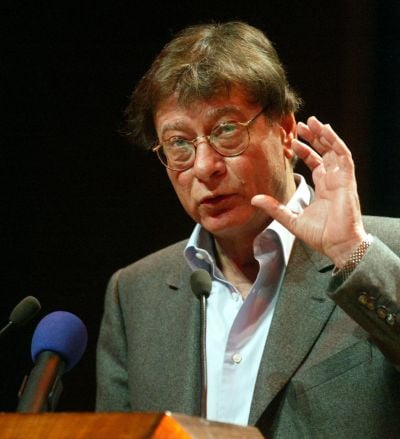
Mahmoud Darwich at the UNESCO Palace in Beirut, Dec. 16, 2003. (Credit: Ramzi Haidar/AFP)






On Friday, Sept. 25, the Sursock Museum will dedicate space to Mahmoud Darwish and the Palestinian poets who write after him. This evening in Beirut is part of Poetry Day, a tribute that brings together about thirty venues around the world. The event will open at 7 p.m. with “Mahmoud Darwish: And the Land, Like the Language.” Directed by Simone Bitton and written with Elias Sanbar, this documentary traces the poet’s journey, from his childhood in exile to those recitals where audiences would repeat his verses in unison. It also seeks to capture this fervor: how poetry born from the Palestinian experience turned into words beloved and recited by so many readers and listeners.
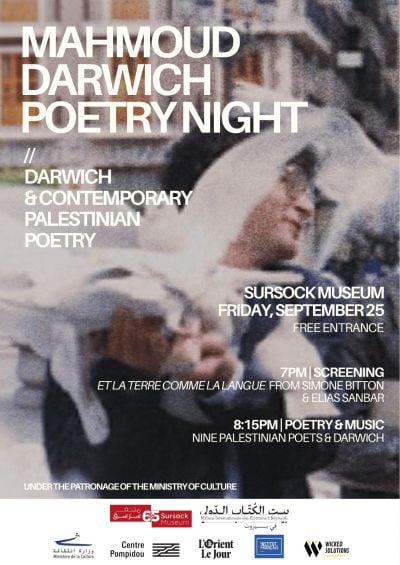
At 8:15 p.m., the film will give way to readings. Dana Mikhael, Tarek Yacoub, Antoine Gaspard, and Raed Tayyan will read texts by Darwish, as well as by Rifaat al-Areer, Najwan Darwish, Samar Abdel Jaber, Hind Jouda, Mosab Abo Toha, Neema Hassan, and Karim Qattan. Jack Estephan will accompany them on electric baritone violin. The evening is organized under the artistic direction of Charif Majdalani and Rima Abdul Malak, general director of L’Orient-Le Jour, who will also take part in the readings. By gathering young voices around Darwish, Majdalani hopes "to share the richness of this literature today."
The event is organized by the International House of Writers ("Beyt El Kottab"), under the artistic direction of Charif Majdalani and Rima Abdul Malak, in partnership with the Centre Pompidou, with the support of L’Orient-Le Jour, the French Institute of Lebanon, and the Sursock Museum, under the patronage of the Culture Ministry.
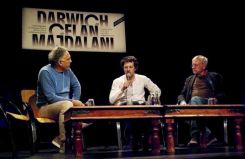
In Guéret, Darwish and Celan
A few days before the evening at the Sursock Museum, Charif Majdalani had already invited people to read Darwish in another setting. The Lebanese writer was in charge of organizing the 21st edition of the Rencontres de Chaminadour, dedicated this year to the Palestinian poet and Paul Celan. From Sept. 17 to 19, in Guéret, in the Creuse region, writers, scholars, filmmakers, photographers, and musicians gathered around their works. Conferences mingled with readings, visuals, and more personal reflections.
Majdalani recounts how he initially hesitated to accept this task. He then joyfully committed to it, happy, in a period of withdrawal and violence, to bring multiple voices together around a Jewish poet and a Palestinian poet. Part of the preparations took place while Beirut was being bombed, including its southern suburbs, just a few streets from his home. For two months, his friends from Chaminadour checked in on him almost every day. He would also reply with updates on the program. He had considered titling these emails "Latest news from the front" — the literary front.
The purpose of these gatherings, Majdalani insists, was not to debate events in Israel and Palestine. Rather, it was to see how two poets, starting from their respective histories — the Shoah for Celan, the Nakba for Darwish — write about loss, exile, and wandering. The discussions focused on identity, on how it can open up to a broader human experience, and on each poet’s relationship to language. For Celan, this issue is especially painful: he continued to write in German, the language of those who persecuted his family. Majdalani wanted to show how literature can still help us think when history seems to make all speech difficult.
The Lebanese writer opened the sessions with a question: in what language do poets speak? Karim Qattan pondered how a young Palestinian generation still reads Darwish; Elias Sanbar took part in a roundtable on translation. The texts of both poets were read by François Marthouret.
With Yasmine Khlat, the path to Celan passed through a memory of Lebanon. In "Rosa… in the Shadow of Your Sister, Edith Stein" (Éditions du Carmel), the novelist returns to Faraya where, at twelve, she walked alone at sunset, above a “sea of billowing clouds.” “I often think of that place where perhaps writing was born in me,” she confides. More than half a century after that walk, while she writes in Paris, it is the “song of Paul Celan” that rises for her in the mountain wind. Her lecture, devoted to Rosa Stein, who died at Auschwitz, thus brought together a personal memory, a Lebanese landscape, and the work of the Jewish poet.
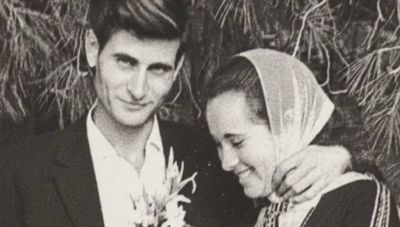
Researcher Stéphanie Hage offered a view of Darwish beyond the sole figure of a poet of resistance. Because he is Palestinian, she notes, his love poems or his attention to everyday beauty are often read as allegories of a lost homeland. Such readings can risk erasing what they also say about desire and the simple pleasure of being alive. Darwish claimed the right “to read the rose as a rose,” the researcher recalls. But this freedom does not negate the political weight of celebration: in "State of Siege" (Actes Sud), opposing poetry and the beauty of nature to military violence is still a form of resistance. For him, celebrating life can be both a free act and a way to endure under siege.
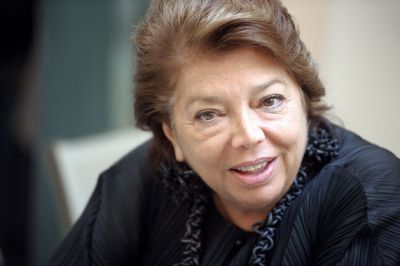
According to Majdalani, the Guéret theater remained full throughout the three days. The audience came from Creuse, but also from Bordeaux, Bergerac, Clermont-Ferrand, Saint-Nazaire, and Paris. Between sessions, conversations continued with the writers and researchers, near the book tables. A genuinely concrete way to keep alive, off-stage, the questions that Celan and Darwish had raised.
In Paris, a work and its legacies
Poetry Day will open on Sept. 25 at the Arab World Institute (IMA), associated for the occasion with the Centre Pompidou as part of the Mediterranean Season. A first roundtable will revisit Darwish’s journey and the spread of his poems beyond Palestine and the Arabic language. It will bring together publisher Farouk Mardam-Bey, anthropologist Hamza Esmili, and researcher Ève de Dampierre-Noiray. The evening will continue with Nour Elassy, a young poet from Gaza, presenting her first collection, "This Is My Home" (Les Liens qui libèrent), during a poetic and musical encounter.
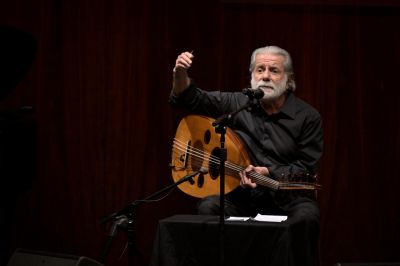
On Saturday, the question will be that of legacy: how do we read Darwish today, and what do those who write or compose after him make of his work? Poet and translator Batool Abu Akleen, singer Walid Ben Selim, and researcher Émilie Picherot will share their perspectives in a roundtable discussion. At 8 p.m., Walid Ben Selim will present "Murale," a musical reading of the long poem published in 2000 in Arabic by Dar al-Rayess (translated by Elias Sanbar in 2003 at Actes Sud). Accompanied by Agathe Di Piro on piano and Lina Belaid on cello, he will seek out its breath and rhythm in its original language, between recital and oratorio.
Sunday will be dedicated to film with two documentaries: "Write Down, I’m an Arab" by Ibtisam Mara’ana and Maya Weinberg, then "Mahmoud Darwish: And the Land, Like the Language" by Simone Bitton. At 5 p.m., Marcel Khalifeh will premiere his new album, fifty years after "Promises of the Storm." It includes four songs composed to Darwish’s poems: "Rita, Oummi, Passport," and "Promises of the Storm." The listening session will be preceded by a conversation with the musician about his bond with the poet.

Elsewhere, each venue invents its own way to make Darwish heard. At the Mucem in Marseille, Haidar al-Ghazali, and Asmaa Azaizeh will read in Arabic, with French subtitles; Rachid Koraichi will present a conference-performance. In Lille, ten artists will blend theater, dance, music, and video in "Métaphore Palestine." In Montreal, bilingual readings and music will gather around his texts. In Tangier, an exhibition dedicated to Ernest Pignon-Ernest will accompany a screening, readings, and a discussion about Darwish’s place today.
In Guéret, two bodies of work met around questions left unresolved by history. In Beirut, Darwish will give the stage to poets who write after him. In Paris and elsewhere, his poems will be passed from one voice, one language, one art to another.
Mahmoud Darwish Poetry Day, running from Sept. 25 to 27, 2026, though some partner events will be held on other dates. In Paris, the meetings, screenings, and listening sessions are free with reservation; the “Murale” performance is ticketed.