

The awards ceremony for the 2nd Arab World Fashion Prize took place on Thursday, Oct. 8 at the IMA. (Credit: Courtesy of the IMA)






Embroidery becomes jewelry, architectural training finds expression in clothing, and Palestinian experience inspires textile exploration: The other talents recognized by the Arab World Institute (IMA) each bring a distinct approach to fashion.
Announced Oct. 8 in Paris, the winners of the prize’s second edition include, alongside Salim Azzam and Hazem Kais, three creatives based in Egypt, Tunisia and Palestine. A special honorable mention also recognizes the work of Bethlehem-based Hind Hilal.

In the press release announcing the awards, the IMA highlighted their backgrounds and the approaches that caught the jury’s attention.
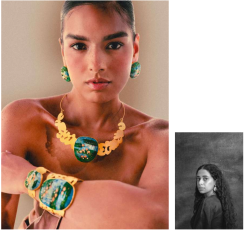
Fatma Mostafa, thread and metal
Egyptian designer Fatma Mostafa, winner in the "Accessory Talent" category, brings together two crafts rarely found in the same atelier: embroidery and goldsmithing. Her pieces combine textile structures and metal elements in compositions that draw on both jewelry and sculpture.
Thread is essential to their construction, giving metal a different texture and a new way to take shape. Mostafa draws inspiration from architecture, ornamentation and stories passed down in Egypt and the Arab world, reinterpreting these influences through experimentation without replicating traditional forms.
Ibrahim Shebani, a wardrobe built to last
Ibrahim Shebani won the "Creative Entrepreneurship Talent" prize for Born in Exile. With Libyan and Tunisian roots, the brand develops and produces its collections in Tunisia, using materials sourced from countries including Italy and Spain.

His ambition — to design pieces people want to keep — is evident in his attention to tailoring, silhouettes and craftsmanship. History, architecture and cultural identity inform his collections, right down to the accessories and jewelry. For Shebani, clothing should stay with its wearer beyond a single season, valued both for its quality and for what it evokes.
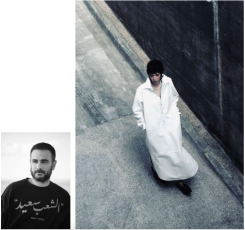
Ayham Hassan: From Palestine to museums
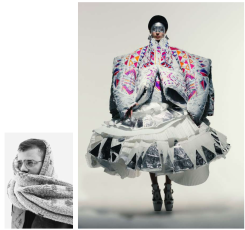
Recognized as an "Emerging Talent," Ayham Hassan already has a strong international profile. His Central Saint Martins graduate collection, "IM-Mortal Magenta," drew attention from publications including Vogue, i-D and Dazed. It is also featured in "The Only True Protest Is Beauty," an exhibition organized by the Fondazione Dries Van Noten as part of the 61st Venice Biennale. His work has entered the collections of the Victoria and Albert Museum and MoMu in Antwerp.
Behind this recognition is an approach deeply shaped by his experience of living in Palestine. Working with local artisans, Hassan draws on ancestral techniques, develops new textiles and creates contemporary silhouettes. Fashion offers him a way to convey that experience, with all its personal and cultural weight.
Hind Hilal: The architect’s eye
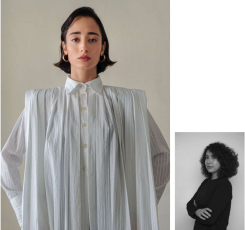
In Bethlehem, Hind Hilal brings an architect’s eye for proportion and structure to clothing. Her brand, Hindhilal, received a special honorable mention, a distinction the jury added this year in recognition of the quality of her creations.
In her studio, design begins with the material. Natural fabrics, their drape and their qualities guide the creation of limited-edition pieces. Production is entrusted to local partners with whom Hilal maintains close ties, allowing her to closely oversee how her designs take shape.
The press release also announced that the Sawiris Foundation will support the prize’s 2027 edition. This marks the first collaboration stemming from a letter of intent signed with the IMA on June 16, 2026, to support designers’ growth and international visibility.
This article was translated from L'Orient-Le Jour.