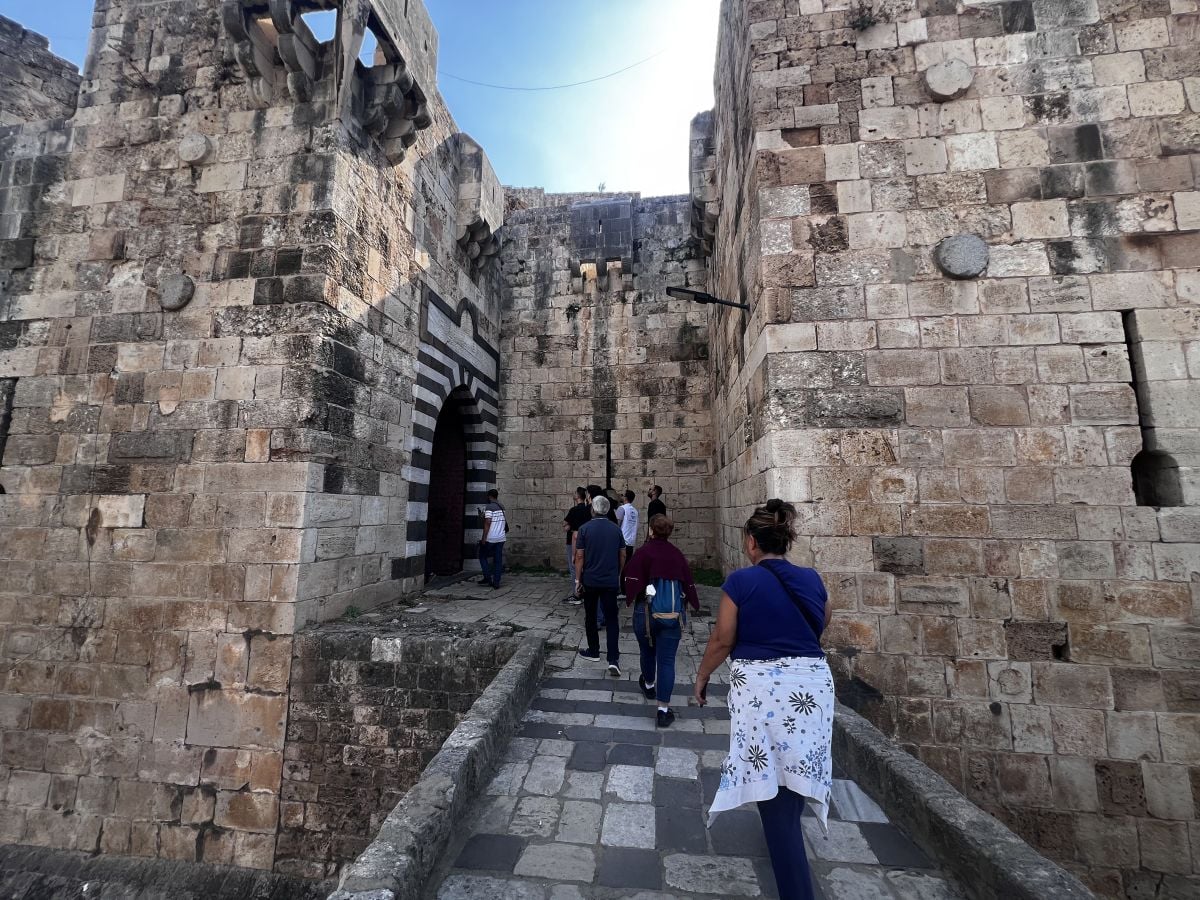
In the citadel of Tripoli, visitors follow Charles Hayek through the centuries of history engraved in stone. (Credit: Saad Tawil)






In Tripoli, history can be felt in its stones, but also in the gestures of merchants, the alleys of its markets and the places where residents gather. This sense of continuity was at the heart of a cultural tour led by historian Charles Hayek on Sunday afternoon, taking participants from the citadel through the city’s old quarters
At the National Bloc headquarters, behind the Chamber of Commerce and Industry, participants arrived gradually, bottles of water and cameras in hand. Drinks had been laid out on a table. Camille Mourani, who organized the walk and is a member of the party’s executive committee, welcomed the group with a few words about Tripoli and the desire to bring people together around the city’s history.
People of all ages and backgrounds mingled, with participants from the city and other regions of the country. Once everyone had boarded the buses, the group set off for the Citadel of Raymond de Saint-Gilles, better known as the Citadel of Tripoli.
From the ramparts, the layers of the city
Inside the entrance, the noise of the city quickly fades away. The ramparts carry the traces of centuries of construction, destruction, and rebuilding. Arches open onto narrow passageways, staircases climb from one level to the next, and the structure itself reflects the many eras that have shaped it.
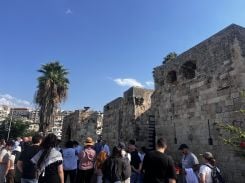
Hayek, a historian who works to make history accessible to the public, is a researcher at the American University of Beirut (AUB) and heads the archives at Saint Joseph College (USJ) in Antoura. He gathers the visitors at one of the citadel’s highest points. Below, Tripoli stretches far beyond the boundaries of the old city. The view runs over densely packed buildings toward the Mediterranean at Mina, then farther still to the mountains of Bsharri.
From here, Hayek begins to trace the city’s history. For centuries, Tripoli was located where Mina stands today. In 1289, the Mamluks conquered and destroyed the Crusader city. By the end of the 13th century and the beginning of the 14th, a new city had gradually taken shape around the citadel.
"It’s about understanding Tripoli as a living and complex whole, where the monuments are connected to each other," Hayek told us. "We walk the same streets as those of the Mamluk city founded in the early 14th century. It’s extraordinary to be able to trace, without interruption since that time, the history of the buildings, streets, and the social, economic, and cultural dynamics."
The citadel itself is evidence of this succession. The structure we visit today continued to evolve after the Crusader period, expanded, and reworked under the Mamluks, then under the Ottomans, up to the 19th century.
After a few photographs and one final look at the city, the group makes its way down toward the souks.
The souk, a living history
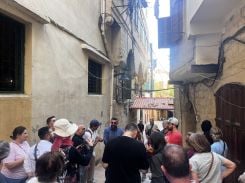
In Souk al-Khodra (the vegetable souk), history unfolds alongside the ordinary business of the day. Stalls spill into the narrow passageways, piled with vegetables, bread, and brightly colored goods. The smell of food mingles with vendors’ calls. Customers stop, bargain and move on, weaving through the crowds.
The group attracts a few curious looks. Merchants call out from their shops, inviting visitors to stop and buy something. Before long, the tour has become part of the souk’s everyday bustle — a reminder that Tripoli’s heritage is not confined to its monuments but is kept alive by the people who live and work there.
For Hayek, that continuity is essential. "Heritage must have a function," he explains. "Heritage is not archaeology. It may be old, but it remains in use." The souks are a case in point. "No matter what happens, the souk will remain a souk," he says.
From places of worship to public baths
A few steps from the market, al-Mansouri Mosque offers a change of pace. Before entering the courtyard, women are handed scarves to cover their heads. Inside, ancient stone, arches, and ribbed vaults surround an open space that feels remarkably calm. At its center, a fountain rises beneath a domed canopy.
The prayer hall is covered in Persian carpets, with Islamic architectural details visible beneath a large copper chandelier. After the noise and movement of the souk, the group gathers quietly around Hayek as he recounts the history of the mosque and the stories associated with it.
The tour then continues to the Hammam al-Nouri, one of the city’s historic baths, which was recently renovated. Its architecture offers a glimpse into the role public baths once played in urban life: places where people carried out daily routines, met one another and socialized.
Toward the Taynal Mosque
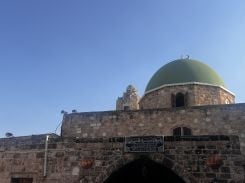
The road to the Taynal Mosque takes the group through a quieter neighborhood and past a cemetery. Among the trees and tombstones, the pace of the walk slows. The mosque comes into view amid greenery and old stone, almost like a garden hidden within the city.

By the time the group reaches the mosque, the route has taken it from the citadel’s ramparts through the markets, places of worship, and burial grounds, with each stop revealing another side of Tripoli. Hayek planned the itinerary to bring these different aspects of the city together while fitting everything into the limited time available.
"We prioritized knowledge over Facebook or Instagram," he says with a laugh. "You can’t tour the whole city in half a day. There’s a lot to see and a lot to explain."
Reconnecting with Tripoli
For Mourani, the walk is part of a broader effort to reconnect visitors with the city. "This isn’t a tourist excursion, it’s a cultural visit," he told us in an earlier interview.
The aim is to understand "society, the market, how it functions, life in these cities, commercial exchanges, how the layouts were designed, religious transformations, everything that has shaped them."
The events are also meant to strengthen ties between Tripoli and the rest of the country. "As part of our movement, we always bring Tripolitans, and we bring to Tripoli people from all over the country," he says.
For Hayek, experiencing a place is an essential part of understanding its history. "To learn without experiencing what history and heritage truly are keeps them abstract," he says. "To better understand the value of a place, you have to experience it and develop a personal connection with it and its history."
At Saint Maron Church, the final stop of the day, the participants share a knefeh and continue talking. Another visit is already in the works, this time focusing on Tripoli’s modernist history and the city that took shape during the 1950s and 1960s.
"I would also like discovering Tripoli to be just that simple," confides Hayek: "letting people satisfy their curiosity in half a day."