


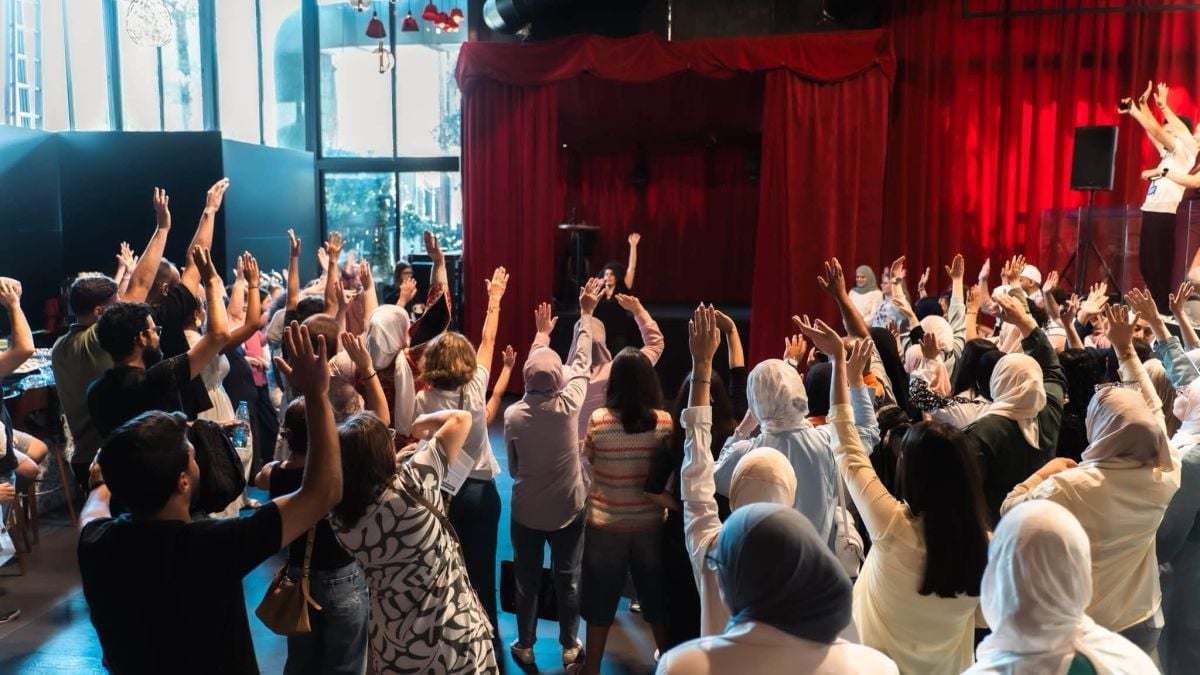
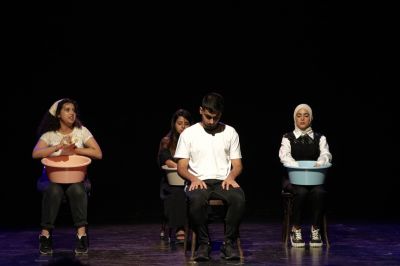
On stage, the participants of a Seenaryo workshop turn their individual stories into a collective adventure. (Credit: Nour Salman/Seenaryo)






They will be a hundred on stage, with their voices, their stories, and their reasons for wanting to leave. Coming from different regions of Lebanon, of all ages and from various backgrounds, the participants of "A Go Again" will gather on Oct. 3 and 4 in the Sioufi gardens. With this collective creation, Seenaryo presents the final part of its “Voyages of Ibn Battuta,” a theater project conceived for its tenth anniversary.
From the United Kingdom to Lebanon, by way of Jordan, Palestine, and Syria, each of the five countries has developed its own play, freely inspired by the journeys of the traveler. The Lebanese chapter was supposed to conclude the adventure last spring. The war decided otherwise: rehearsals were interrupted and the show was postponed. It was not until August that the main troupe gathered again, soon joined by the choir, the physical expression group and the children.
Restarting first meant being able to bring everyone together safely. For Lama al-Amine, artistic director of Seenaryo and the director of the show, this responsibility weighed heavily on the decision for a long time.
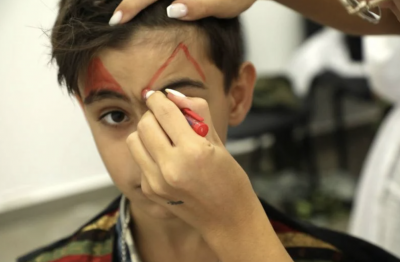
"To be honest, at first, I told myself: Are we really going to start all this again?" she confides to L’Orient-Le Jour. "Imagine: I am working with a hundred people. Safety comes first. That was my biggest concern."
Theater in the garden
Amine could have chosen a theater. She insisted on the Sioufi gardens, on this shared space where the show could find its place within the life of the neighborhood.
"I really didn’t want to do it in a theater," she explains. "I wanted to bring the community together in a place where it also grows."
This desire aligns with the Seenaryo approach: opening up theatrical practice to people who would not necessarily have access to it. The hundred participants are divided among the main troupe, the choir, the physical expression group, set design, and the children’s group. The show is built out of their contributions, bringing together on stage different generations and experiences.
"Theater for everyone," summarizes the director. "Meeting in the same place and sharing a moment, despite everything that has happened in the country."
In a battered Lebanon, the simple act of gathering takes on particular significance in her eyes. "The politicians haven’t succeeded in bringing people together. Theater, meanwhile, managed to do it."
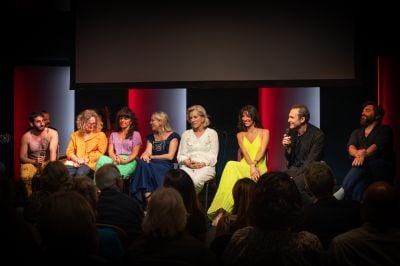
A visa to nowhere
At the beginning of the play, a group shares an urgent desire: to leave the country. The reasons differ — war, racism, discrimination — but all hope to find the possibility of another life elsewhere. They are then promised a visa that would open the doors of the world to them.
But first, they must obtain it. The show seizes on administrative absurdity and pushes it to the burlesque. To put together their file, the applicants must provide ever more improbable documents: their baby teeth, even their cat’s hair. Beneath the laughter lies a well-known experience, that of endless procedures and requirements whose meaning is difficult to grasp. "We are poking fun at the necessary steps to obtain this Ibn Battuta visa," explains Amine. In this fictional process, a year of preparation is required even before being allowed in.
Once inside, the applicants are caught in an increasingly mechanical system. They follow instructions, react to light signals, execute movements. No one tells them what is really going on.
"There is no communication," she says. "There is nothing human about it." The ordeal then becomes intimate. They must answer personal questions, reveal something about themselves to a system that already knows the answers. "They have to play a game and reveal something very personal," continues the director. "Then it’s the system that decides."
The freedom to travel, then and now
In the 14th century, Ibn Battuta crossed continents in a world where travel was not subject to current visa and passport regimes. "A Go Again" starts from this freedom and confronts it with today’s borders, the forms to fill out, and the conditions that determine who can leave and who must stay.
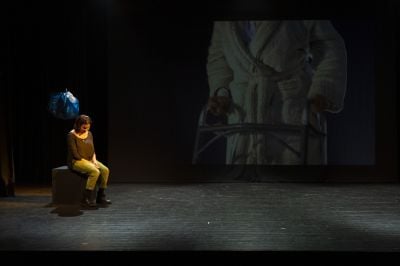
The question directly concerns part of the communities involved in the project. "Most refugees or migrant workers cannot travel," recalls Amine.
Ibn Battuta’s accounts also offer her a different perspective on the region, through the cultural richness they attest to. "He wrote about the richness of our culture," she says. "That’s also what I try to remind people of in the play: we are Arabs."
Making room for the other's story
By its scale, the Lebanese chapter stands out from the other creations of the project, carried out by smaller troupes. But for Amine, the value of bringing together a hundred people lies above all in the encounters this work makes possible. Participants who perhaps would never have met learn to listen to each other, to make room for the story of the other.
"My story matters, but the other’s story matters too," she emphasizes. "That’s what makes collective projects strong." Each person comes with their own journey, expectations, and relationship to leaving. The play brings these experiences together within the same ensemble, in which the director hopes the audience will see themselves. "I want the Lebanese audience to think: this is my story too," she confides. "I want spectators to understand that we are all together and living similar realities."
The adventure thus ends in Lebanon, where Seenaryo began its work in 2015. After months of interruption, the participants had to be brought together again, rehearsals resumed, and the energy of the show regained. The title, "A Go Again," also resonates with this need to start over.
On stage, however, starting over takes a more troubling turn. Those who appeared before the system end up becoming part of its machinery. Others are already arriving to try their luck.
"They themselves become part of the system," explains Amine. "And you see the choir and the children running onto the stage to submit their applications, as if it were a never-ending circle."
This article originally appeared in French on L'Orient-Le Jour.

 7 p.m. recap: Netanyahu seeks mastermind behind Flydubai incident; Washington sanctions 2 French nationals; Ben Gvir's 'I want to kill you' threat