





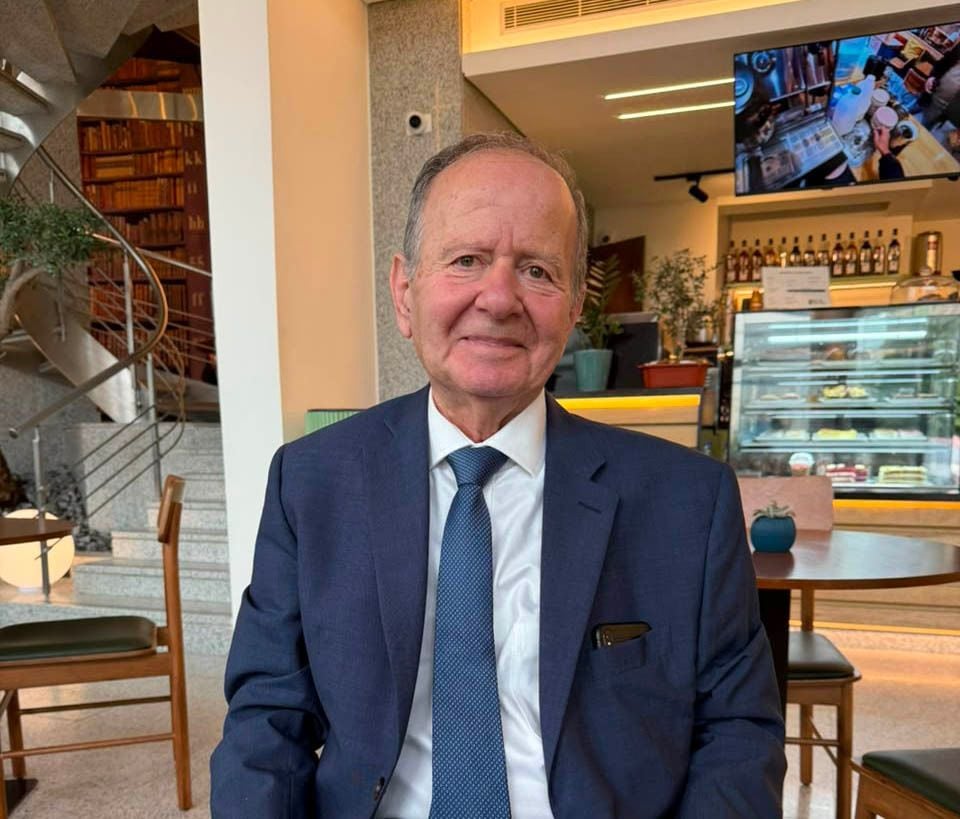
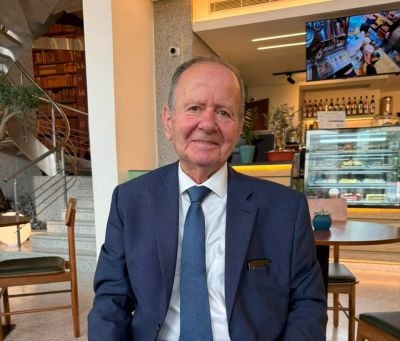
Samir Haddad, who passed away less than a month ago at the age of 78. (Credit: His son, Salim Haddad)






"Teb3uneh la t7assno khatkon" ("Follow me to improve your writing"): For thousands of people online, these words had become familiar. Samir Haddad would sit down in front of the camera, pen in hand, and quickly make something that might seem intimidating easy to understand: a letter, a pronunciation, a common error, a stroke of Arabic calligraphy. Then, on Sept. 12, his voice fell silent.
A native of Aley, Haddad died at 78 after dedicating his life to the Arabic language — first through teaching and journalism, then through calligraphy and finally through the peculiar virtual connection made possible by social media.
His son Salim remembers a father who had lived many lives before the internet discovered him. "He was very charismatic," he told L’Orient Today. "He got involved in anything that concerned the community. He was a very endearing person."
At home, he was reserved, calm, caring, and confident. He was a man who preferred discussing ideas to discussing people, who loved nature, animals and art, and a father who shaped his son's musical tastes and, in retirement, began making leather pouches and satchels.
All in all, his was a "normal" life — long before his face became familiar in vertical videos.
Language errors
Salim doesn't remember exactly how old his father was when he started working. "He started young," he said. After studying philosophy at the Lebanese University, he joined An-Nahar, where he spent 43 years correcting language errors and editing copy before retiring in 2015.
He had no idea that his career in teaching and journalism, along with his longtime love of Arabic calligraphy, would lead him to social media — a world entirely foreign to him. This unexpected adventure began when Salim, watching his father write, realized he wanted to preserve a record of his handwriting.
"I saw a talent. I told myself: I want to document it," he recalled. "If something happens to him, I want to be able to remember him, see his handwriting again, memorize his voice."
The first video was filmed Jan. 26, 2024, on Samir’s birthday. Salim asked him to write "Assalamu alaikum" in Arabic for a TikTok video. His father hesitated at first. Reserved, like most men of his generation, he didn’t like the idea of sharing his private life on social media. The first video got about 2,000 views. Then another reached 30,000. The audience kept growing.
When a jeddo meets Gen Z
It is striking that a former newspaper proofreader in his 70s became the beloved grandfather of a generation raised on quick cuts, memes and endless scrolling. His son attributes this success in part to the format: short videos that clearly convey one piece of information at a time. "He had a very warm face and voice," he explained.
Even as the views climbed, he remained humble. Salim would sometimes read him the comments and watch him laugh. When his son expressed excitement about reaching a million followers, his father’s response was characteristic: "Always stay humble and never forget who you are."
His lessons carried the same warmth. He advised practicing for 10 or 15 minutes a day. Take one letter at a time. Keep at it until writing your own name in Arabic feels natural.
The father behind the screen
"When I think of him, I remember him smiling, putting his hand on my head and telling me, ‘ya sabi, I love you,’" he said.
Other memories live on, too: laughter during filming, repeated jokes and a promotional video for his father’s course in which Salim kept saying "See you soon in the series." His father corrected him, reminding him it was a course, not a series — then laughed himself.
Then there are the works left unfinished.
According to Salim, Haddad was working on a book titled "Mi'at akhta' sha'i'a" ("A Hundred Common Mistakes"), as well as another manuscript, "Qusati ma'a al-hareb" ("My Story With the War"), about the Lebanese Civil War. Both projects were unfinished when he died. Salim hopes to complete them one day. It is no doubt, in part, his own way of grieving.
'The grandfather of everyone learning Arabic'
Asked what he hopes people will remember about his father, Salim immediately shifts from the personal to the collective. "I just want people to remember that he was my father," he said. "And that he was, in a way, the grandfather of everyone learning Arabic on the internet."
His father’s relationship with Arabic also carried a sense of responsibility. "My father was worried about the gradual erosion of the language, especially as errors became more frequent in the media. It's part of our identity that we’re gradually losing."
Salim Haddad has now decided to keep his father’s Instagram and TikTok pages active. The decision came after he posted a video announcing that he would continue his father’s work. It reached 10 million views. Suddenly, a personal promise became a public responsibility.
"For now, I want to do the same thing he was doing," he said. "I still have lots of videos of him. I can edit them to make him appear in new videos." That may be why the account will continue to feel more like a conversation than an archive: Samir’s familiar voice responding in one video, Salim carrying on in another, the handwriting reappearing on screen.
"I think it will help me keep in touch with my father. Even though he’s no longer here," Salim says.
Instagram: samirselhaddad
This article was translated from L'Orient-Le Jour.

 7 p.m. recap: Iran warns Egypt, Israeli soldiers vote in south Lebanon, Haret Hreik responds to Kataeb