






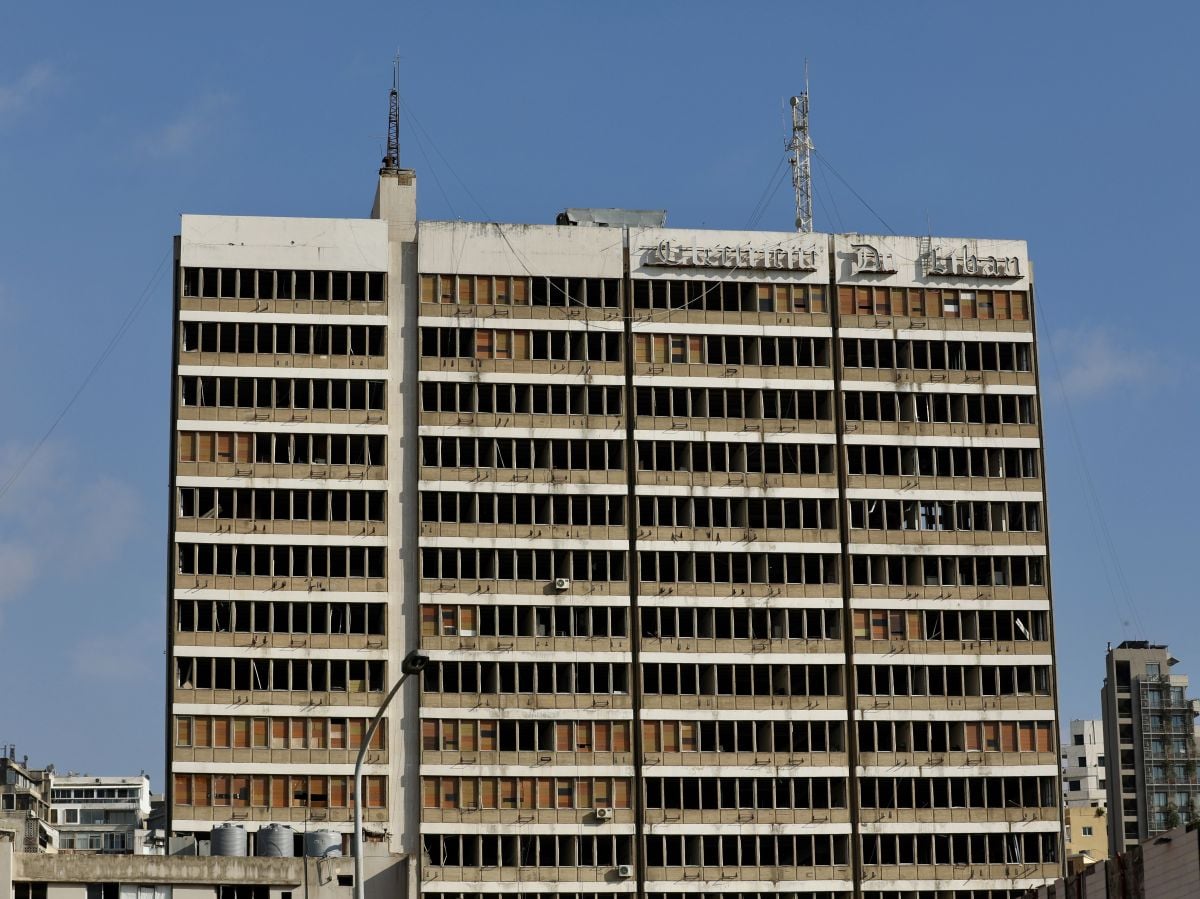
The Électricité du Liban, Lebanon's public electricity provider, headquarters in Mar Mikhael, in the capital Beirut, on July 4, 2026. (Credit: Matthieu Karam/L’Orient-Le Jour)






Mustafa Dah is an Associate Professor of Finance and the chairperson of the Department of Finance and Accounting at Lebanese American University (LAU)
State failure is not only exacerbating the public sector. It’s also reshaping how private capital is allocated in Lebanon. It affects how many firms can devote to productive investment and which activities attract capital.
Over time, these distortions influence the structure of the economy even without any deliberate industrial policy.

Consider two manufacturers with the same idea. One operates with reliable infrastructure and invests in machinery, technology and production. The other operates in Lebanon and must use part of its capital to provide the basic conditions needed to operate.
I call this institutional replacement capital spending. Unlike growth spending, which expands production, or maintenance spending, which protects existing productive assets, institutional replacement spending pays for basic infrastructure that should function outside the firm. Electricity is the clearest example: Long before the current crisis, most Lebanese businesses already relied on private generators.
This spending also changes competition by creating a barrier to entry. The same infrastructure cost consumes a smaller share of the resources of a large firm than of a small one. A new business may have a better product and still fail because too much of its limited capital is spent simply becoming operational. The market rewards the ability to replace the state alongside the ability to produce well.
For firms that survive, the cost still has to be absorbed somewhere. It may raise prices, reduce profits, limit wages and hiring, lower quality or eventually push the firm out of the market. But some losses never appear in company accounts, which record the equipment purchased to keep operations running, not the production line that was cancelled, the technology that was not adopted or the new product that was never developed. For the economy, the greatest cost may therefore be the investment that never happens. Institutional replacement spending can increase recorded private investment without producing a corresponding increase in productive capacity.
Public failure redirects capital in a second way. New investors may deliberately place money in businesses that profit from the state’s absence because a failed public service creates immediate and predictable demand for its private substitute. A genuinely new venture, by contrast, must build demand, and its return may take years. In an uncertain economy, replacing what is missing can look safer than building something new. The result is less capital for entrepreneurship, innovation and long-term growth.
State failure therefore redirects investment twice: It absorbs capital within productive firms through institutional replacement spending, while directing new capital toward businesses that provide substitutes for failed public services.
Industrial policy is supposed to encourage investment activities that raise productivity and support long-term growth. Lebanon’s failures often create the opposite incentives. They favor activities with ready demand and quick capital recovery while adding cost and uncertainty to manufacturing, technology and other investments that depend on continuous production, experimentation and long-term commitments. Weak infrastructure did not create Lebanon’s service-heavy economy by itself, but it makes that structure harder to change. State failure makes patience expensive.

Before the 2019 crisis, Lebanon’s financial system reinforced the same pattern. High deposit rates drew more household and other savings into banks, while high returns on government debt and Banque du Liban instruments encouraged banks to direct a large share of those deposits toward government deficits and the costs of sustaining a failing state. Savings that could support productive investment were instead increasingly used to finance the state.
This changes how public infrastructure should be valued: not only for the services it provides, but also for how it changes the allocation of private capital. The return on reliable electricity is not limited to cheaper power and fewer interruptions. It includes the private capital that no longer has to buy continuity. A new firm becomes easier to start because less money is needed simply to operate, while an existing business can direct more of its funds toward equipment, technology, workers or expansion. The value of infrastructure reform includes the firms that become viable, the projects that can proceed and the innovation that is no longer displaced.
Lebanon has spent years asking why its private sector does not invest more, innovate more or produce more. Part of the answer is that the country has been running an industrial policy in reverse: weak infrastructure raises the cost of productive investment, while substitutes for failed public services may offer safer returns.
Part of why this system persists is political. Failed public services create profitable private markets and politically protected beneficiaries that gain from the status quo, making reform harder even when the broader economic costs are substantial.
Lebanon does not simply need more investment. It needs functioning public infrastructure so that private capital can finance productive activity rather than basic services the state should provide. Until then, public failure will continue determining which firms can enter, which investments can survive and which activities attract capital. Lebanon’s problem is not only that it lacks an industrial policy. It is that state failure is already writing one.