






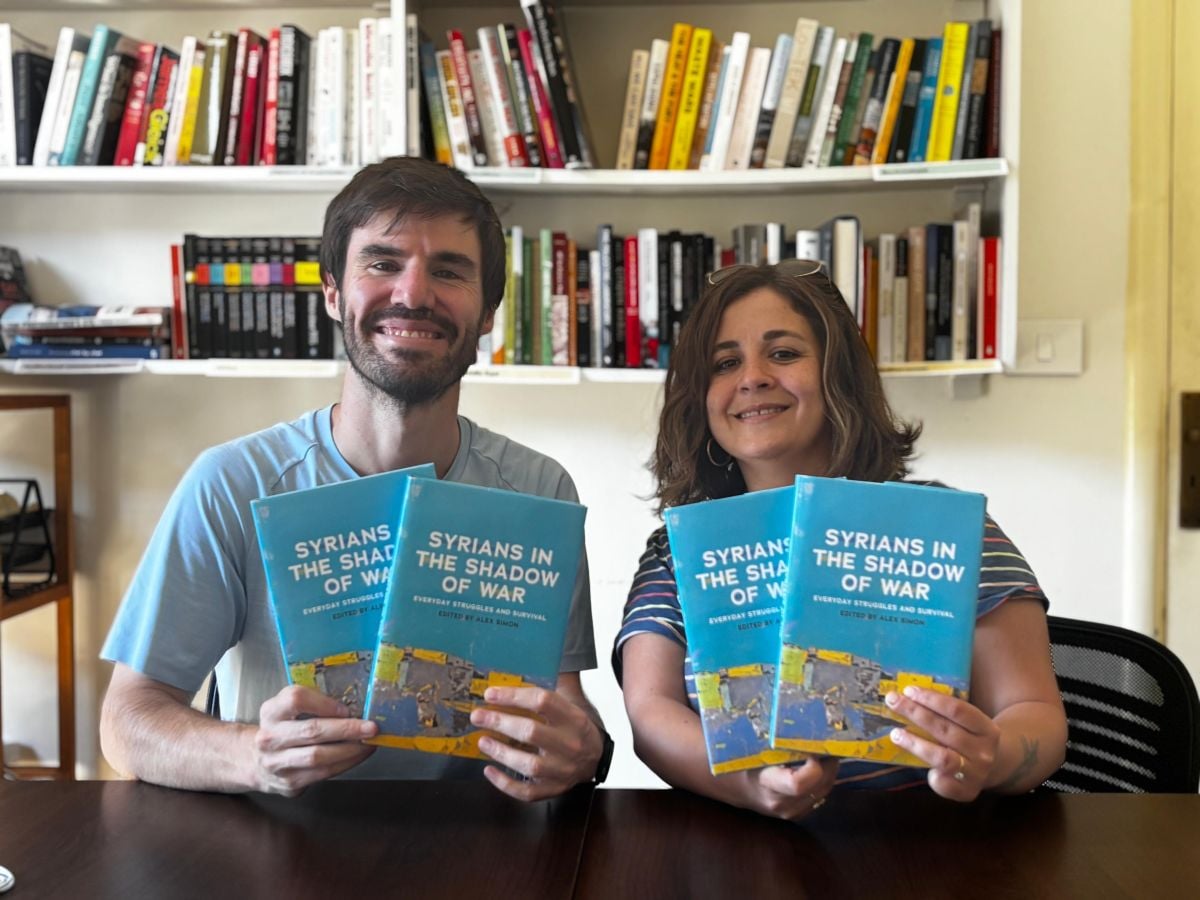
Alex Simon and Lina Ghoutouk hold their book, "Syrians in the Shadow of War: Everyday Struggles and Survival." Photo sent by Simon.






Between 2017 and 2024, as the Assad regime retook much of Syria from opposition groups and the world looked away, a small team of Syrian researchers working with the Synaps research laboratory in Beirut conducted more than 3,000 interviews with Syrians, most of them in regime-held areas, as well as elsewhere in Syria and Lebanon.
Looking past labels applied from the outside, they documented how farmers, traders, widows, and activists lived their everyday lives through violence and economic collapse. For years, the work circulated mostly as unpublished reports, its authors unnamed. The regime’s fall in December 2024 made "Syrians in the Shadow of War: Everyday Struggles and Survival" possible.
The book arrives in a Syria of hope, but also of other violence, renewed sectarian tension, and an evolving space for women. Here, Alex Simon, the book's editor, and Lina Ghoutouk, one of its researchers, tell L'Orient Today how the research was done and where it goes next.
L'Orient Today: To begin, could you tell us about the circumstances under which this project was born?
Alex Simon: The project began in late 2017 and early 2018, at a moment when the Syrian regime was expanding its control over former opposition-held territories. Up to that point, international attention and research infrastructure had largely focused on opposition-governed areas. As the regime retook territory, those research networks broke down. Regime-controlled Syria remained a black box, even as it expanded. We wanted to understand how the country was actually functioning under the surface — focusing on daily life, local economies, and administrative realities in areas under Assad’s control. To do this, we built a core team of four Syrian researchers: Malak al-Shanawani, Lina Ghoutouk, Lina Omran, and Manar al-Tizini. Some were based in Beirut, others in Damascus, and part-time consultants across the country supported them. Operating as an all-female team was not intentional, but it proved to be a crucial safety factor, as men in Syria faced added risks relating to military conscription and targeting by the security apparatus.
Lina Ghoutouk: It was a time of feeling deep defeat across the Syrian opposition and diaspora, and many researchers and activists were leaving Syria altogether. We felt a responsibility to look beyond high-level politics at how ordinary people were surviving. Because open research in regime areas was so dangerous, we relied on Synaps's presence in Beirut, which kept us in constant contact with Damascus while protecting the team. We used cover stories when necessary, conducted interviews by phone, anonymized all transcripts, and kept identifying data off digital platforms. One important goal for us was to humanize people living under the regime and challenge the monolithic "loyalist" label applied to them from outside.
OT: Women played a central role both in executing this research project and in sustaining Syria's wartime economy. How has the role of women evolved from the wartime period to the present post-regime transition?
L.G.: Women led much of our fieldwork and brought a distinct openness to team deliberations. During the war, women stepped into major economic roles out of necessity while men often faced higher risks of detention or were wanted for military conscription.
A.S.: The war forced women into more public roles within their communities, and it remains to be seen how the transition affects this. Shifting religious norms, economic hardship, and patterns of violence against minority groups have pushed some women to restrict their behavior and movements in ways they didn’t used to.
OT: Could you expand on why you felt such a strong need to focus on regime-controlled areas, and what role Beirut played in enabling that research?
L.G.: Researching regime-controlled areas required stepping away from purely high-level political framings to focus on human daily life. While regime violence was omnipresent and impossible to ignore, there was a major research gap regarding how ordinary people functioned under that violence. Synaps was willing to take calculated security risks and assume responsibility for supporting researchers working inside Syria. Lebanon was central to this effort; despite local security challenges and pressure on Syrians, Beirut remained a relatively open hub with direct access to Damascus compared to other neighboring countries. It allowed us to bring activists and researchers out of regime areas for training and workshops before they returned.
A.S.: During this period, spaces for serious knowledge production on Syria closed in neighboring countries like Jordan and Turkey. Lebanon was the only place with a large Syrian population that maintained continuous exchange with regime-controlled areas. This connectivity enabled us to build relationships with cross-border traders, civil society figures, and diaspora networks, providing insight into the economic and social realities inside the country.
OT: How has that relationship between Lebanon and Syria evolved since the fall of the regime?
L.G.: Having moved back to Damascus after spending years in Belgium and Lebanon, I notice that the social tension in Beirut toward Syrians has eased a bit. Syrians are no longer viewed strictly as refugees or economic burdens, and there is a shared sense of hope regarding Syria's future, even as Lebanon navigates its own political confusion.
A.S.: Public perceptions in Lebanon fluctuate. At times, media portrayals frame Syria's post-regime trajectory around sectarian instability; at other times, there is an overly romanticized belief that Syria's basic infrastructure and economy are immediately fixing themselves. While systematic state crackdowns against Syrians in Lebanon have paused for now, many Syrians remain stuck in psychological and economic limbo — unable to work legally in Lebanon, yet unprepared to return to Syria.
OT: In the book, you examine informal support networks: kinship, neighborhood, and community structures. How have these networks functioned during the transition, and can the same networks that provided protection also channel violence?
A.S.: The Assad regime largely survived by devolving power to a patchwork of local militias, neighborhood defense groups, and security branches. When the central authority collapsed, these decentralized informal reflexes remained. Consequently, much of the violence post-December 2024 has been highly decentralized, driven by local factions, tribal mobilization, and the like. But decentralization can equally play a positive role. The emergency relief and humanitarian responses — such as community aid following massacres on the coast — have often relied on the same informal, grassroots networks that operated under the regime.
L.G.: During the war, diverse groups of Syrians were united by a single common goal: opposing the regime. Once the regime fell, that unifying factor disappeared, bringing previously unaddressed ideological, religious, and sectarian divisions to the surface. Yet, the activists and local researchers who operated quietly under regime control are often the same individuals leading relief efforts and community organization today.
OT: Your methodology relies heavily on "instances": granular, single observations, individual accounts, or specific offices. What is the evidentiary value of an instance compared to quantitative research or statistics, and how does one build rigorous generalizations from them?
L.G.: Quantitative research in wartime Syria was deeply flawed; the big numbers cited by international organizations often lacked grounding. We prioritized qualitative depth: a single quote from a farmer, a woman running a household, or a delivery worker could be more accurate than an abstract statistic. We validated our findings with local communities and shared drafts for external feedback. A shared commitment to the values of citizenship and humanizing all parts of Syrian society also helped us handle messy field realities constructively.
A.S.: Academic citations of methodology can sometimes function as a performance of rigor. Our rigor came from an intensive collective review process. Every piece of research was reviewed by six deeply knowledgeable colleagues, bringing distinct analytical perspectives to challenge assumptions. Individual instances, when examined closely, reveal broader structural truths. For example, investigating why farmland was burning revealed that combine harvesters were using makeshift, locally refined fuel that emitted sparks — a single detail that illuminated the complete breakdown of state agricultural infrastructure.
OT: Why was the decision made to publish the material in English first, and how did funding structures shape language choices and target audiences?
A.S.: English first was a structural necessity, not a preference. Research funding in the aid sector goes overwhelmingly to English-language analysis. Our interviews were almost entirely in Arabic, but field notes were compiled in English, because our editorial capacity was necessarily English-centric. Over time, we built a dedicated Arabic editorial and translation pipeline led by our brilliant translator Hassan Hassani; but we did so of our own initiative, without any designated resources for it. Our goal now is to ensure the book is translated and published in Arabic, so that it can reach the Syrian audience for which it is intended.
OT: Looking ahead, how do you see the focus and methodology of your research shifting in this new Syrian context? What gaps are you seeking to fill now?
A.S.: Syria currently boasts a remarkably vibrant landscape of local journalists and researchers. Our goal is to fit in and address some analytical gaps, of which there are many: Rural areas are absent from most policy discussions. The debate on reconstruction is focused on flashy real estate projects but ignores the ways communities are rebuilding on their own, and so on. Methodologically, we are experimenting with ways to share knowledge in formats other than written analysis. For example, we recently produced a short Arabic-language guide to crowdfunding small infrastructure projects, and are co-producing short videos with Syria Untold.
L.G.: Knowledge production must now serve Syrians directly, helping reconnect communities that were physically and politically divided for 14 years. By making Arabic our primary structural language, we can engage directly with rural researchers, farmers, and local youth, broadening the scope of who produces knowledge in Syria.
Alex Simon and Lina Ghoutouk will present the book tomorrow at 7 p.m. at the IFPO stand during the “Beyrouth Livres” book fair in Seaside Arena.

 2 p.m. recap: UNIFIL, Hezbollah at heart of debates; ballistic missile intercepted in Riyadh; pope operated for cancerous nodule