








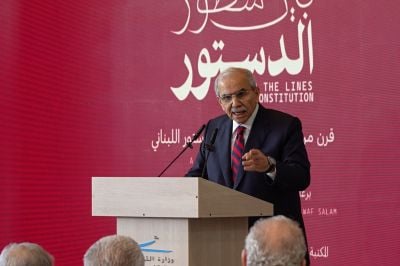
Prime Minister Nawaf Salam and Culture Minister Ghassan Salameh were right to emphasize Wednesday, at the opening of an exhibition marking the Constitution’s centenary, that the founding document that established the Lebanese Republic was far from being a wholly imported product.
Titled “Between the Lines of the Constitution,” the exhibition is being held at the National Library in Sanayeh and will run through the end of the year.
Although inspired by the constitutional framework of France’s Third Republic (1870 to 1940), the Lebanese Constitution is by no means a faithful copy. It, of course, incorporates the main principles of parliamentary democracy, separation of powers, government accountability to Parliament, and equality before the law. But it also gives considerable weight to Lebanon’s own realities. This explains, for example, why the powers of the presidency are structured in a way that is much closer to the philosophy of France’s Fifth Republic than its Third, as Salameh noted. It also explains the sectarian factor, something far removed from the spirit of French institutions, though it was intended to be “temporary.”
And what of that supposedly temporary arrangement? The Taif Agreement had introduced 37 years ago some revisions to the original text without fundamentally altering it. But a century after the Constitution, not only is the famous Article 95 still there, but the practice of political sectarianism has since gone far beyond the letter and spirit of both the original Constitution and its post Taif version.
The weapons of Lebanon’s Civil War have fallen silent, and the crimes committed during it have been amnestied. Yet the conflict continues, fiercer and more absurd than ever, on another front: identity politics or, put differently, sectarian self-interest. That self-interest regularly leads some to paralyze the state when they discover, to their alarm, that a given ministry has more Muslim couriers than Christian ones. Others have come to regard it as a violation of the National Pact for the rest of the Lebanese to try to prevent them from starting wars whenever they please.
As in almost every aspect of public life, the Lebanese state has reached a point where, unable to regulate things properly, it either tolerates everything or bans it outright. Like hunting and driving.
Unable to bring order to the giant circus that road traffic has become, authorities swing between looking the other way, making grand announcements, and wasting money. One day, seat belts are mandatory. For the other 364 days of the year, motorcyclists swarm like flies, speeding the wrong way down one-way streets, running red lights, phone in hand and cigarette in mouth.
Or, how to deter countless inconsiderate drivers who double and triple park, blocking traffic, authorities choose to redesign streets instead of issuing fines.
Admittedly, for the first time in decades, Lebanon has an executive whose basic mandate is more or less aligned with the political aspirations of a clear majority of Lebanese who were long silenced. But the failings of this dysfunctional state run too deep to be fixed overnight.
Back to political sectarianism. A century after 1926, should we not stop and try, together, to understand not only why the “temporary” arrangement promised from the outset never proved temporary, but also what drove sectarianism to become so entrenched that the system would be completely unrecognizable to its founding fathers?
The real problem, as with road traffic, is that many remain trapped in an all-or-nothing mindset: either abolish the system altogether or enforce it to the extreme, far removed from the spirit of the constitutional texts. For decades, those have been the only choices presented to us.
The other major problem is that the harmful effects of rigid sectarianism extend far beyond political representation and the distribution of public posts. They also undermine key principles enshrined in the preamble to the Constitution, the very foundations of the Republic. Among them, the ban on women passing on their Lebanese nationality to their spouses and children, driven by petty sectarian calculations, is a blatant, absolute, and shameful violation of a fundamental constitutional principle: equality before the law.
“Back to the Constitution.” That should be the title, and the starting point, of any road map for putting the Lebanese state back on track. Once that course has been set, we can go further with reforms.
This article was originally published in French in L'Orient-Le Jour and was translated by Sahar Ghossoub.