











There has been growing talk for the past few days of a new Israeli offensive in southern Lebanon, primarily aimed at seizing the Ali Taher hill, a strategic site held by Hezbollah southeast of Nabatieh.
The hill overlooks access to the militia’s key bases farther north, on the outskirts of Jezzine.
With Israeli elections looming, Benjamin Netanyahu, who has more at stake this time than perhaps ever before, will very likely go all in to achieve his objective as quickly as possible, with only two months to go before the vote that could determine his political fate.
What can be done to avert the apocalypse? Beg Hezbollah to drop the matter by handing over all these sites to the Lebanese Army, as demanded by Israel, the United States, everyone who matters on the planet, and, a good portion of the Lebanese people?
Or must the whole world be in the wrong simply because the Unmentionable — in other words, Israel — is among those making the demands?
In any case, there is, alas, reason to fear that these pleas will once again fall on deaf ears, for the simple reason that, as has been said time and again, Hezbollah is little more than a negligible entity. Its chief, its MPs, its media outlets, its card-carrying members, its grassroots base, are nothing more than an army of remote-controlled automatons.
But is it really still that way, particularly since the disappearance of Hassan Nasrallah? Is not the Revolutionary Guard now on the ground, directing the operations themselves?
In reality, even during Nasrallah’s time, decision-making power was clearly beyond the control of the Lebanese.

Shortly before the July 2006 war broke out following a hostage-taking operation carried out by Hezbollah across the border, the party’s then secretary-general assured his interlocutors around the national dialogue table that the summer would be promising. Tourists and expatriates would arrive in droves. Prosperity would follow.
Instead, Lebanon lost nearly 1,200 lives, saw most of its road and river bridges destroyed, and suffered billions of dollars in damage.
More than a month later, as that episode drew to a close, Nasrallah went on television and delivered his famous “If I had known...” line, while hailing what he called a “divine victory.”
Most people, however, failed to grasp the full significance of these remarks, as persistent but unverified reports had circulated in select circles since July 12 that Nasrallah had not been informed of the operation that triggered the war until 15 minutes before it began.
In reality, appeals to reason directed at Hezbollah are futile, but not simply because the decision lies beyond its control. After all, even Iran must know that, given the resources Israel has deployed and remains prepared to deploy, a victory over Israel in southern Lebanon is impossible.
It might be assumed that if Tehran’s objective were to defeat Israel, it would itself heed these appeals to reason. But that, precisely, is where the problem lies: Its goal is by no means to win; its goal is simply to keep the Israeli army, and behind it the U.S. administration, tied down for as long as possible in an attempt to improve, even slightly, its negotiating position with Washington.
That is what the Lebanese lives that will be lost in the future will be used for. And around the corpses, Hezbollah’s bigwigs will once again dance, claiming the dead as martyrs to their cause. Thus, even suicide can prove to be a good deal!
And what of the Lebanese state in all this? What should it do to prevent what now appears inevitable? The Lebanese Army is undoubtedly right to be cautious, given that the threat of civil war dictates everything else. Yet it still falls short of what it is reasonably expected of it.
Above all, the state should recognize that it holds a powerful weapon that has already proved effective against Iran and its Lebanese proxy: The direct negotiations with Israel.
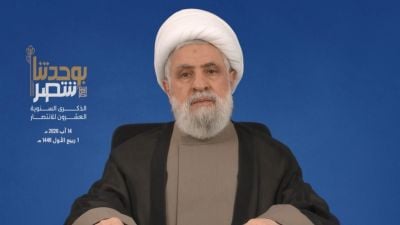
Hezbollah’s hostility toward these negotiations is living proof of their effectiveness and, if one may put it that way, of their genuinely Lebanese character. It is precisely because this process challenges Tehran’s use of Lebanon for its own ends.
It doesn’t matter that the talks are currently going through a rough patch. Israel’s hardened stance is certainly deplorable, but it is predictable given the upcoming elections.
After the election — with or without Netanyahu — there may be new horizons, regardless of the twists and turns of the U.S.-Iran dialogue.
The hope for a better future for Lebanon lies entirely in its ability to move forward regardless of the outcome of the U.S.-Iran dialogue.
This editorial was translated from L'Orient-Le Jour.

 7 p.m. recap: Iran warns Egypt, Israeli soldiers vote in south Lebanon, Haret Hreik responds to Kataeb