






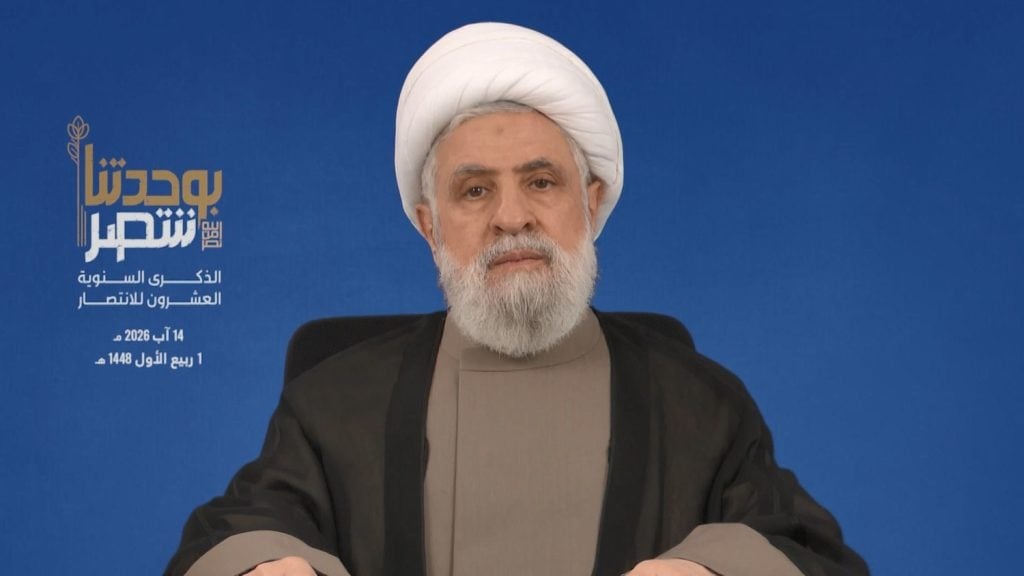
The Secretary General of Hezbollah, Naim Qassem, during a speech delivered on Aug. 14, 2026. (Credit: Screenshot published on the website of al-Manar, the party’s channel)






BEIRUT — Hezbollah Secretary-General Sheikh Naim Qassem again criticized the Lebanese state on Friday, accusing it of being “controlled by the United States” and directly warning those in power that they could face “popular anger.”
In a speech marking the “anniversary” of the end of the Hezbollah-Israel war on Aug. 14, 2006, Qassem called on his supporters to “contain their anger” and “prepare to use it at the appropriate time to achieve their objectives and meet their demands.”
He then warned: “Anger knows its hour, and it may erupt. How will it erupt? Those who are unable to act and who oppose the ‘Resistance’ and its members should bear the responsibility.”
New criticism of the 'pilot zones'
Qassem called on the state to “at least take a stand” following recent remarks by Israeli Defense Minister Israel Katz that Israel would “not withdraw” from occupied territories in south Lebanon.
“Don’t you hear what [Defense Minister] Katz and [Prime Minister Benjamin] Netanyahu say every day, that they will not withdraw [from south Lebanon]?” Qassem asked the Lebanese authorities. “At the very least, respond to Katz and Netanyahu by taking a stand,” he continued.
“We know that behind the scenes, the Americans tell you that they can do nothing in the face of the Israeli enemy because they support its actions,” he said.
President Joseph Aoun met with his U.S. counterpart, Donald Trump, in late July and urged him to pressure Israel to withdraw from south Lebanon. “Everyone who observed the scene in Washington saw only one camp: the American-Israeli camp. As for the Lebanese camp, it was subordinate, carrying out what the United States dictated to it,” Qassem reiterated.
Aoun and Prime Minister Nawaf Salam regularly condemn Israeli demolitions in south Lebanon and, more broadly, Israel’s occupation of nearly 700 square kilometers of Lebanese territory. On Friday, Salam emphasized this point before Lieutenant General Clearfield, who heads the U.S.-sponsored cease-fire monitoring mechanism.
Qassem also criticized the fact that “the state has found no other target but Hezbollah’s weapons, rather than going after the Israeli enemy that does not respect its commitments.”
“Lebanese authorities have not cooperated with the Resistance, whereas, for 15 months [the period of the cease-fire between November 2024 and March 2026], the Resistance provided a remarkable example of honoring its commitments and cooperating with the political authorities,” he said.
The Hezbollah chief again criticized the “framework agreement” signed between Beirut and Tel Aviv on June 26 under U.S. mediation. He said it was “as if the Lebanese authorities wanted to polish their image and fulfill the commitments they made when they came to power.”
He also reiterated that direct negotiations between Lebanon and Israel had produced “no results.”
“Show me just one concrete outcome from the seven rounds of negotiations,” he said. According to Qassem, the talks “give Israel in advance what it wants,” bringing only “shame and disgrace.” “The authorities must admit they have failed and use all the elements of strength at our disposal to confront this arrogant Israeli enemy,” he said.
In this context, Qassem again lambasted the “pilot zones,” which, under the framework agreement, are intended to allow for the gradual withdrawal of Israeli forces in exchange for Hezbollah’s disarmament in designated areas.
“What is this invention that you have called ‘pilot zones’? Zawtar Gharbieh, which was not occupied, has now become a pilot zone that Israel must authorize you to enter?” he said.
“Despite this, Israel prevents the Lebanese Army from deploying throughout Zawtar Gharbieh, prevents residents from entering and imposes restrictions,” he added.
‘We do not accept surrender’ to Israel
Qassem also called on the state to “stop accumulating failures.” “This accumulation is destroying the country and harming its future,” he said. “We do not accept surrender, and we will remain standing and steadfast. We will not allow our country’s sovereignty to be violated or the blood of martyrs to have been shed in vain.”
He made the remarks without elaborating, as Hezbollah has halted attacks on the Israeli army since a nominal cease-fire took effect in mid-June.
According to Qassem, “it is the Islamabad agreement [signed between Iran and the United States in mid-June and providing in its first article for a cease-fire in Lebanon] that enabled residents to return, and it was the Islamabad agreement that ended large-scale fighting.”
“Some claim that 300,000 people returned thanks to the ‘framework agreement.’ That’s laughable,” he said.
He also held the state “responsible before any other party” for rebuilding south Lebanon and assisting displaced people. “Of course, we are playing our part by providing aid, cooperating and making every possible effort, but it is primarily the state’s duty to fulfill its responsibilities, and that is what we are working toward. Housing and assistance must be provided, as well as repairs to the damage,” he said.
Qassem concluded by asking: “Where are the solutions you promised to implement in the ministerial declaration? And where are those mentioned in the inaugural speech?”
“You have failed in the face of economic and social challenges, in ensuring equal opportunities, as well as in appointments, which are made behind closed doors,” he said.
Qassem delivered the speech as the Israeli army appeared poised to launch a military operation, primarily targeting the Ali Taher heights, which Israeli authorities say are home to Hezbollah’s southern command, senior members of Iran’s Islamic Revolutionary Guard Corps, party officials and numerous fighters of other nationalities.