







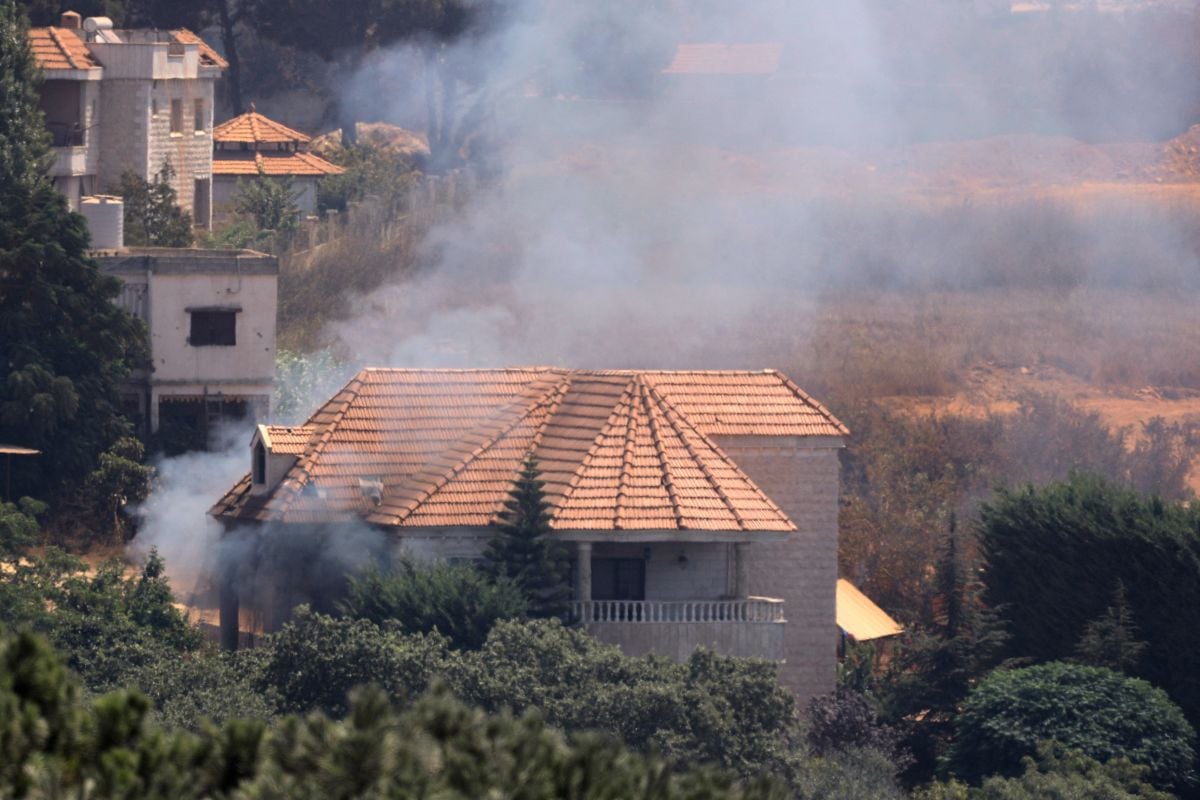
Smoke rising from a house in the village of Zawtar Sharqieh, controlled by Israel, on Aug. 13, 2026. (Credit: Ammar Ammar/AFP)






SOUTH LEBANON — As south Lebanon braces for a possible new Israeli operation targeting the Ali Taher hills, the Israeli army intensified attacks on Friday around Ali Taher, al-Dabshe and al-Tahra, as well as Mansouri in the Sour district, according to our correspondent.
Despite calls to halt these attacks by Prime Minister Nawaf Salam and Parliament Speaker Nabih Berri to the United States, it seems Washington is not willing to slow the momentum of its ally as long as Hezbollah remains armed, according to statements made to the media by U.S. Ambassador to Lebanon Michel Issa, following his visit to Ain al-Tineh, where he accompanied the head of the "mechanism," Lieutenant General Joseph Clearfield, on Friday.
On the ground, the Israeli army has maintained pressure for several days on the strategic site of Ali Taher, which it hopes to control, while Mansouri is a village split in two by the "yellow line" that marks the area occupied by Israel and where an Israeli soldier was killed in a building that was reportedly booby-trapped, thwarting the return of the Lebanese Army.
On the heights of Ali Taher, the Israeli army repeatedly fired machine guns at the al-Dabshe and al-Tahra hills as well as at Dohat Kfar Roummane in the same area. Flares were also dropped over the Ali Taher woods since Thursday night.
On Thursday night into Friday, an Israeli drone had already dropped explosives on Mansouri, after subjecting the coastal locality to two raids during the day and heavily shelling six villages with artillery. The Israeli army also carried out multiple demolition operations in six other localities, targeting homes and infrastructure.
Israeli soldiers also demolished buildings in Markaba (Marjayoun), and movements of Israeli military vehicles were reported at dawn inside Haddatha (Bint Jbeil), which had been targeted by artillery shelling and machine-gun fire.
Overnight, Israeli artillery bombed the Zibqin valley (Sour), the Slouki valley (Marjayoun), and the outskirts of Mayfadoun (Nabatieh). Israeli forces also fired medium-caliber automatic weapons toward Kfar Tibnit and Ali Taher.
Israel occupies around 600 square kilometers of Lebanese territory since fighting resumed with Hezbollah. This situation, combined with statements made Wednesday by Israeli Defense Minister Israel Katz, asserting the Israeli army would not withdraw from Lebanon, prompted Salam to denounce Tel Aviv's 'illogical' attitude, while Beirut threatens to suspend direct negotiations with Israel that led to the June framework agreement and the creation of "pilot zones" where the Lebanese Army is to disarm Hezbollah without Israeli army intervention.
Clearfield visits Berri and Salam
It is in this context that Lieutenant General Clearfield, who leads the U.S.-led cease-fire monitoring mechanism, and the U.S. Ambassador to Lebanon, Michel Issa, continued their tour of Lebanese officials, which began Wednesday with visits to the head of state, Joseph Aoun, and the commander-in-chief of the Lebanese Army, General Rodolph Haykal. The two American officials were received Friday by Berri at Ain al-Tineh, before heading to the Grand Serail for a meeting with Salam.
With the head of government, discussions focused on the military aspect of the negotiation framework and developments on the ground in south Lebanon, according to a statement posted on the Grand Serail's X account. Salam insisted on the need to end the Israeli army’s destructive operations in this part of the country, expand the area of the "pilot zones" defined in the framework agreement — two have already been created — and set a clear timetable for an Israeli withdrawal from Lebanese territories.
After the departure of his visitors, Berri, who is also the head of the Shiite Amal movement allied with Hezbollah, stated, 'The key to stability is forcing Israel to end its war and withdraw to the international border.'
'Shortlist' of countries
Ambassador Issa, told the press that Israeli demolitions will stop in South Lebanon when Hezbollah hands over its weapons. 'They will stop when the time comes. Tell Hezbollah that as soon as it hands over its weapons, everything will stop," he said after his meeting with Berri.
Regarding who will be responsible for verifying Hezbollah’s disarmament by the Lebanese Army in the pilot zones, the U.S. ambassador said: "No agreement has yet been reached on which party will handle the verification, but we have a shortlist of specific countries and are consulting with them before deciding which one will be selected."
Asked whether the United States supports a possible Israeli attack against Ali Taher, the U.S. ambassador said he did not know: "I don't know. You know more than I do."
Finally, asked about the next session of negotiations between Lebanon and Israel, he said, "No date has been set yet for negotiations, but they will continue." He added that Joseph Clearfield's visit to Ain al-Tineh was intended to explain to Berri the reality of the situation, in reference to the progress of negotiations and obstacles related to the implementation of the framework agreement.