






French leftist party La France Insoumise (LFI) MP Eric Coquerel (C-L) marches alongside to LFI presidential candidate Jean-Luc Melenchon (C), Mayor of Saint-Denis and LFI member Bally Bagayoko (C-R), LFI member of European Parliament Manon Aubry (2R) and LFI group MP Claire Lejeune (R) during a nation-wide protest against the "high cost of living" in Paris on Oct. 17, 2026. (Credit: Matthieu Rondel/AFP)






Protests are sweeping across France as anger over conditions in schools meets frustration with exorbitant living costs. The current government of President Emmanuel Macron, which is reaching a potential end to its tenure with presidential elections scheduled for May 2027, is accused by large segments of the population of doing little to address the deep-seated socioeconomic woes facing people.
How it started
High school students at the Lycée Saint-Exupéry in Créteil, a commune in the southeastern suburbs of Paris, initiated the first demonstrations on Sept. 17. The students organized to protest severe teacher shortages, dilapidated school facilities, and overcrowded classrooms.
The initial local action quickly triggered blockades across the Île-de-France region before expanding into a nationwide movement, with trade unions, teachers, and the general public joining the protests on Oct. 6th. Many have compared this movement to May 1968, the historical mass movement of French youth and workers.
The rallies have been met with unprecedented police repression and force. Even though several students were severely injured due to police violence, including a 15-year-old boy who had his hand blown off by a police stun grenade, France's Interior Minster defended the police response as "proportionate." The police watchdog, meanwhile, is investigating at least two dozen allegations of police violence.
After weeks of mobilization in cities and towns all over France, about 550,000 people demonstrated nationwide on Saturday, according to the Interior Ministry. The CGT union told Reuters it estimated protesters at 800,000 people.
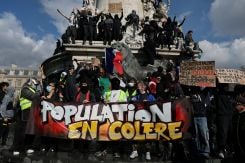
Interconnected struggles
Protesters said most people had marched peacefully, and put much of the violence down to the police and to some protesters who resorted to property damage as a way to express their anger or take advantage of what many say is a law and order vacuum left by a disorganized police force and misdirected police tactics. In certain areas, police officers focused on dispersing protests by firing tear gas and charging at protesters, sending people away from the dedicated route of the demonstration.
Many demonstrators held signs bearing slogans against the police, the president, and the wealthy, while many also held signs in support of Palestine or waved the Palestinian flag as a way of connecting global liberation struggles.
"We are fighting because the cost of living is too harsh, because the price of fuel is too high, because high school pupils are being violently attacked and hurt all over the country just for trying to protest and ask for more teachers and decent learning conditions," said Lola, a 19-year-old protester in Paris.
Protesters in high-visibility vests blocked streets, recalling the "Yellow Vest" movement against Macron's pension overhaul in 2023 that marked Macron's previous term in office.
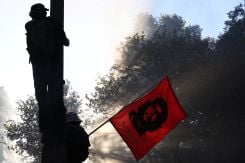
Rioters, meanwhile, attempted to break into the Galeries Lafayette department store, smashed up banks, ransacked a Lacoste store as well as other luxury boutiques, and looted an SFR mobile phone shop. Protesters set objects, including cars, bins, and bus stops ablaze throughout the day.
In Limoges, the city hall was set ablaze; in Marseille, a group of protesters broke into city hall and sprayed graffiti on the walls; and in Lyon, protesters torched the city's tourist office.
Nearly 2,400 people were arrested as part of the protests, French Prime Minister Sebastien Lecornu added while visiting the sites following the protests. He claimed more than 150 police officers had been injured in Saturday's protests, but did not mention any protesters hurt by the police.
Macron on Sunday slammed the "unbridled" violence of rioters. In an address to the nation, Macron said local authorities would be able to ban — "if necessary" — certain rallies in coming days, what would be an unprecedented move of repression of the right to protest. He stopped short of announcing drastic measures, such as a state of emergency or curfew.
Macron critics pounce
Macron is entering the final stretch of his presidency, facing a fragmented political landscape and growing pressure over the economy, with just a few months before the 2027 presidential elections for which both the far right and the radical left are predicted to reach the second round.
France's efforts to reduce public debt have not reassured investors, pushing government borrowing costs to their highest levels in over two decades.
Jean-Luc Melenchon, head of the far left France Unbowed party and a presidential candidate, attended the rallies along with fellow party members, which he described as calm and peaceful. He blamed government "incompetence" and said that "absurd leadership has opened the door to chaos." He stated that the government is "solely responsible" for the destruction and "failed to organize the maintenance of public order."
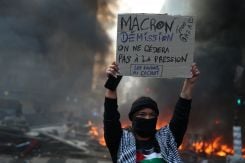
Leader of the far right party Rassemblement National (RN) Marine Le Pen, also running for president, accused Macron's administration of "running on fumes, exhausted and disoriented."
Macron said "our country deserves a fine presidential election," marked by debates "with the parties, rather than in the streets with violence."
With images of French town halls burning and shops being looted grabbing headlines around the world, U.S. President Donald Trump waded into the debate, blaming immigration for the unrest.
"France is burning! The immigration of people from an entirely different world, people with hatred in their hearts, has shattered that once great country," he said in a social media post.
Macron responds
Macron acknowledged on Monday "failures in anticipation and intelligence," while some opposition politicians had already called for the sacking of Interior Minister Laurent Nunez.
Nunez admitted Monday that the police "lost control" in some cities during violent protests that erupted in cities across the country at the weekend. He said there had been a "lack of anticipation" in preparations and that he had tendered his resignation to Macron on Sunday because he "felt responsible for everything that happened." Macron has declined Nunez's offer to resign, the Elysee presidential office said on Monday.
Macron said he had asked Nunez to "draw all necessary lessons," particularly with regard to intelligence gathering and anticipation, adding he expected "clear answers." The president had also instructed him to "put in place new operational methods for security forces" to handle the crisis.
Macron vowed that top officials would "make decisions in coordination with mayors to protect our cities, public buildings, and businesses."
He said that businesses that suffered would be supported and vowed there would be "full transparency" over the response by security forces to the protests.
Protests spread to other countries
In protests partly inspired by those in France, several hundred mostly young people protested in Brussels, some met with police brutality. Belgian student groups have said they are protesting against rising education costs and reforms they fear will make higher education less accessible.
In Albania, police fired what appeared to be rubber bullets at protesters during a fifth day of mass student demonstrations calling for Prime Minister Edi Rama to step down.
In Portugal, tens of thousands took to the streets of Lisbon following days of unrest to protest against housing and other living costs. Housing prices in Portugal have doubled since 2017, fueling one of the worst affordability crises in Europe.
In Italy, a march against high costs of living in Milan degenerated into disorder, with police clearing people from the central cathedral square using tear gas. Police in Bologna used water cannons to try to disperse crowds and made seven arrests after another protest turned violent, the ANSA news agency reported.