












Seven years on, how many people now regret having missed their chance on these charged days of October 2019, when the streets of Beirut and elsewhere filled with protesters — after recently hearing MP Hassan Fadlallah or Sheikh Ahmad Kabalan spew venom at the Lebanese state and threaten it with the direst reprisals?
Or perhaps the question should be phrased differently: how many among the “thawra” crowd still believe today that the problem was the “system,” and that Hezbollah, unlike all the other political players, did not embody that system?
The more clear-sighted — or rather, those less blinded by ideology — would concede that Hezbollah had served as the system’s shield.
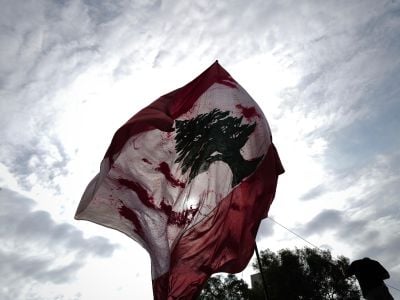
How tragically farcical those scenes were, when hordes of Hezbollah thugs would charge at demonstrators gathered in public squares to beat them up, without the slightest concern for who belonged to the March 14 Alliance and who to the March 8 Alliance; who labels them public enemy number one and who still regarded them as a “resistance.”
Hezbollah had, in fact, understood perfectly well that the movement could only be hostile to it, even if many of those taking part in it failed to realize this, out of ignorance, blindness, naivety, or ideology.
Quite simply, in 2019, Hezbollah was the “system” — and the system was Hezbollah, and nothing else. All the others were either accomplices or defeated opponents.
For years, many Lebanese political figures and intellectuals had been embroiled in a pointless debate. To put it simply, there were — and still are — those who argued that you could repair the bathroom before building the roof, and those who tried to explain that without a roof, the slightest storm would undo whatever repairs had been made here and there.
Hezbollah, however, knew that even the most insignificant loose screw somewhere in the building — its building — would cause the entire structure to collapse.
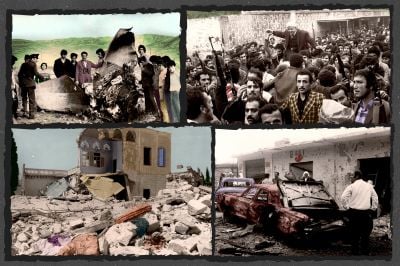
We were told that the problem was the economic model, the Ponzi scheme, the banks, the governor of the Banque du Liban (BDL, central bank) and, of course, the corruption of the political class, whose interests were one and the same as those of the bankers. All of this is undoubtedly true, but only in part.
There is something that caused these long-standing factors to worsen at a certain point, eventually triggering the financial collapse.
There was a time when Lebanon’s economic model and banking system, despite all the criticisms that could be leveled against them, generated prosperity. The fact that this prosperity was poorly distributed does not change that reality. It was only when certain political conditions came together that these former strengths turned into weaknesses.
The Civil War had certainly dealt a severe blow to the country’s economic foundations, but without bringing them down. The same could be said of the stabilization of Arab regimes, which were no longer collapsing every week, each time sending fresh flows of wealth into Lebanon.
After the war, as debt-fueled economic recovery got underway, the state’s political governance became entirely dependent on the goodwill of Syria, the power exercising tutelage over Lebanon which sought to maintain a balance between political forces and communities in a way that served its own interests and perpetuated its hegemony.
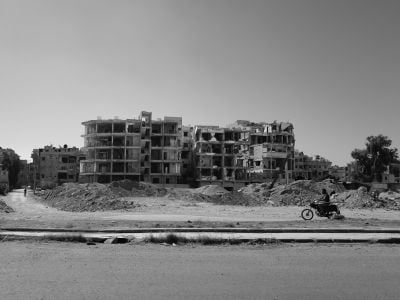
But after 2005, everything changed. Lebanon freed itself from external tutelage, only to enter a period of a fight to the death among its various constituents over how to reshape the balance of power within the state.
Within a few years, Hezbollah, wielding significant leverage, eventually managed to impose its own “system:” consensus as the overriding principle, which in practice gave it veto power over executive decisions, a power that neither the Constitution nor the law grant.
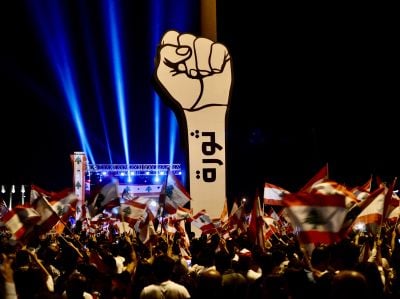
When the Oct. 17, 2019 uprising erupted, this system had already been in place for more than a decade, with one visible result — except to those who refused to see it: the collapse of political governance, reflected in the growing prevalence of patronage politics.
How so? It is simple: once everyone becomes a partner in state decisions, and the government turns into a U.N. Security Council, with each of its constituent groups wielding veto power, political action serves just one purpose: to cater to each group’s own patronage network and consolidate its clan.
But maintaining these patronage networks comes at a high cost, and competition is fierce. Hence the mobilization of BDL and the banking sector to finance what would prove to be a descent into hell, which the clan-based selfishness of some and the lure of profit for others prevent them from seeing. Worse still, when the political forces finally recognize the extent of the disaster, they have reason to rejoice: a widespread impoverishment means even more patronage… at a lower cost!
Added to this is Hezbollah’s open hostility toward the Gulf monarchies, which drove Lebanon away from its traditional donors. And what about the obstacles to the structural reforms demanded by the international community? Hezbollah is largely the architect of these, but it can remain in the shadows because, willingly or not, scrupulously or unscrupulously, most political forces had, on the eve of Oct. 17, already aligned with the “system.”
This is the reality that many of the 2019 protesters failed to grasp, and that some of them still fail to grasp today. Why? Because Hezbollah claims to be “resisting” an occupation that did not exist before its own military adventures of 2023–2024?
What is most alarming today is the realization that Hezbollah is not alone. It has managed to create a “deep state” that undermines the (insufficient) efforts of the current political leadership to dismantle it. It has also built around itself, across all of the country’s constituent groups, a powerful army of useful idiots who help it carry out its mission.
It is against this deep state and these useful idiots that a new Oct. 17 uprising must be brought about today. This time, however, it must be free of the mistakes of the past.
This editorial originally appeared in French on L'Orient-Le Jour and was translated by Joelle El Khoury.
 2 p.m. recap: Pit discovered north of Beirut, Hezbollah warns of ‘imminent explosion’ in the streets, settlers arrested in West Bank