






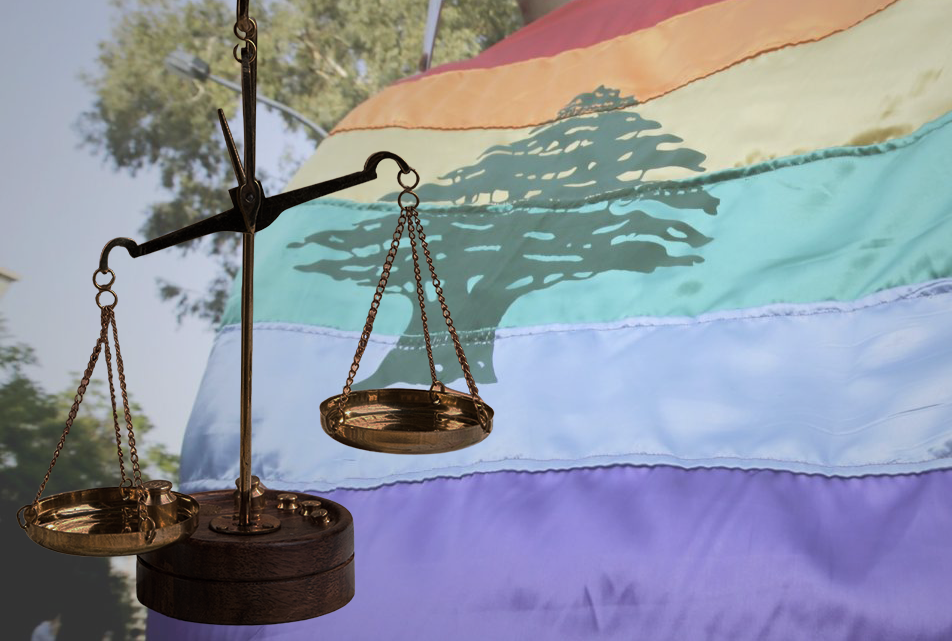
(Collage by Nima Salha/L'Orient Today)






The person whose judicial case for a sex change was in the spotlight last month was born in 1989.
By the time they entered the courtroom six years ago, they had already lived through the long and deeply personal process of transitioning. Then, in July, the state recognized what their life had already made clear. Yet, when the decision became public, all of that complexity seemed to disappear. The debate quickly narrowed to a familiar question: should the law allow this? As though the matter could be reduced to a choice, made in isolation, rather than understood as the culmination of a lifetime of struggle.
A few days earlier, a young trans man I knew died by suicide.
I cannot help but think about these two events together. Although the stories differ, they exist within the same reality: one in which trans people are repeatedly asked to prove the legitimacy of their existence, while the violence, exclusion, precarity and loneliness that shape so many of their lives remain largely invisible to those debating them.

Many of the barriers that trans individuals experience are documented. For most, transitioning is not a choice made under conditions of freedom, but within a web of constraints. Discrimination begins at home and in schools, and continues in the workplace, healthcare, and when dealing with public institutions. Identity documents that do not reflect who someone is expose them to repeated questioning, humiliation, and even danger. These difficulties accumulate and shape a person's ability to live and participate in society effectively and with dignity.
The law does not create trans people; it can only decide whether to recognize them. This distinction matters. For example, when the law recognizes a marriage, a person's right to pass on their nationality to their children, or the right to reasonable accommodations due to a disability, it does not create those relationships, identities, or needs; it gives them legal recognition and consequence. The same principle should guide our understanding of legal gender recognition. When recognition is denied, it does not erase trans identities. Instead, it carries this contradiction into every system that relies on legal identity to function, creating an institutional disorder that prevents people from fully participating in economic, social, and political life, in a country already struggling with profound crises.
Often, the argument is that such court decisions constitute a threat to social norms and order. We should instead consider what this pursuit of legal recognition actually represents: an attempt to be legible within the very legal and social structures that already exist. Not the opportunity to overturn them. More broadly, it can also be understood as bringing us one step closer to a country where people's rights are not determined by sectarian or religious institutions, but by citizenship itself.

In India and Nepal, courts did not wait for unanimous social acceptance before recognizing the rights of transgender people. Landmark judgments established that gender identity is connected to fundamental rights, dignity, equality, and self-determination, and pushed governments toward legal reform. Lebanon's own courts have similarly begun to recognize the gap between a person's lived gender and their legal documents. At least two cases involving requests to change legal gender markers have resulted in favorable rulings. In 1987, a Beirut court granted a request to change a person's gender marker after determining that their legal identity should correspond with their physical reality. In 2015, the Beirut Court of Appeal overturned a lower court's rejection and recognized a trans man's right to change his gender marker, grounding its decision in the discrepancies he experiences, as well as his right to privacy and necessary medical treatment. And now, in 2026, the Bint Jbeil Civil Court has added its voice to this growing body of case law.
The debate, then, should no longer be about whether legal gender recognition should be allowed. Rather, how it should be carried out: based on clear pre-conditions and requirements; through an accessible and streamlined process; and within a predictable and consistent legal framework, rather than one that leaves people's rights dependent on judicial uncertainty and the court of public opinion.
At the end, when we decide what kind of society we want to grow, who are we willing to let bloom, and who are we willing to let die? The judiciary is no spectator to this choice.
Perfect.good job.
15 August 2026 11:19