





Search
Search
Voices from the Middle East

IN DEPTH INTERVIEW

Rahaf Aldoughli: Syria remains an entirely masculinist state


Rahaf Aldoughli: Syria remains an entirely masculinist state

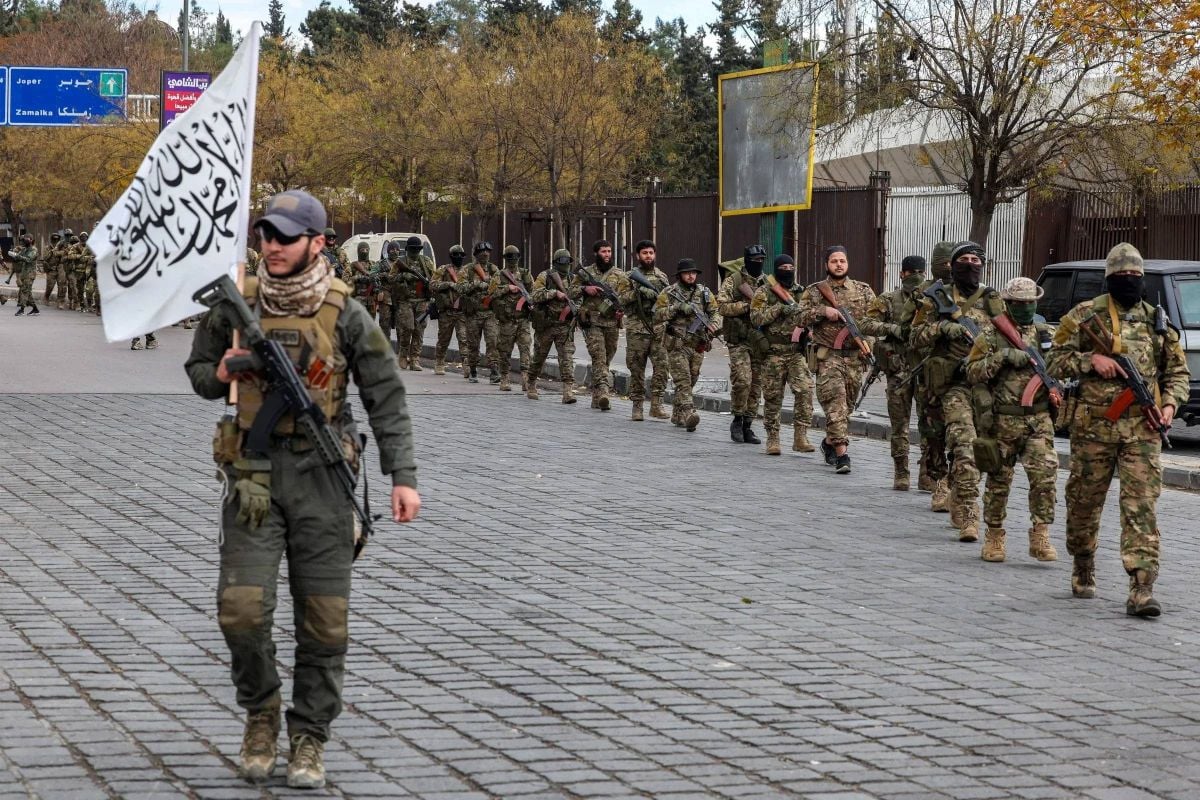
Fighters affiliated with Syria's new authorities, which succeeded the regime of Bashar al-Assad, take part in a military parade in the capital, Damascus, on Dec. 27, 2024. (Credit: Omar Haj Kadour/AFP)


The fall of Bashar al-Assad’s government on Dec. 8, 2024, brought more than five decades of tyrannical rule by the Assad family to an end and opened a contested transition under forces led by Hay’at Tahrir al-Sham.

As Syria’s new authorities seek to consolidate power, questions of political legitimacy, citizenship, sectarian belonging, and women’s place in public life have acquired renewed urgency. The transition has also raised a broader question: how much of the former regime’s authoritarian culture survived the fall?

Dr. Rahaf Aldoughli is a Lecturer in Middle East and North African Studies at Lancaster University. Her research focuses on nationalism, sectarianism, authoritarianism, gender and political violence in Syria and the wider Middle East. She is the author of "Romanticizing Masculinity in Baathist Syria: Gender, Identity, and Ideology" (Manchester University Press, 2024), which examines the intellectual roots and political uses of "romantic" and "muscular" nationalism under Baathist rule.

Drawing on that research, interviews with opposition fighters conducted between 2022 and 2024, and follow-up fieldwork after Assad’s fall, she spoke to L’Orient-Le Jour about the militarized ideal of manhood built by the Baath, its transformation during the uprising and war, and its influence on Syria’s emerging order.

L’Orient-Le Jour: During the revolution and civil war, some analysts portrayed Assad’s Syria as a secular state favourable to women’s emancipation, symbolized by Asma al-Assad, in contrast to conservative Islamist currents within the opposition. Yet your research shows that the regime “romanticized” a particular masculine ideal. What defined it, and what were its intellectual foundations?

Rahaf Aldoughli: There has long been an assumption, even among scholars, that the Baath was a secular state that emancipated women. But even at its height, women held no more than around 12% of parliamentary seats — one of the lowest rates in the world — and only one reached the party’s central leadership. Those seats reflected Baathist loyalty, not women’s empowerment.

What the regime built was an ideal of manhood I call romantic, or muscular, masculinity: belonging to the nation depended on a man’s readiness to fight, sacrifice, and die for the homeland and its leader. It was instilled from childhood through organisations such as tala’i al-Baath and shabibat al-thawra, where boys received paramilitary training while girls learned sewing and cooking. Its foundations lay not in local religion but in the European Romantic nationalism of Herder, Fichte, and Renan, borrowed by the Baath’s founders.

L’OLJ: European colonial powers often constructed two opposing images of the Arab man: effeminate and emasculated on the one hand, threatening and dangerous on the other. Did these representations influence Arab nationalism?

R.A.: To some extent, yes. Early Arab nationalism in the Levant, Egypt and Iraq sprang from a masculinized humiliation, which defeats against Israel in 1948 and 1967 deepened. Defeat itself was painted as emasculation.

The secular, pan-Arab tradition answered by building the nation around a virile, martial and self-sacrificing man: the heroic Arab warrior defending the homeland from foreign invaders. After the French mandate, the Syrian constitution and the Baath’s charter defined the nation against imperialism and colonial domination, making resistance to the external enemy the basis of citizenship. To be a citizen was to be ready to defend the nation, and that readiness was coded as male.

This reflex was not confined to secularists. Islamist and opposition currents defined themselves against pan-Arabism, but never broke from its gendered grammar.

L’OLJ: What impact did Baathist authoritarianism have on masculinity beyond the public sphere, particularly within the home and in family relationships?

R.A.: The two spheres mirrored each other. The ruler was the father of the nation, and the father the ruler of the household: two versions of one hierarchy. A man’s dominion over his household offered compensation, and continuity, for his own subordination to the state.

The legal order made this concrete. A supposedly secular regime left personal status law to religious courts, denied women the right to pass their nationality to their children, criminalized abortion and maintained sharply reduced penalties for honor crimes, reformed only late and partially. Women’s private subordination was not a traditional residue that a modernizing state was overcoming; it was written into state law.

L’OLJ: By contrast, what was the “feminine ideal”?

R.A.: It was defined entirely in relation to men. Arsuzi is the most explicit founder: woman as housewife, the one who “cannot live without the man,” who rests and steadies him so he can fulfil his public duties and keeps the home as a national hearth transmitting the forefathers’ heritage. She appears as mother, as the symbol of land that must be protected and as the witness who rewards male heroism, but never as an agent in her own right.

L’OLJ: Did the militarization of the revolution give rise to new forms of masculinity?

R.A.: It did, as my interviews with opposition fighters between 2022 and 2024, and follow-up work inside Syria after Assad’s fall, show. Militarization produced a new masculinity, though not from nothing and not simply by turning the regime’s muscular manhood against itself. It developed along two intertwined tracks that I call grievous masculinity and combat-driven masculinity. The first was forged in humiliation and the drive to redeem it; the second was consolidated on the battlefield through risk, sacrifice, and brotherhood.

Interviewees almost never called themselves soldiers and rarely mujahidin; they preferred thuwwar, revolutionaries, or rijal al-thawra, “men of the revolution.” Unlike Baathist manhood, grounded in obedience, theirs rested on rebellion against injustice and the reclamation of karama, dignity. To be a man was to be a revolutionary.

Dignity emerged as the reversal of an intensely gendered humiliation. Asked why they took up arms, men recalled scenes of emasculation rather than abstract politics: a father dragged away, a sister slapped, a veiled neighbour pulled from her home as male relatives watched helplessly. These were moral injuries, violations of a sacred order in which men protect family, women and land. Honor saturated the interviews. It was less an Islamist category than a socio-cultural duty, making armed struggle an ethical means of reclaiming manhood.

Brotherhood was perhaps the strongest pull. In armed groups, shared danger and loss forged bonds described as stronger than blood: ikhwa fi al-dam, brothers in blood, a chosen family. The battlefield turned victims of emasculation into bearers of masculine worth and fused personal, revolutionary, and collective identities.

L’OLJ: To what extent does this new masculinity break from the Baathist ideal?

R.A.: In its source of authority, it broke from the Baathist model: dignity was earned through resistance rather than submission to the father-leader, and manhood proved in rebellion rather than service to the state. But its deep structure carried the regime’s masculinity forward: honor, protection, sacrifice, a feminized nation and womenfolk to defend, and a man proving his worth through his readiness to kill and die.

The revolutionary identity defining these fighters’ masculinity did not disappear when Assad fell. Victory was supposed to redeem their sacrifice, yet for most fighters I interviewed again it brought no such redemption.

L’OLJ: Why?

R.A.: The new authority kept its core intact. The men governing are Hay’at Tahrir al-Sham’s leaders, and the state they are building rewards loyalty to that core over competence. Fighters who had done the fighting and dying saw their institutions dissolved, posts handed to cadres from Idlib, and themselves placed under commanders they had distrusted or fought. What they carried out of the war was not recognition but a fresh sense of grievance: after paying the highest price, they were sidelined in the very order their sacrifice had produced.

L’OLJ: What are the consequences of this form of marginalization?

R.A.: This unrealized revolutionary feeling has not stayed contained. Fused with a narrative of Sunni victimhood, the majority's long suffering reread as a claim to own the new order, it has hardened into what I call, in my book, hyper-Sunnism, and it has turned outward against those recoded as the enemy.

The grievous masculinity once aimed at the regime has become vengeance against ethnic and sectarian minorities. The coastal massacres of Alawites in March 2025, triggered by the ex-regime “fulul” ambush which killed over 400 security men, when fighters went house to house asking whether residents were Alawite or Sunni before deciding who would live, and the massacres of Druze in Sweida in July 2025 were gendered as well as sectarian killings. They were rituals of emasculation in which victors unmade the enemy’s manhood to assert their own, forcing Alawite men to bark like dogs and shearing Druze men’s moustaches, striking at the emblem of their dignity.

The new order stages masculine authority through two figures: the masked, armed and overtly pious security man, and the suited technocrat performing moderation for an international audience. Both leave women at the margins. There is only one woman among 23 ministers. The dead are commemorated in the streets as sons and brothers, while women who fought, were detained or disappeared are written out of public memory.

L’OLJ: Are we then witnessing the replacement of one strongman by another in Ahmad al-Sharaa?

R.A.: In one important sense, yes. Syria remains an entirely masculinist state whose political culture cultivates a militarized ethos. Assad’s fall removed Bashar and the cult of personality built around his family over five decades, but not clearly the habit that cult expressed, with the nation embodied in one strong male figure.

In the minds of many Sunni Syrians, we can even note an analogy between Sharaa and Saddam Hussein’s frame of masculinity.

The 2025 Constitutional Declaration concentrates executive authority, the selection of the legislature, and senior judicial appointments in one office. Official language increasingly casts Sharaa less as the head of a constitutional order than as its savior and liberator. The form persists, but the source of this masculinity and the idiom in which it is performed have changed almost completely.

Baathist masculinity was manufactured from above. Hafez sculpted the nation in his image as a father-commander with intimate and absolute authority. Bashar [his son] inherited this militarized vision but softened its surface, presenting himself as a modern, cross-sectarian leader: the London-trained ophthalmologist and civilian moderniser, the doctor rather than the general his father had been, who married a Sunni woman in 2000 as a signal of modernity above sectarian divisions. When that apparatus fell in December 2024, the identity it sustained dissolved within a fortnight, showing how much of it had been performed compliance.

Sharaa’s provenance is completely different. His authority was not granted by a state or inherited from a father; it was earned on the battlefield through a jihadist and revolutionary trajectory. The revolution’s militarized manhood is now installed at the summit, and his symbolic choices make that visible. In his Victory Speech on Jan. 29, 2025, he stood before armed factions in Damascus and announced their dissolution. Legitimacy moved from party or ideology into the singular male body of the man able to disarm other men, absorb their legitimacy, and overwrite their masculinities with his own.

His masculinity is doubled because Western leaders also hail it. Externally, he offers pragmatism and moderation. Internally, he remains the steadfast military and religious leader, governing through his HTS core and distributing positions by loyalty rather than competence, with his piety and militancy undiminished.

L’OLJ: What elements does Sharaa draw upon in constructing his image as a head of state?

R.A.: The first is a biography of grievance and resistance. In recent interviews, he refuses to disown his past, framing his radicalization as the natural response of a young Arab man who came of age watching the invasion of Iraq and felt rage. The second is religious legitimacy: the pious masculinity of the mosque and armed piety, with the leader cast as protector. The third is a sectarian-sovereign frame, in which he is being constructed, and constructs himself, as the shield of Sunnis and saviour of the Sunni crescent, while the war against Iran positions him as the strongman rolling back Iranian and Shiite influence. The fourth is external validation of his manhood.

L’OLJ: Can we describe the new order as “Sunni rule”?

R.A.: The first thing to say is that Sunnism in Syria is not one thing but many: Damascene Sufi-traditionalists, Salafis, daʿwa currents, the Muslim Brotherhood, activist currents and the Idlib networks now in power, each with a different account of Islam. As one senior official told me, Sunnis across these currents might be more open to Christians than to one another. Rivalry persists between the Sufis and the new authority. I call this “sectism”: the permanent contest within the Sunni field over who may define authentic Sunnism.

What has emerged under Sharaa is not yet a coherent Sunni-Islamist state implementing a doctrine. I call this hyper-Sunnism, whose key feature is saturation without consolidation. Sunni symbols and vocabularies saturate public life — the call to prayer sounding through ministries, Umayyad chants and the honorific “sheikh” migrating into government offices — yet no official state program unifies them. There is no presidential address naming an Islamic vision of the state, constitutional definition of the relationship between sharia and law, or single authoritative account of what Sunnism demands.

L’OLJ: So, Syria isn’t really being “islamized”?

R.A.: It might become so within a few years, and the everyday texture of public and private life is changing fast. The clearest sign is the Ministry of Awqaf. Under Assad, it was an instrument of co-optation: a minority-led regime extracted religious legitimacy from the Sunni majority to secure the ruler’s survival. Its target was the cleric. Central directorates vetted Friday sermons and required imams to name Bashar in supplications broadcast from mosque loudspeakers. It kept the pulpit obedient but did not regulate the ordinary believer.

Under the new authority, the target has shifted from cleric to citizen. The Ministry now runs public daʿwa campaigns of a kind no Baathist minister would have contemplated, promoting sanctioned marriage, prescribing lawful dress and policing devotion in commercial and public space; the call to prayer sounds through government ministries. Provincial and municipal authorities have also imposed a makeup ban in Latakia, a prohibition on gender-mixing in Wadi Barada, alcohol restrictions in Damascus and a ban on dance classes in Hama, all part of the same drift.

I call this moralization: a religious bureaucracy once charged with managing religious authority now actively shapes the religious-moral content of ordinary life and reaches into private space in ways the Assad-era Awqaf did not.

What the state does not do through its institutions, it permits others to do: this is the second half of the mechanism. Abd al-Razzaq al-Mahdi, a Salafi cleric with a long, openly antagonistic history with Sharaa after he left HTS in 2017 and demanded the release of its detainees in 2024, led a takbir procession on the eve of Eid al-Adha through Hamra Street and Bab Touma, among Damascus’s most cross-communal and historically Christian quarters, under visible General Security protection.

Sheikh al-Dhahabi, an Egyptian former Nusra official on the coast, injured in the war and disavowed by fellow muhajirun, has campaigned since Assad’s fall to distribute a million “lawful” garments. His campaign targets women who already cover in their own regional styles, steering them toward a single sanctioned form, and operates inside universities with local approval and, again, General Security protection. Neither man is a creature of the new authority: one is an old antagonist, the other a disavowed foreigner. Yet the state neither sponsors nor suppresses them. It turns a blind eye, and in doing so reaps the religious saturation of public space without ever authoring it.

The fall of Bashar al-Assad’s government on Dec. 8, 2024, brought more than five decades of tyrannical rule by the Assad family to an end and opened a contested transition under forces led by Hay’at Tahrir al-Sham.As Syria’s new authorities seek to consolidate power, questions of political legitimacy, citizenship, sectarian belonging, and women’s place in public life have acquired renewed urgency. The transition has also raised a broader question: how much of the former regime’s authoritarian culture survived the fall?Dr. Rahaf Aldoughli is a Lecturer in Middle East and North African Studies at Lancaster University. Her research focuses on nationalism, sectarianism, authoritarianism, gender and political violence in Syria and the wider Middle East. She is the author of "Romanticizing Masculinity in Baathist Syria: Gender,...



