






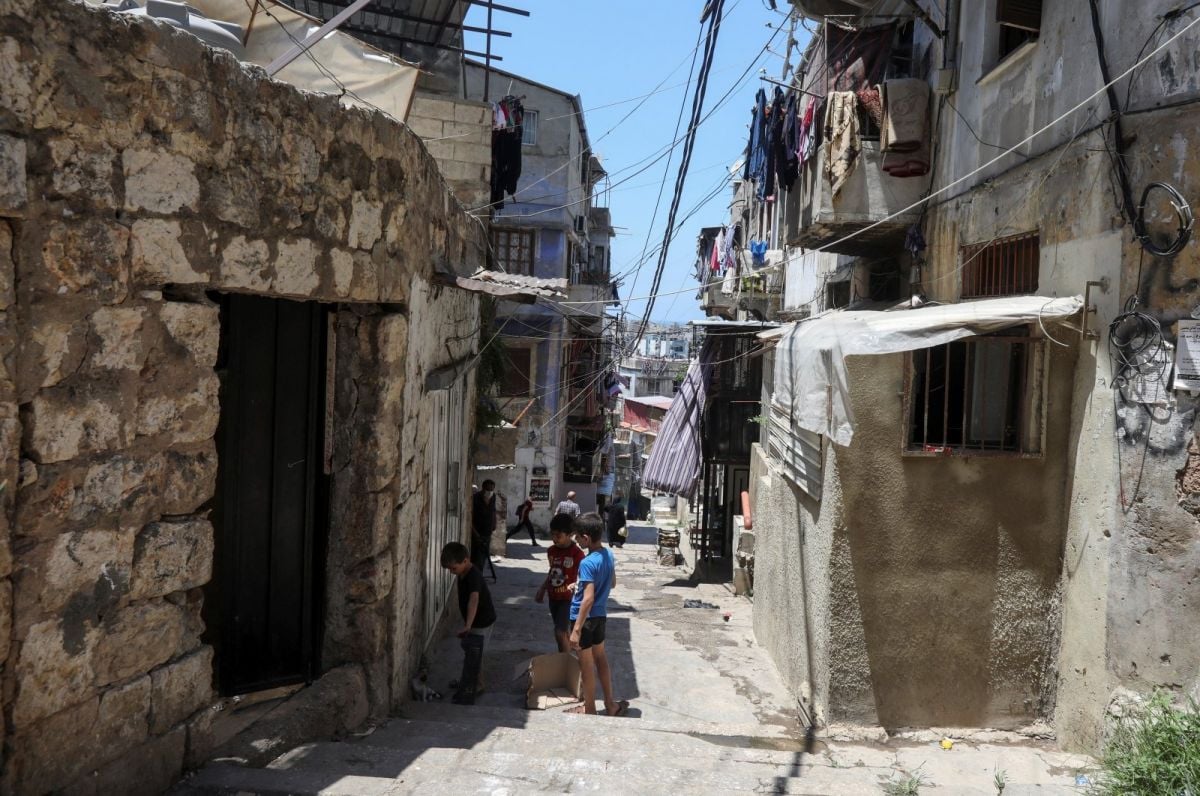
Boys play in an alleyway in Tripoli, northern Lebanon, July 1, 2020. (Credit: Reuters)






Mustafa Dah is an Associate Professor of Finance and the chairperson of the Department of Finance and Accounting at Lebanese American University (LAU)
Lebanon is often described as resilient for its businesses that stay open, families that keep paying, hospitals that keep running, and schools that keep teaching.
There is truth in that. But the descriptor praises survival without asking who pays for it, and what a country becomes when survival itself becomes privately financed.
Lebanon has kept functioning through political deadlocks, economic crises, and war because people have learned to replace what the state does not provide.
Generators and solar panels have replaced unreliable public electricity.. A lack of trust in the financial system has made way for cash and transfer apps, and remittances stand in for an economy that no longer provides reliable income. Private services fill in the gaps of public ones. This is usually called adaptation, entrepreneurship, or simply survival.

It is also a resilience tax: the extra amount households and businesses pay every month because public systems do not work. No ministry collects it. No budget records it. It is spread across many small charges, plus the hours lost managing problems that should not require private management. That is part of why it stays invisible, even though it adds up to real money.
The problem is not that people adapt. They have no choice. The problem is that adapting has become so normal it hides how badly the state has failed. What started as coping has become a shadow public sector, one built not on rights or equal access, but on who can pay. It is reshaping Lebanon in five ways.
First, it turns public failure into unequal citizenship. A public system, however flawed, is supposed to provide the same basic level of service to citizens regardless of how much they can pay. Private substitutes do the opposite. A household with access to dollars can buy continuity. Those who don’t absorb delay, lower quality, and debt. Both are Lebanese citizens, but they no longer experience citizenship in the same way. One buys distance from the state's failure. The other lives inside it.
Second, the tax is regressive. Survival costs do not shrink because a family earns less. For a wealthy household, they are an annoyance. For a poor one, they can consume whatever remains after rent and food. That is what a regressive tax looks like, whether or not anyone calls it one.
In February 2026, the Cabinet approved an immediate LL 300,000 increase on every 20-liter can of gasoline, while exempting diesel from the same measure because private electricity depends on it. That exemption is the real story: the state is taxing around a broken system rather than fixing the one that made the workaround necessary.
In the same package, it also agreed to send Parliament a proposal to raise VAT from 11 to 12%, adding another regressive layer to households already paying privately for public failure.
Third, it lowers pressure on the state itself. If every basic function has a private substitute, the pressure to rebuild the public one weakens. Failure becomes manageable enough for those in charge to leave it as is.

Fourth, workarounds stop being temporary and start becoming systems of their own. Each one develops revenues, routines, clients, and people whose livelihoods now depend on the gap staying open. What began as a response to state failure can turn into a competing arrangement that resists being replaced, because dismantling it would cost real people real income, not just inconvenience the state.
Fifth, the resilience tax weakens citizens' incentive to demand change. The households most able to buy their way through failure are often also the households most able to push for repair. But because they can rely on private substitutes, they are also more likely to opt out of unreliable public services, a pattern economist Albert Hirschman identified in his work on exit and voice. What is rational at the household level becomes corrosive at the national level.
The answer is not to eliminate private coping. It is to redirect private coping toward the public systems it was forced to replace. Private solar should reduce dependence on generators while grid repair remains the goal. Payment apps and digital wallets need consumer protection and clear rules. Remittances should be treated as family support, not a national development strategy. A child's education and a patient's treatment should not depend only on what a family can privately afford.
Lebanon did not survive because its state worked. It survived because its people kept replacing the state, piece by piece. That is an achievement but also a warning. The question for the next stage of recovery is not how much more Lebanese society can absorb. It is how much longer the country can afford to make private citizens pay for public failure.