


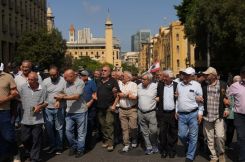
Protesters gathered near the Lebanese Parliament in downtown Beirut ahead of parliamentary sessions, Aug. 11, 2026. (Credit: Mohammad Yassine/L’Orient-Le Jour)






BEIRUT — With a sufficient number of members present to ensure a quorum when the session resumed at 6 p.m., MPs had time to vote on the information law, which had been awaited for over 15 years, before the departure of MPs from the Free Patriotic Movement (FPM) and Hezbollah caused a loss of quorum just as they were about to address the highly controversial general amnesty law. The session was ultimately adjourned, and examination of the text was postponed until Wednesday, bringing to light the tensions surrounding the bill, which had been in the works for several weeks.
According to media outlets present in the chamber, the Parliament speaker had decided to wait in an attempt to persuade MPs to return, while discussions were underway to reverse the situation. Meanwhile, Ibrahim Kanaan, an MP from the Free Patriotic Movement and chairman of the Finance Committee, had also withdrawn.
At the heart of the tensions that had already led to the suspension of the morning session was Defense Minister Michel Menassa's desire to speak and outline the army's reservations about the bill, while Prime Minister Nawaf Salam maintained that it was the prime minister's prerogative to express the executive branch's position. Menassa was not present when the debates resumed.
During the break, Elias Bou Saab confirmed to the media that the session had been suspended to resolve the dispute. Meanwhile, Parliament Speaker Nabih Berri was scheduled to meet with Salam to try to break the deadlock.
L'Orient-Le Jour also learned from parliamentary sources that contacts had been made with the Defense Ministry during the suspension, particularly to try to soften the army's reservations regarding the bill. A parliamentary source contacted by L’Orient-Le Jour had not hidden their fears that the vote would be prevented due to a lack of quorum, while the FPM parliamentary group had met on the sidelines of the debates to discuss how to proceed with the dispute.
“We are not going to stand idly by while a prime minister commits a flagrant violation of the Constitution,” declared FPM MP Cesar Abi Khalil, referring to Article 67 of the Basic Law, which stipulates that ministers have free access to the chamber and must be heard when they request it.
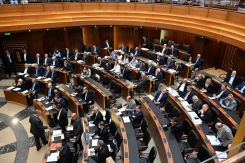
The quorum was indeed present when the session resumed, but Menassa did not attend. According to MP and former General Security Director Jamil al-Sayyed, the prime minister allegedly prevented his defense minister from participating in the debates until he changed his position on the amnesty law. The MP further stated that Salam also believed that if the bill were not passed, the defense minister would put the army at odds with the Sunni community.
Speaking in Parliament, Salam denied this version of events and reiterated that the Constitution stipulates that the prime minister represents the government and speaks on its behalf, confirming that Menassa had indeed prepared a statement regarding the proposed amnesty law.
“I informed him that I would speak on behalf of the government when this point was raised and that there was therefore no need for further intervention,” he explained, citing Article 64 of the Constitution, which states that “the President of the Parliament is the head of government, he represents it and speaks on its behalf … We are not 24 governments,” he declared.
Regarding the army command’s position on the amnesty law, Salam explained that it had already been presented to the parliamentary committees through the defense minister, who had also submitted a written memo on the matter prior to the adoption of the final version of the proposal currently before MPs.
Dinner proposal
The prime minister reaffirmed his commitment to the military institution, emphasizing that he would not accept "anyone claiming to be more concerned than we are about the army and its martyrs." He concluded by asserting that his concern for preserving the army led him to reject any interpretation or position that might portray it as a party in a confrontation with a Lebanese faction or place it in conflict with any party on the domestic scene.
According to local media, MP Sajih Attieh suggested to Berri that he invite Salam and Menassa to dinner to resolve their disagreement, believing that the president of the republic — the defense minister being part of his quota in the Salam government — and the prime minister seemed to be "operating on two different lines of reasoning."
Salam immediately retorted: "Let no one involve the president of the republic in this matter. My relationship with the defense minister is excellent."
In recent days, MP Nabil Badr had predicted to L’Orient-Le Jour that the amnesty bill would be adopted without difficulty on Tuesday, especially since its final version had the support of the main Sunni figures, despite their initial divisions. On one side, some MPs were calling for the release of as many prisoners as possible, including Islamist Ahmad el-Assir, imprisoned since 2015 for his participation in the deadly clashes against the army in Abra in 2013. Most of these MPs boycotted the session.
On the other side, several Sunni MPs were advocating for the swift adoption of the amnesty law. Among them were Nabil Badr (Beirut), Walid Baarini (Akkar) and Bilal Hosheimi, who had attended the session. The Lebanese Forces, for their part, indicated that they would side with the Sunni MPs on this issue. The party's elected representatives are expected to vote in favor of the bill.
On July 16, Parliament had already convened to examine the amnesty law, while the Sunni community, though largely in favor of the principle of amnesty, was deeply divided on the text to be adopted.
Law on information and bank resolution
At the start of the evening session, at 6 p.m., MPs quickly voted on the information bill, which had been awaited since 2010. Recently approved by the joint parliamentary committees, the bill had stirred controversy in journalistic circles and among advocates of freedom of expression.
At issue, in particular, was paragraph b of Article 104, which provided for prison sentences of up to three years, with the possibility of increased sentences or forced labor in certain cases, for "disinformation and the dissemination of false information or harmful news." This provision could be open to numerous interpretations and infringe upon press freedom, a source close to the journalists' union told our newspaper. According to several sources, however, Article 104 has been removed from the text.
Amendments to the Bank Resolution Law adopted last year are also on the parliamentary agenda. At the request of the International Monetary Fund (IMF), the government prepared a series of amendments, which were submitted to Parliament on May 12. These amendments, examined during seven meetings of the Finance and Budget Committee between June 11 and Aug. 3, were subsequently revised by MPs.
The new version has raised concerns among several government officials. According to them, some changes backed by committee Chairman Ibrahim Kanaan, Banque du Liban Governor Karim Souhaid and a majority of committee members depart from the version negotiated with the IMF, raising the prospect of a scenario similar to that of the banking secrecy law, which underwent several revisions between 2021 and 2025 to comply with the fund’s requirements.
Exchanges and sit-ins
Tuesday’s session was also marked by another dispute. MP Ali Hassan Khalil questioned the government about a recently published Israeli map that appeared to annex part of southern Lebanon, as well as the measures authorities had taken in response. MP Kassem Hachem also criticized the government’s handling of the situation in southern Lebanon.
MP Samy Gemayel then addressed Berri, saying: “If power is worth so little, why don’t they resign?” He was referring to Hezbollah-affiliated ministers. Hezbollah MP Hussein Hajj Hassan responded: “We know who we sit with and who we talk to, and we do not ask for your opinion.”

 7 p.m. recap: 1 person killed near border with Lebanon; 200 kilos of explosives carried by mules; Riyadh shuts its airspace