






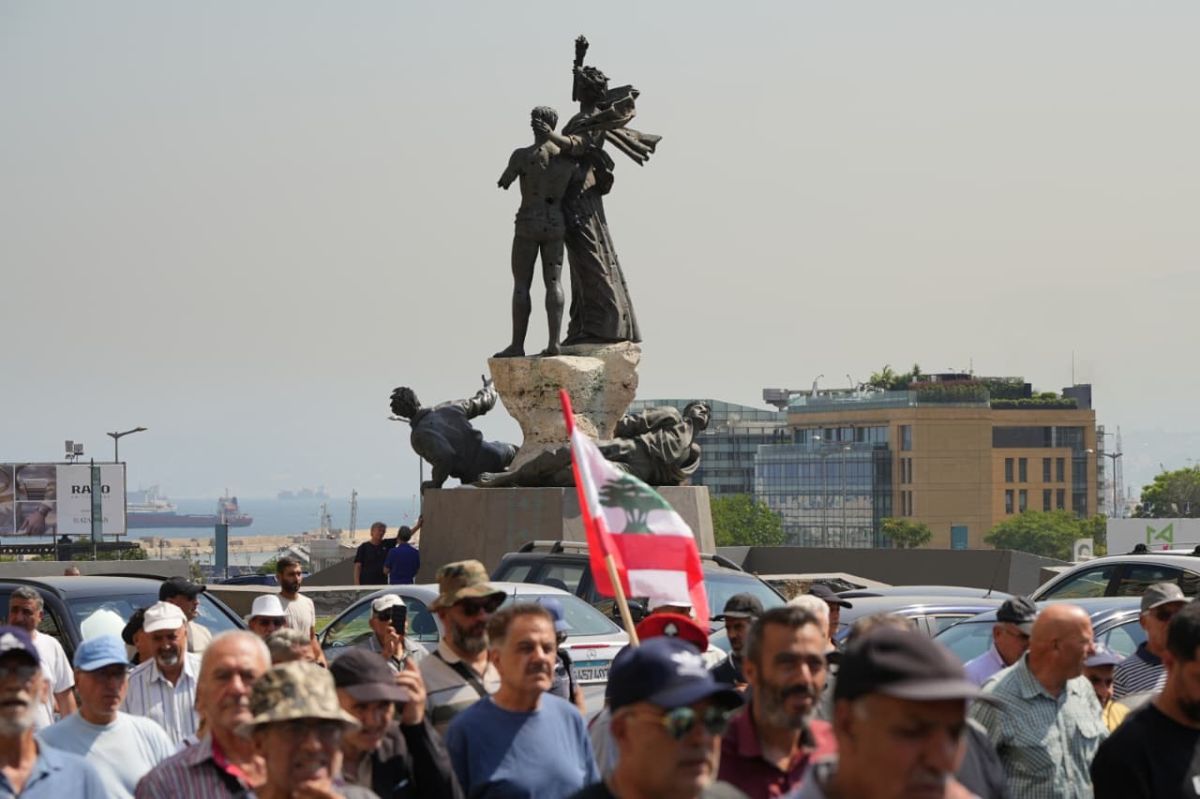
A sit-in takes place in Martyrs’ Square as lawmakers meet in the Lebanese Parliament in downtown Beirut, Aug. 11, 2026. (Credit: L’Orient-Le Jour/Mohammad Yassine)






BEIRUT — Lebanon took a historic step Tuesday as Parliament voted to abolish the death penalty, ending a de facto moratorium that had been in place since January 2004.
The amended law removes capital punishment from Lebanese legislation, meaning courts will no longer be able to issue death sentences. It also specifies that crimes committed before the law entered into force will instead be punishable by life imprisonment.
According to L’Orient-Le Jour, MPs from the Free Patriotic Movement, Hezbollah and independent MP Jihad Samad voted against abolishing the death penalty.
The vote came during a parliamentary session that was later suspended over a dispute between Prime Minister Nawaf Salam and Defense Minister Michel Menassa regarding the general amnesty law.
Justice Minister Adel Nassar congratulated Parliament in a statement to L’Orient-Le Jour, calling the vote a landmark for human rights.

“Lebanon is today reclaiming its pioneering role in the region as a protector of human rights,” Nassar said, adding that judges would no longer face the “dilemma of deciding whether or not to put an end to a life.”
“By abolishing the death penalty, Lebanon has chosen to fight murder rather than resort to killing,” he added.
Nassar stressed that abolishing capital punishment should not be interpreted as leniency toward criminals. “Deprivation of liberty is not leniency,” he said, adding that Lebanon had sent “an essential message in favor of fundamental rights” at a time when human rights are increasingly marginalized across the region.
The abolition of the death penalty was one of several major bills debated during Tuesday’s parliamentary session, alongside the long-awaited general amnesty law.
UN reaction
The U.N. High Commissioner for Human Rights welcomed the Lebanese Parliament's vote to abolish the death penalty, calling on countries in the Middle East and North Africa to follow suit.
"Lebanon is now the first country in the region to take this step, and I call on other countries that still retain the death penalty to follow its example by ending this inhumane practice," Volker Türk said in a statement.
Human Rights Watch
In a statement released mid-afternoon, the Justice Ministry stressed that Adel Nassar had placed this reform “at the forefront of his priorities” since the formation of Nawaf Salam’s government in February 2025, defending the conviction that “the strength of justice is not measured by its ability to end the life of a condemned person, but by its ability to establish the truth, to deliver justice to victims and to punish perpetrators in accordance with the guarantees of the rule of law.”
Ramzi Kaiss, a researcher at Human Rights Watch, also welcomed the decision, describing it as “a monumental step for human rights in the country, a clear break with a cruel and arbitrary sentence that should never have been imposed.”
Activist Ougarit Younan, known for her long fight against the death penalty, describes the adoption of the law abolishing it in Parliament as a "historic moment."
"This is the case in all countries where the death penalty is abolished because this law changes the very concept of governance when the authorities are stripped of the prerogative to kill," she told L'Orient-Le Jour.
Present in Parliament for the vote on Tuesday, along with several young activists, Younan, who is also a sociologist, writer and trainer, described the palpable emotion in the chamber.
"The vote was followed by applause, and afterward, we took a photo with the MPs who supported the bill on the Parliament steps, despite the guards' protests," she recounted.
Regarding the text itself, she protested against certain amendments that retained the terms "forced labor" and "aggravated life imprisonment" in the law.
"But at least they followed my advice by keeping Article 1 clear and concise, with this single, clear sentence: The death penalty is abolished from all Lebanese laws," she emphasized.
Younan, however, cannot help but share a somewhat mixed feeling: "For me, the abolition of the death penalty is a major event in any country. I wonder how Lebanon, still at war and plagued by successive crises, is currently able to seize this moment and grasp its magnitude. Especially when death remains so omnipresent in the news."
On a personal note, she wished that her life partner, writer Walid Slaiby, who died in May 2023, were still alive to witness this major achievement. “His writings were cited several times in Parliament during the debate,” she remarked.
EU reaction
The European Union also congratulated Lebanon on adopting the law abolishing the death penalty “for all crimes, including with retroactive application,” in a statement by EU High Representative for Foreign Affairs Kaja Kallas on behalf of the Union. She said the abolition “is a continuation of the de facto moratorium on executions observed in Lebanon since 2004 and demonstrates Lebanon’s commitment to respecting, protecting and guaranteeing the right to life.”
“By becoming the first country in the region to abolish the death penalty, Lebanon sets a powerful example for other countries in the Middle East and beyond, reinforcing the global trend toward abolition and the growing international support for the elimination of capital punishment worldwide,” the statement continued.
‘An example for countries in the region’
Former Justice Minister Ibrahim Najjar shared the activist’s enthusiasm. “My first reaction to the announcement of the abolition of the death penalty was to think that this is a great day for Lebanon, a decision that makes it an example for countries in the region, including Israel,” declared Najjar, who has also been vice president of the International Commission on the Abolition of the Death Penalty (ICPD) since 2018.
“The abolition of the death penalty and democracy go hand in hand; all authoritarian regimes rely on the death penalty and executions to consolidate their power,” he told L’Orient-Le Jour.
The legal expert welcomed the political circumstances that allowed for the “miracle” of the vote against the death penalty in Parliament, praising Justice Minister Adel Nassar, as well as President Joseph Aoun and Prime Minister Nawaf Salam, who agreed to bring the bill before Parliament. He noted that the division during the vote was not based on sectarian or religious affiliation, whereas there was a time when many claimed that abolishing the death penalty contradicted the teachings of Islam.
For Najjar, the abolition of the death penalty in Lebanon today is the culmination of a long process of de facto suppression, since no executions have taken place in the country since 2004. He pointed out that Lebanon voted in favor of a moratorium on the death penalty at the U.N. General Assembly in 2011 and that it adopted a resolution even allowing those sentenced to death to benefit from a commutation of their sentences. Furthermore, the creation of the Special Tribunal for Lebanon following the assassination of former Prime Minister Rafik Hariri in 2005 also necessitated the suspension of executions.
“On a more personal level, I feel immense satisfaction because I see that the human person, in all their dignity, is placed at the heart of Lebanon,” Najjar said.
‘Life is a gift from God’
Opposition MP Marc Daou celebrated the abolition of the death penalty on his social media account, calling it “murder by law.”
“Life is a gift from God, and no human being has the right to end it,” he continued. The MP asserted that “life imprisonment and lifelong deprivation of liberty are far worse punishments than execution.”