


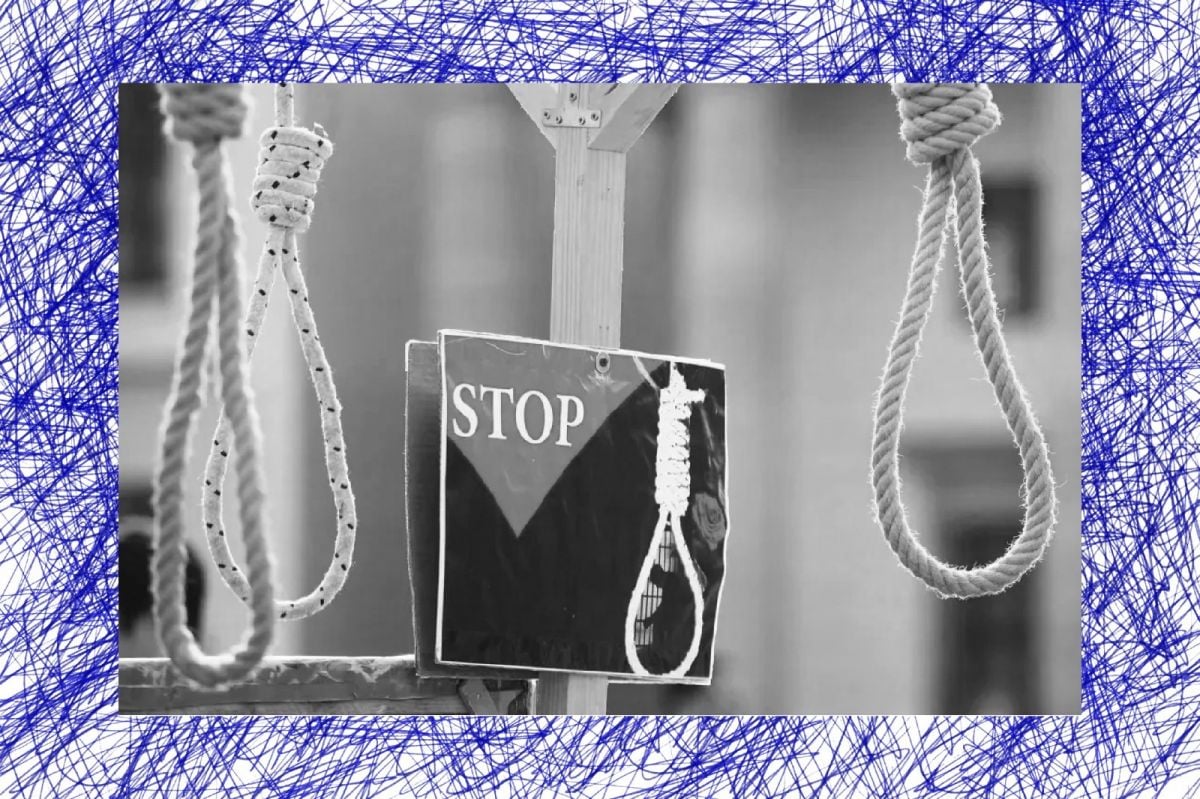
A poster in support of abolishing the death penalty. (Credit: Wolfram Steinberg/AFP/DPA)

Lebanon recently announced that it had begun the process of abolishing the death penalty. At first glance, the announcement may seem largely symbolic. After all, Lebanon has not carried out a single execution since 2004, more than 20 years ago.
Yet here’s the paradox: Lebanese courts continue to hand down death sentences.
Justice Minister Adel Nassar made the announcement during the 9th International Congress Against the Death Penalty in Paris, where Lebanon’s move was welcomed as a major step toward abolition.
The timing was also notable.
Just a couple of months earlier in March, Israel approved legislation allowing the death penalty for Palestinians convicted of deadly terrorist acts, making Lebanon’s announcement stand out even more in the regional context.
So, how did Lebanon get here? What does the law say about capital punishment? And why does it still exist if it is no longer carried out?
Let’s break it down.
1- What does Lebanese law say about the death penalty?
Capital punishment has existed since ancient times and was originally rooted in the principle of retributive justice — the idea of “an eye for an eye” — whereby punishment was meant to mirror the gravity of the crime.
After gaining its independence from the French mandate in 1943, Lebanon incorporated the death penalty into its Penal Code when it was adopted that same year, making it one of the punishments that courts could impose for the country’s most serious crimes.
Today, the death penalty remains legal.
Lebanese courts can still impose it for some of the country’s gravest crimes, including aggravated murder, certain terrorism-related offenses resulting in death, treason, espionage, crimes against state security and some military offenses committed during wartime. Altogether, 41 legal provisions across the Penal Code, the Military Justice Code and several special laws still allow courts to issue death sentences.
It's important to note that receiving a death sentence, however, does not automatically lead to an execution.
Once all appeals are exhausted, the case is referred to the Higher Judicial Council, which gives its opinion on whether the sentence should be carried out or commuted.
An execution can only take place after a decree is signed by the president, the prime minister and the justice minister. If any one of them refuses to sign, the execution cannot proceed.
The method of execution depends on which court handed down the sentence. People convicted by ordinary criminal courts are executed by hanging, while those sentenced by military courts face a firing squad.
The last executions in Lebanon took place in January 2004, when three men were executed inside Roumieh Prison — two by firing squad and one by hanging. The three men had been convicted in separate murder cases, including the killing of eight co-workers in a shooting spree, the murder of three Lebanese soldiers and a triple homicide committed during an armed robbery.
According to the Lebanese Army’s legal review, 53 executions were carried out between Lebanon’s independence and 2004. Since then, no execution decree has been signed, even though Lebanese courts have continued to issue death sentences.
Today, abolitionist organizations estimate that more than 78 people remain on death row, including at least four women.
2- If Lebanon stopped carrying out executions in 2004, why does the death penalty still exist?
The answer lies in what lawyers call a de facto moratorium.
Unlike abolition, a moratorium does not remove the death penalty from the law. It simply means the state voluntarily stops carrying out executions while courts continue to hand down death sentences.
The push to abolish the death penalty, however, began even earlier.
At the institutional level, several initiatives sought to translate the moratorium into law.
In 2004, seven MPs introduced the first parliamentary bill to abolish the death penalty and replace it with life imprisonment with hard labour. The proposal, however, never passed. This was followed by a similar proposal by the Justice Ministry in 2008.
In 2011, Parliament amended the Law on the Execution of Sentences, allowing judges, under specific conditions, to commute death sentences to prison terms.
In 2012, Parliament debated Lebanon’s National Human Rights Plan, which recommended adopting the U.N.’s call for a global moratorium on executions, ratifying the Second Optional Protocol to the International Covenant on Civil and Political Rights, and modernizing prisons to accommodate inmates serving life sentences.
None of these initiatives, however, resulted in the abolition of capital punishment despite the suspension of executions.
Civil society played an equally important role.
In 1997, activists Ogarit Younan and the late Walid Slaiby launched Lebanon’s National Campaign to Abolish the Death Penalty, publishing one of the country’s first comprehensive studies on capital punishment. A parliamentary survey they conducted in 2001 helped pave the way for legislative reform, and in 2003 they co-founded the Lebanese Association for Civil Rights (LACR), which spent years lobbying MPs, documenting death-row cases and advocating abolition.
In October 2025, the LACR drafted the bill currently before Parliament, signed by seven MPs
Among the movement’s most prominent voices is Antoinette Chahine, who was sentenced to death before being acquitted after a retrial, becoming a symbol of the risk of wrongful convictions. She was accused of involvement in the allegedly politically motivated 1992 murder of Father Sam’an Boutros al-Khoury,
She has campaigned alongside lawyer Lina Aya Chamoun of the Justice and Mercy Association (AJEM), which has long advocated for prisoners’ rights and alternatives to capital punishment.
3- Where do things stand now?
Lebanon may be closer than ever to formally abolishing the death penalty.
In June 2026, a few months after the Lebanese government issued a favorable opinion, Parliament’s Administration and Justice Committee approved the LACR bill filed in October 2025, which calls for abolishing capital punishment and replacing it with life imprisonment under very strict detention conditions after introducing several amendments.
The bill is sponsored by seven MPs from different political blocs. It must now be debated and voted on during a plenary session — a meeting of all 128 MPs, where a simple majority of those present is enough to pass the law.
Momentum has also grown outside Parliament.
Speaking at the 9th International Congress Against the Death Penalty in Paris, Justice Minister Adel Nassar announced that Lebanon “began the process” of abolishing capital punishment after more than two decades of a de facto moratorium, describing the reform as part of the country’s commitment to democracy and human rights.
Whether the law is finally adopted now depends on Parliament, which has the final say.





