


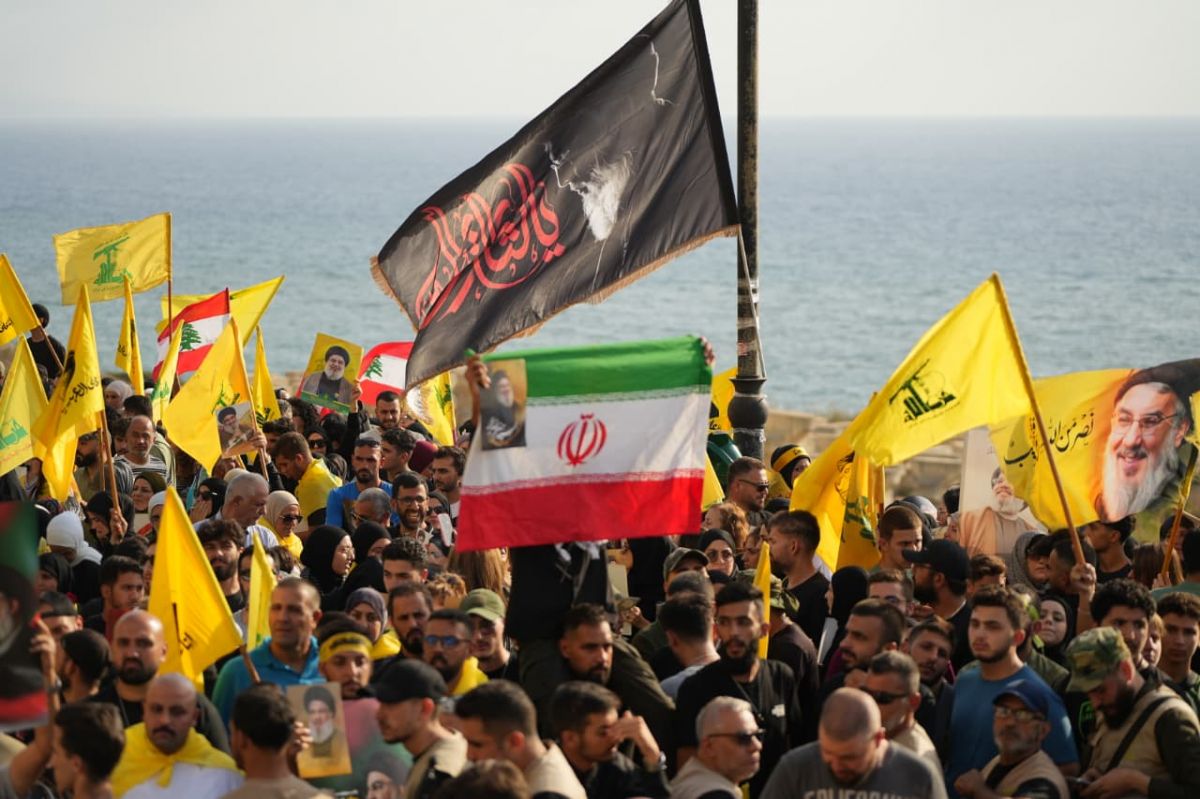
Hezbollah, Lebanese and Iranian flags waved during the commemoration of assassinated Hezbollah leader Hassan Nasrallah on the Beirut Corniche, on Sept. 25, 2025. (Credit: Mohammad Yassine/L'Orient-Le Jour)






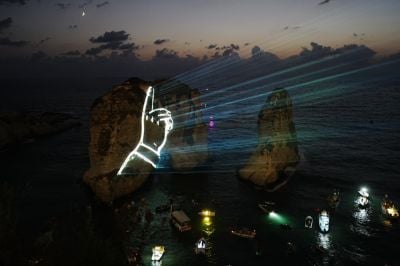
Back from New York, President Joseph Aoun on Monday defended the army and security forces, who were accused of failing to act to prevent Hezbollah from projecting images of its late leaders onto Beirut’s Raouche Rock, in defiance of a ban by Beirut governor Marwan Abboud.
Aoun, who had until now stayed silent on the controversy surrounding last Thursday’s commemoration of Hassan Nasrallah’s assassination, said the army and security forces are a “red line” and that it is “unacceptable to criticize them.”
“Civil peace takes precedence over all other considerations, and it is the duty of the army and security forces to preserve it,” Aoun told a delegation from the Arab Open University, according to a post on the presidency’s X account. He said both institutions are “fully carrying out their mission” to achieve that goal.
“Without the vigilance of the army and security forces to protect citizens and Lebanese society in all its components, Lebanon would not have regained its safety and stability, and we would not be here today,” added Aoun, who served as army commander before being elected president.
“It is unacceptable to criticize or target the army and security forces, and they remain a red line that cannot be crossed,” he said, stressing that they work “in full coordination to combat terrorism, organized crime and drug trafficking.”
Large turnout
Hezbollah last Thursday projected portraits of its assassinated leaders onto the landmark rock despite a ban by Prime Minister Nawaf Salam and a circular issued by Abboud, who had only authorized a rally of about 500 people without road closures.
Instead, Hezbollah gathered thousands of supporters, blocked the seafront corniche, and staged the projection in commemoration of the assassinations of two of its leaders by Israel in September and October 2024.
Interior Minister Ahmad Hajjar, whose ministry oversees the Internal Security Forces, had already addressed criticism in an interview with al-Joumhouria after the incident. “The permit was ignored and exceeded despite being very clear,” Hajjar said.
He added that security forces “faced a very large number of protesters, who had placed the laser machines used for the projection in the middle of the crowd, which prevented them from being seized.”
Hajjar said an investigation is underway under the supervision of the state prosecutor to determine responsibility for the violations. “The ministry’s main concern remains maintaining security stability, implementing government decisions and punishing violators at the prosecutor’s order,” he said, promising that “legal and administrative measures related to the violation of the ban and circular will be taken and followed through to the end.”
Responding to suspicions that senior officials colluded with Hezbollah, Hajjar stressed: “The ISF director and I have no reference other than the state, and we act accordingly.”

A challenge to Salam and the state
Hezbollah’s defiance of the governor’s ban was widely seen as a challenge to Salam’s government, which since last August has been committed to disarming the group, and to the Lebanese Army tasked with carrying it out.
In this context, Parliament Speaker Nabih Berri on Monday voiced support for Salam during a plenary session. At the start of the meeting, he stressed that “the prime minister is the head of the government of all of Lebanon,” emphasizing that the Cabinet “is not the government of one person or one camp, but a government in which everyone is involved.”
After the session was cut short over a lack of quorum and heated disputes on electoral law, Berri went to Baabda Presidential Palace to meet the president.
 Israeli army carries out demolition at Jabal Amel School in Houla as strikes continue