







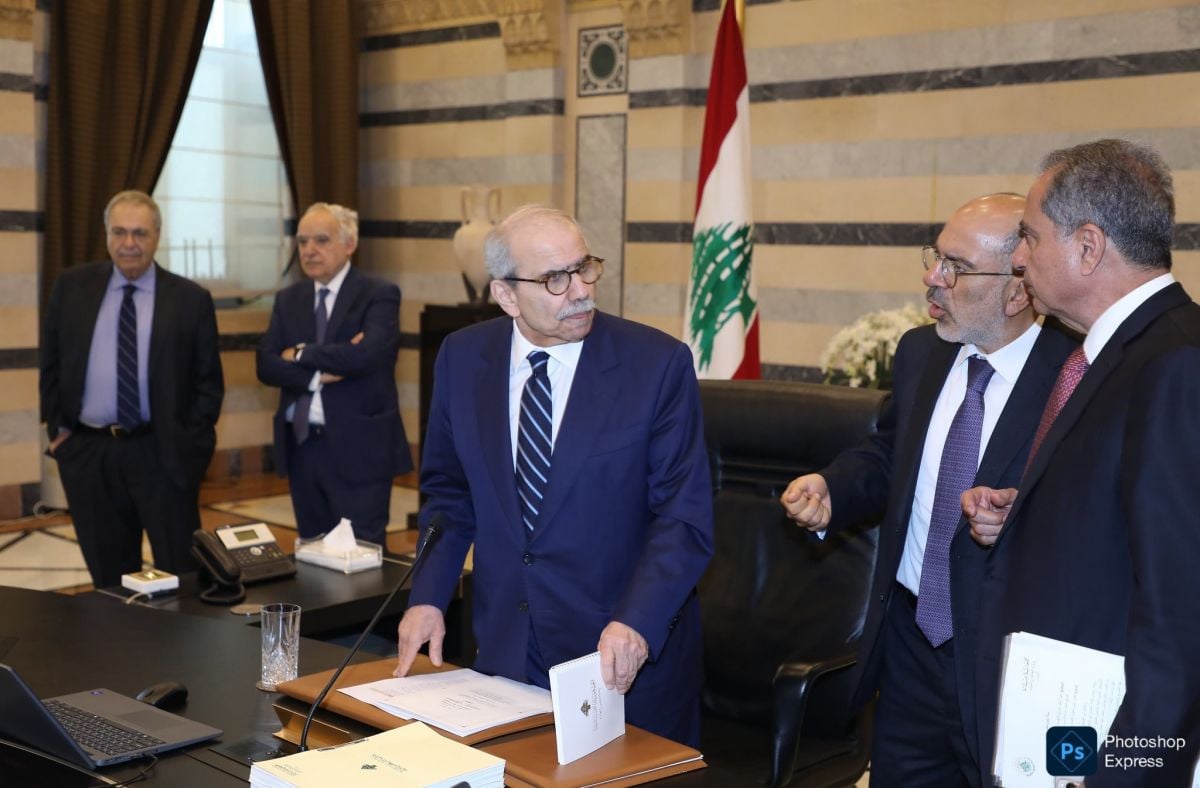
Prime Minister Nawaf Salam at the beginning of the Council of Ministers meeting, June 4, 2026. (Credit: Photo published by the presidency of the Council on X)






BEIRUT — PM Nawaf Salam asserted Thursday that negotiating with Israel was "the best" option for Lebanon, while reaffirming Beirut's demands, including a complete Israeli withdrawal and the return of Southern residents.
Advocating for the implementation of the Taif Accord and the state's exclusive control over arms, he called on all sides to "work together under the authority of the state."
Israel and Lebanon on Wednesday agreed to the "implementation of a cease-fire" under certain conditions and the creation of "pilot zones" under the control of the Lebanese Army, following two days of talks in Washington.
Regarding disarmament south of the Litani, the prime minister insisted it was not an externally imposed demand. "This is a commitment Lebanon made before the international community when it accepted Resolution 1701 in 2006," he recalled.
At the opening of the Cabinet session, Salam emphasized that negotiation with Israel is "the fastest and least costly way for Lebanon and the Lebanese people, as well as for the South and its residents."
"Negotiation was not the only option available to us, but it was the best," he said, noting that Lebanon could have "stood by helplessly in the face of a war it did not choose, which was never considered for even a moment." He also indicated that Lebanon could have turned to the U.N. Security Council or "international courts, risking years of waiting while continuing to suffer even more losses."
Discussing the ongoing talks, Salam acknowledged that "the negotiations have not been easy" and that the Lebanese delegation faced "Israeli intransigence." However, he reaffirmed Beirut's demands: "a complete Israeli withdrawal from our territory" and "the return of our fellow citizens to their homes and villages, with dignity and security." He also said, "[We are] strong in our right to our land, the support of our Arab brothers, backing from the international community, and American understanding."
Salam also advocated for the application of the principle of exclusive state control over arms throughout Lebanese territory, noting that the country had already "fallen far behind in implementing the provisions of the Taif Accord, signed by the Lebanese themselves" and "missed this opportunity" after Israel’s withdrawal in 2000 and then after Syria’s withdrawal in 2005. "We cannot afford to miss it again, as the consequences this time would be particularly grave," he warned.
The prime minister finally announced that "the next step" would be the deployment of the Lebanese army in "pilot zones," arguing that this measure "in no way undermines our right to a total Israeli withdrawal; on the contrary, it brings us closer to it." "Every hour that passes without implementing this measure is an hour for which the South and its residents pay the price," he added.
Salam concluded his remarks by stating that "all parties are called upon to put the interests of Lebanon and its people above any other interests, whether foreign or partisan, and to take responsibility."
"Those who refuse or stall will bear sole responsibility for any resulting consequences, before history and, above all, before the Lebanese people who have endured so much and made the greatest sacrifices," he concluded.
"So I address everyone with clarity: let us work together under the authority of the state. I repeat, this path is neither easy nor short, but it becomes shorter and makes us stronger when all efforts converge within the institutions of the Lebanese state." These statements came as Israeli strikes continued Thursday in southern Lebanon and Hezbollah claimed responsibility for multiple attacks on Israeli positions inside Lebanese territory.
The government then moved on to its agenda, approving most items, including assigning Cabinet Secretary-General Judge Mahmoud Makkiyeh to serve as acting director of the Cannabis Regulatory Authority and to handle current affairs until a permanent general director is appointed, exempting the education ministry from organizing official Brevet exams for 2026, and increasing educational grants to 20 million Lebanese liras in public schools (with a ceiling of 60 million) and 50 million in private schools (with a ceiling of 150 million).