






Lebanese President Joseph Aoun (L) meets with head of the Lebanese delegation in the Lebanese-Israeli negotiations, Simon Karam, in Baabda Palace on Aug. 10, 2026. (Credit: Lebanese Presidency on X)






BEIRUT — Lebanese President Joseph Aoun gave the head of the Lebanese delegation, Simon Karam, his directions for the next stage of negotiations with Israel on Monday, according to the Lebanese Presidency. Meanwhile, Lebanon’s Foreign Minister Joe Rajji told his Egyptian counterpart that Lebanon is determined to continue the negotiation process “in a manner that preserves national sovereignty and guarantees Lebanon’s rights.”
This comes as Lebanon and Israel held their seventh round of negotiations in Rome last week. The three-day meetings failed to bring an end to Israel's daily demolition of infrastructure in south Lebanon or to add new areas to the "pilot zones" project, which entails an Israeli withdrawal, and the deployment of the Lebanese Army.
According to the Lebanese Presidency, Karam briefed Aoun on the substance of the discussions held in Rome last week.
In parallel, a statement from the Lebanese Foreign Ministry stated that Rajji held a phone call with his Egyptian counterpart, Badr Abdelatty, during which they discussed, among other issues, the ongoing negotiations between Lebanon and Israel.
The two ministers discussed the latest developments in the direct talks and the broader regional situation. The call also addressed preparations for the Arab League ministerial meeting, scheduled to take place in Cairo in September.
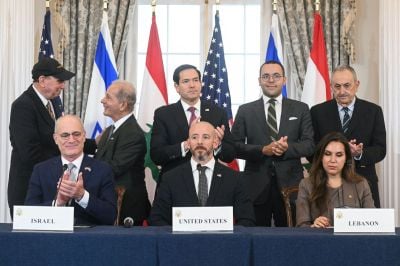
They stressed the importance of continued coordination between Beirut and Cairo ahead of the meeting, which comes amid a regional context that, in their view, requires "unity in the Arab position," and increased consultations among member states.
Meanwhile, the state-run National News Agency (NNA) reported that Parliament Speaker Nabih Berri received Defense Minister Michel Menassah and discussed with him the general situation, particularly the state of the military institution, as well as political and field developments in light of Israel’s continued attacks, including the demolition and destruction of villages and homes and the burning of agricultural and wooded areas in the South and western Bekaa.
Following reports that the next round of negotiations will take place in early September, a source close to the Lebanese delegation’s leadership said Lebanon will not participate in the next round of talks if its conditions are not met: namely, a complete cease-fire and an end to the demolitions. Lebanon is also demanding the establishment of new “pilot zones” and is still proposing Khiam and Bint Jbeil as part of the initiative.
Return of displaced people, reconstruction
The Lebanese Presidency also reported Monday that Aoun received Social Affairs Minister Haneen Sayed, who briefed him on work undertaken by her ministry to develop a comprehensive plan for the return of displaced people and the restoration of essential services in areas affected by the war. She also presented him with initial estimates of needs and priorities to be identified in the first phase, as well as implementation and funding mechanisms.
The president also received Dalia Khalifa, the World Bank’s regional director for the Middle East department. Aoun stressed that “Lebanon currently needs the support of the World Bank and its partners, particularly, particularly to help the state address the needs of more than 600,000 people who have returned to their areas,” while noting that a “large number of towns and villages have sustained significant damage, with some having been almost entirely destroyed.”
Prime Minister Nawaf Salam also received Khalifa on Monday for a courtesy visit marking her assumption of her new duties, according to the Grand Serail.
Salam and Khalifa discussed the World Bank’s role in rebuilding areas affected by the war, including damage assessments, infrastructure rehabilitation and coordination of donor efforts.
According to the Grand Serail, Salam stressed “the urgent need to accelerate these measures,” alongside the government’s efforts in the south, in a way that supports the resilience and return of residents of southern Lebanon and is consistent with the government’s priorities in this area.
Last week, the United Nations said that more than 800,000 people displaced by Israeli attacks on Lebanon had begun returning to their hometowns, adding that more than 360,000 remained displaced, around 26,000 of them in government shelters. Israel is still occupying more than 60 villages in southern Lebanon, preventing residents from returning to them.

 8 p.m. recap: Israel again threatens Beirut’s south suburbs; 2 ships hit near Hormuz; Riyadh football matches canceled