


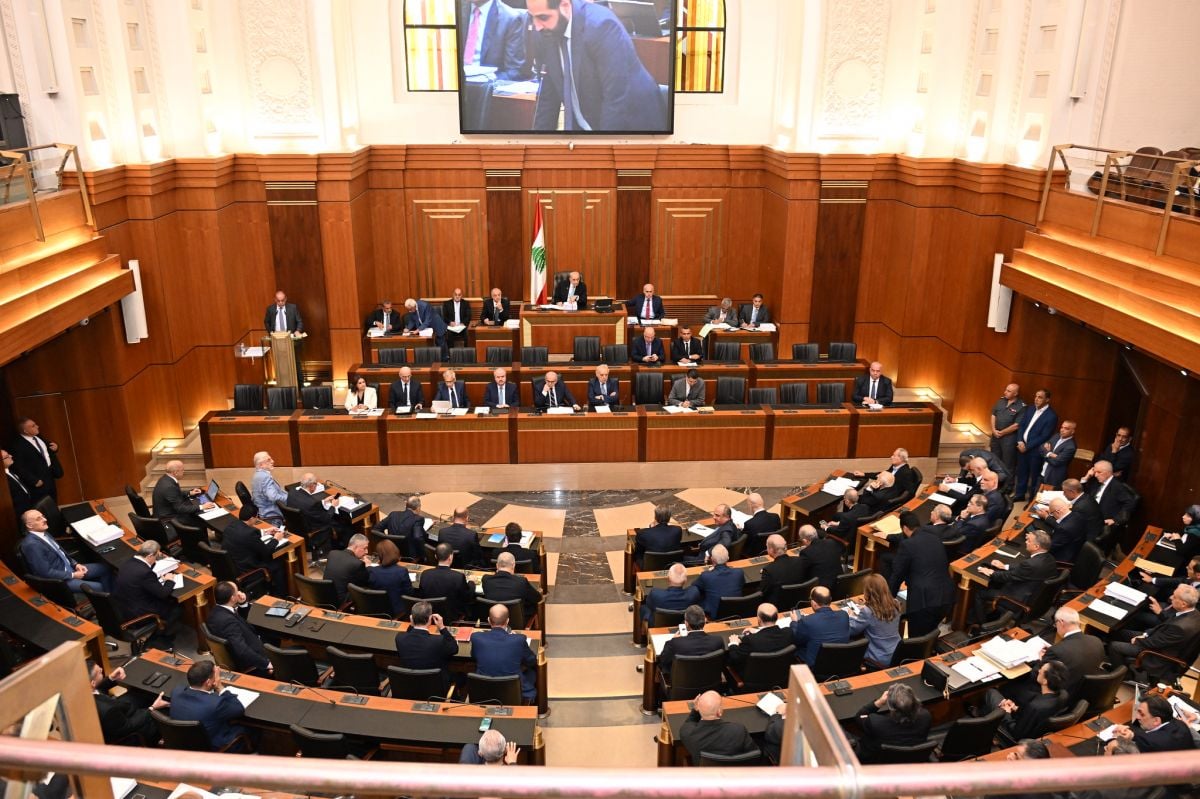
The Lebanese Parliament in plenary session on Sept. 29, 2025. (Credit: Hassan Ibrahim/Lebanese Parliament)






Lebanese Forces and Kataeb MPs walked out of Parliament's plenary session on Monday after disputes over expatriate voting caused the loss of quorum and forced Speaker Nabih Berri to adjourn the meeting.
MPs clashed over whether to keep the 2017 electoral law as it is — which calls for six new “overseas MPs” to represent Lebanese abroad — or to amend it so expatriates can vote for all 128 seats based on their district of origin.
After Parliament adopted several draft laws, another session was scheduled for Tuesday at 11 a.m.. Both sides accused each other of trying to delay the legislative elections due in spring 2026. Monday’s session was not supposed to address electoral law, following a decision Friday by the Parliament Bureau and Berri, who leads the camp opposed to any amendment.
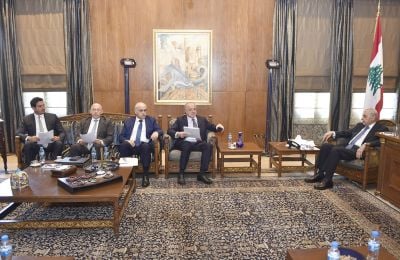
According to local media, tensions flared when George Adwan, head of the LF parliamentary bloc, announced his MPs would suspend participation in the subcommittee studying electoral law. Amal MP Ali Hassan Khalil accused the LF of wanting to “sabotage” next year’s elections. Berri threatened to adjourn the meeting if calm was not restored. Soon after, the four Kataeb MPs left the chamber, followed by their LF allies.
Adwan warned that any delay would be a “danger to holding elections on schedule,” saying it would show that “the state, the presidency, the government and Parliament have all failed.”
Kataeb leader Samy Gemayel added that the Cabinet itself had admitted the current law is inapplicable and said Parliament must either clarify or amend it. He warned that without debate, “expatriates risk being deprived of their right to vote — whether for 128 or six MPs — and this could lead to postponing elections or holding them without granting that right to hundreds of thousands of Lebanese abroad.”
Free Patriotic Movement leader Gebran Bassil said at the start of the session that the government must apply the law instead of shifting responsibility to Parliament. He pointed to an existing report with solutions for implementing the expatriate voting article and called on the Cabinet to begin registering overseas voters “to counter all excuses for postponing the 2026 elections.”
MP Waddah Sadek (Opposition, Beirut) responded that shifting the matter to the government was only a pretext to delay the vote.

Berri holds firm: Apply current law
In an op-ed Monday in the daily al-Joumhouria, Berri called for “applying the electoral law in force.”
The article on six overseas MPs, part of the 2017 law, was never implemented in the 2018 and 2022 elections, as the mechanism for creating those seats was left vague.
On June 30, Berri blocked an amendment that would have allowed expatriates to vote for all 128 MPs and refused to include the matter on Monday’s agenda.
Parties, including the LF and Kataeb, are demanding full voting rights for the diaspora and accuse Amal, Hezbollah, and the FPM of trying to dilute their impact by limiting overseas voters to six seats. In 2022, expatriates helped bring in several new MPs from the 2019 protest movement.
Interior Minister Ahmad Hajjar said he had received a report on the challenges of applying the law, but no new legislation had been passed. He stressed that “the Interior Ministry must apply the existing law and coordinate with the Foreign Ministry” to register overseas voters.
He added: “Parliamentary elections will be held as scheduled in May 2026, and the first deadline for expatriate registration is set for Nov. 20.”
Support for Salam
At the start of the session, Berri voiced strong support for Prime Minister Nawaf Salam, who faces fierce criticism from Hezbollah’s camp for government commitments on disarmament.
“The prime minister is head of government for all Lebanon,” Berri said, stressing that the Cabinet “is not for one faction but for everyone.”
Tripoli MP Ashraf Rifi echoed the backing in a statement, saying “the Cabinet remains one of the pillars of building a state of law, and Nawaf Salam, son of Beirut and prime minister, is the guarantor of applying the Constitution and protecting institutions, whose legitimacy is stronger than the militia.”
Laws adopted
Parliament adopted an amendment to the law governing public-private partnerships and approved an additional credit line of LL 2.35 billion (over $26 million at the current exchange rate) to fund monthly payments of LL 12 million ($134) for retired public sector employees.
An amendment to the currency code allowing new banknote denominations (LL 500,000 and LL 1 million) also awaits final approval. The bill was first passed in April 2025, but was sent back by President Joseph Aoun for revisions.
Parliament must also vote on a bill concerning deserters from the Internal Security Forces since the 2019 financial crisis.
Among the 17 agenda items is also a controversial proposal to exempt taxes and fees for those whose property was damaged in the Hezbollah-Israel war, a measure that sparked heated debate when first voted on in June.
Berri-Aoun meeting
After the session was adjourned, Berri headed to Baabda Presidential Palace to meet with Aoun.
At the end of the meeting, Berri said it had been “excellent as usual” and that he discussed with Aoun the “current issues” as well as the meetings he held in New York. “We informed him of what happened in Beirut a few days ago,” Berri added, according to the presidency’s X account.
 Israeli army carries out demolition at Jabal Amel School in Houla as strikes continue