President Joseph Aoun in Baabda, on Feb. 16, 2026. (Credit: Mohammad Yassin/L'Orient Today)






BEIRUT — President Joseph Aoun stated Thursday that the "cease-fire" agreed upon between Lebanon and Israel "could be implemented within 24 hours following its final approval," considering it the "last chance" to end the war.
Israel and Lebanon agreed Wednesday to "implement a cease-fire" and to create "pilot zones" under control of the Lebanese Army, following two days of direct high-level talks in Washington.
"We are waiting for the responses of all concerned parties, as well as guarantees of commitment and the implementation of the cease-fire," said Aoun during a discussion with journalists. "We have proposed that the 'pilot zone,' in a first phase, include the areas of Zawtar Gharbieh and Zawtar Sharqieh as well as Beaufort Castle," all located in the Nabatieh district, on the northern banks of the Litani, Aoun revealed. "Yesterday's negotiations [Wednesday, in Washington] were very difficult and [after an interruption] resumed following the intervention of U.S. Secretary of State Marco Rubio," he indicated.
Beirut and Tel Aviv announced their intention to "accelerate the establishment of so-called "pilot zones" in which the Lebanese Army will exercise exclusive territorial control, excluding any non-state actor." According to the statement, these measures should allow progress toward "a comprehensive agreement of peace and security." Hezbollah has yet to comment on this agreement, but the party's Secretary General Naim Qassem is expected to speak Thursday afternoon.
"The agreement we have reached is our last chance, otherwise each should bear their own responsibility," the president added. "The current agreement is different from that of Nov. 27, 2024 [cease-fire enacted after the 2023–2024 war], because it will be lasting. We are counting on the role of President Trump and his administration," he added.
These statements come as Israeli strikes continue to pound southern Lebanon on Thursday. Hezbollah has claimed several attacks on Israeli positions on occupied Lebanese territory.
'Give Israel no pretext'
"The negotiations held in Washington between the Lebanese, U.S., and Israeli delegations result in positive outcomes, allowing for the establishment of a lasting cease-fire and an end to the suffering of the Lebanese people in general, and the populations of the South in particular," Aoun said as he received the French envoy to Lebanon, Jean-Yves Le Drian, at the Presidential Palace in Baabda. Aoun highlighted "the need to give Israel no pretext for not withdrawing from the South," considering that "any effort in this direction will have a positive impact on the course of the negotiations."
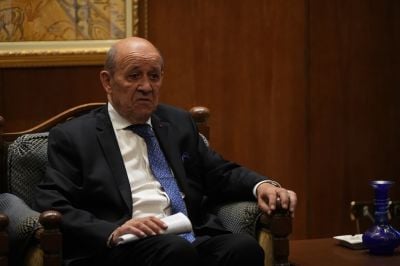
President Aoun welcomed "the assistance provided by brotherly and friendly countries to strengthen the cease-fire and move toward the next steps, notably the withdrawal of Israeli forces from Lebanese territories occupied in the South, the deployment of the Lebanese army at internationally recognized borders, and, ultimately, the end of hostilities between Lebanon and Israel."
The discussions also addressed the phase that will follow the end of the United Nations Interim Force in Lebanon (UNIFIL) mission in southern Lebanon. Aoun welcomed "the interest of European and other countries in maintaining their forces in the South in order to contribute to strengthening stability and supporting the Lebanese army after its deployment at the border," specifying that "contacts are underway to find an appropriate formula for maintaining this presence, in coordination with the United Nations and the countries concerned."
Aoun also thanked French president Emmanuel Macron for "the support he brings to Lebanon at different levels," highlighting "the importance of the historic and deep Franco-Lebanese relationship." Le Drian said that his visit to Beirut aimed to "express France's support and solidarity" toward Lebanon.
Before meeting with Aoun, the French envoy had been welcomed by Prime Minister Nawaf Salam and Speaker of Parliament Nabih Berri.